
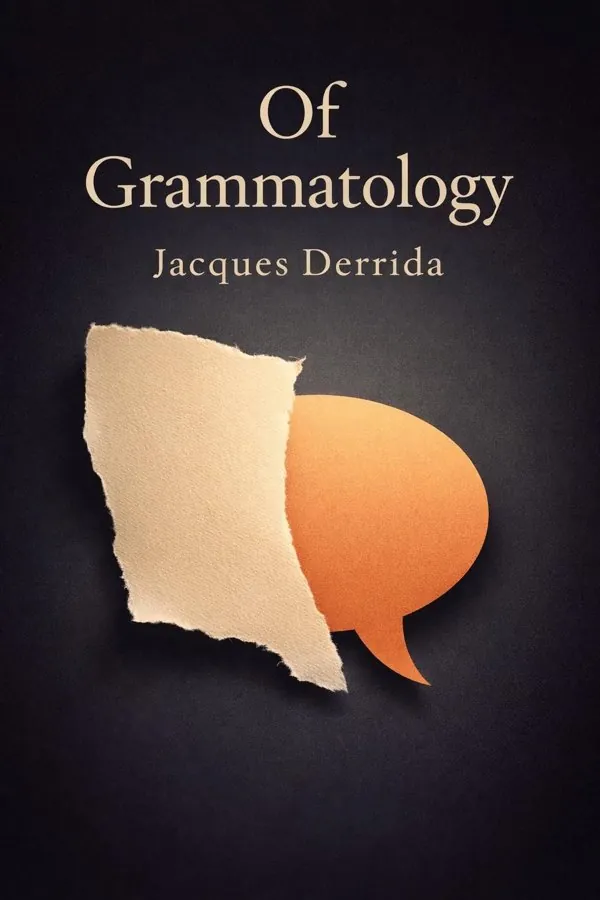
Of Grammatology: Summary & Key Insights
 10 min10 chaptersAudio available
What Is Of Grammatology About?
Of Grammatology by Jacques Derrida is a western_phil book spanning 10 pages. Originally published in French in 1967 as 'De la grammatologie', this groundbreaking work by Jacques Derrida introduced the concept of deconstruction and challenged the foundations of linguistics, philosophy, and literary criticism. In 'Of Grammatology', Derrida explores the primacy of writing over speech and questions traditional hierarchies of language and meaning. The English translation by Gayatri Chakravorty Spivak, first published in 1976, has become a cornerstone of contemporary critical theory and philosophy.
This FizzRead summary covers all 10 key chapters of Of Grammatology in approximately 10 minutes, distilling the most important ideas, arguments, and takeaways from Jacques Derrida's work. Also available as an audio summary and Key Quotes Podcast.
Of Grammatology
Originally published in French in 1967 as 'De la grammatologie', this groundbreaking work by Jacques Derrida introduced the concept of deconstruction and challenged the foundations of linguistics, philosophy, and literary criticism. In 'Of Grammatology', Derrida explores the primacy of writing over speech and questions traditional hierarchies of language and meaning. The English translation by Gayatri Chakravorty Spivak, first published in 1976, has become a cornerstone of contemporary critical theory and philosophy.
Who Should Read Of Grammatology?
This book is perfect for anyone interested in western_phil and looking to gain actionable insights in a short read. Whether you're a student, professional, or lifelong learner, the key ideas from Of Grammatology by Jacques Derrida will help you think differently.
- ✓Readers who enjoy western_phil and want practical takeaways
- ✓Professionals looking to apply new ideas to their work and life
- ✓Anyone who wants the core insights of Of Grammatology in just 10 minutes
Want the full summary?
Get instant access to this book summary and 100K+ more with Fizz Moment.
Get Free SummaryAvailable on App Store • Free to download
Key Chapters
Ferdinand de Saussure’s structural linguistics begins with a profound insight: that the relationship between the signifier (sound-image) and the signified (concept) is arbitrary. Meaning arises not from intrinsic essence but from difference within a system of signs. Yet, despite this radical premise, Saussure ultimately re-centers speech as the privileged medium of linguistic reality. In his *Cours de linguistique générale*, he warns against studying writing, regarding it as a dangerous supplement that can obscure the purity of spoken language.
This exclusion of writing betrays what I call phonocentrism — the metaphysical privileging of voice as presence, as the immediate expression of thought. For Saussure, speech seems closer to the origin of meaning, whereas writing merely represents it. But once we recognize that both speech and writing function through differential systems of signs, the hierarchy collapses. Writing, far from being a secondary representation, exposes the mechanism that makes meaning possible: the interplay of difference, the absence of a fixed origin.
By reading Saussure against himself, I show that the system of signs he describes already undermines his valorization of speech. His own framework reveals that meaning depends on the play of differences, not on a self-present subject who speaks. In this sense, writing — understood in the broader sense of *écriture* — precedes and structures speech itself. The very thing Saussure seeks to exclude is what enables his theory to function.
To move beyond the conventional idea of writing as mere inscription, we must recognize *writing* as a general structure — a system of traces, differences, and substitutions that underlies all forms of signification. I call this generalized understanding *écriture*. Before any literal writing, before alphabets or scripts, there is this deeper writing, a play of signs through which meaning becomes possible.
When we say that speech comes before writing, we presuppose an origin — a self-present thought that expresses itself in voice. But this origin is always already divided. The signifying chain — whether spoken or written — never leads back to a pure presence; each sign refers to another, in an infinite series of supplements. Writing, therefore, is not secondary. It is the name for the system of differences that both enables and disrupts meaning.
If we look at the history of thought — from Plato’s suspicion of writing as a pharmakon (both poison and medicine) to Rousseau’s fear that writing corrupts natural speech — we find the same pattern: writing is excluded because it threatens the illusion of origin. But what these exclusions reveal is the dependency of presence on what it denies. Writing is not the enemy of speech; it is the trace of difference constitutive of both.
+ 8 more chapters — available in the FizzRead app
All Chapters in Of Grammatology
About the Author
Jacques Derrida (1930–2004) was a French philosopher best known as the founder of deconstruction. His work profoundly influenced contemporary thought in philosophy, literary theory, and the humanities. Derrida’s writings examine the structures of language, meaning, and interpretation, reshaping modern intellectual discourse.
Get This Summary in Your Preferred Format
Read or listen to the Of Grammatology summary by Jacques Derrida anytime, anywhere. FizzRead offers multiple formats so you can learn on your terms — all free.
Available formats: App · Audio · PDF · EPUB — All included free with FizzRead
Download Of Grammatology PDF and EPUB Summary
Key Quotes from Of Grammatology
“Ferdinand de Saussure’s structural linguistics begins with a profound insight: that the relationship between the signifier (sound-image) and the signified (concept) is arbitrary.”
“I call this generalized understanding *écriture*.”
Frequently Asked Questions about Of Grammatology
Of Grammatology by Jacques Derrida is a western_phil book that explores key ideas across 10 chapters. Originally published in French in 1967 as 'De la grammatologie', this groundbreaking work by Jacques Derrida introduced the concept of deconstruction and challenged the foundations of linguistics, philosophy, and literary criticism. In 'Of Grammatology', Derrida explores the primacy of writing over speech and questions traditional hierarchies of language and meaning. The English translation by Gayatri Chakravorty Spivak, first published in 1976, has become a cornerstone of contemporary critical theory and philosophy.
You Might Also Like
A Little History of Philosophy
Nigel Warburton
10 min
Areopagitica
John Milton
10 min
How To Think Like A Philosopher: Essential Principles For Clear Thinking
Peter Cave
10 min
Language, Truth and Logic
A. J. Ayer
10 min
The Age of Reason
Thomas Paine
10 min
The Essays
Michel De Montaigne
10 minBrowse by Category
Ready to read Of Grammatology?
Get the full summary and 100K+ more books with Fizz Moment.