
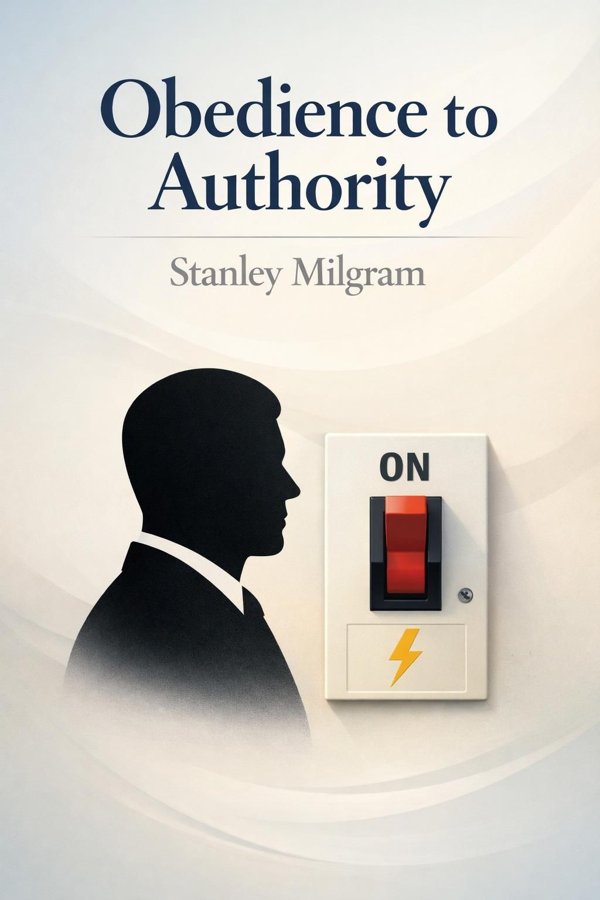
Obedience to Authority: An Experimental View: Summary & Key Insights
 10 min5 chaptersAudio available
What Is Obedience to Authority: An Experimental View About?
Obedience to Authority: An Experimental View by Stanley Milgram is a psychology book spanning 5 pages. Obedience to Authority: An Experimental View es un estudio clásico de psicología social que explora cómo las personas responden a la autoridad y hasta qué punto están dispuestas a obedecer órdenes que entran en conflicto con su conciencia personal. Basado en los experimentos de Milgram realizados en la Universidad de Yale en la década de 1960, el libro revela la sorprendente disposición de individuos comunes a infligir dolor a otros cuando se les ordena hacerlo por una figura de autoridad.
This FizzRead summary covers all 5 key chapters of Obedience to Authority: An Experimental View in approximately 10 minutes, distilling the most important ideas, arguments, and takeaways from Stanley Milgram's work. Also available as an audio summary and Key Quotes Podcast.
Obedience to Authority: An Experimental View
Obedience to Authority: An Experimental View es un estudio clásico de psicología social que explora cómo las personas responden a la autoridad y hasta qué punto están dispuestas a obedecer órdenes que entran en conflicto con su conciencia personal. Basado en los experimentos de Milgram realizados en la Universidad de Yale en la década de 1960, el libro revela la sorprendente disposición de individuos comunes a infligir dolor a otros cuando se les ordena hacerlo por una figura de autoridad.
Who Should Read Obedience to Authority: An Experimental View?
This book is perfect for anyone interested in psychology and looking to gain actionable insights in a short read. Whether you're a student, professional, or lifelong learner, the key ideas from Obedience to Authority: An Experimental View by Stanley Milgram will help you think differently.
- ✓Readers who enjoy psychology and want practical takeaways
- ✓Professionals looking to apply new ideas to their work and life
- ✓Anyone who wants the core insights of Obedience to Authority: An Experimental View in just 10 minutes
Want the full summary?
Get instant access to this book summary and 100K+ more with Fizz Moment.
Get Free SummaryAvailable on App Store • Free to download
Key Chapters
My research did not emerge from a vacuum. It was born in the shadow of war, amidst the moral reckoning that followed the Holocaust and the trials of Adolf Eichmann in Jerusalem. Humanity had witnessed the unimaginable, and psychologists were confronted by an agonizing mystery—how could so many participate in atrocities, claiming they were 'just following orders'? I saw the need to examine obedience not as a rare pathology but as a routine, often commendable social behavior that sustains civilization itself. Authority, after all, organizes society: it commands soldiers, teaches students, and directs institutions. But the same authority that builds order can also dismantle morality when its power becomes absolute.
I traced obedience through history and philosophy—how Hobbes viewed it as a legitimate source of social cohesion, while thinkers like Arendt and Fromm warned of its potential to erode freedom. My approach was empirical, not theoretical. Rather than speculate, I sought to measure obedience experimentally. My goal was modest in form yet ambitious in spirit: to create a setting where the psychological forces of authority could be observed plainly, stripped of historical complexity. The laboratory, though artificial, would allow truth about obedience to unfold in its purest psychological form.
The experiment itself took place in a modest room at Yale University. Participants, whom we called 'teachers,' were ordinary citizens recruited through newspaper ads. They believed they were joining a study on learning and memory. Opposite them sat the 'learner,' an accomplice of mine, safely hidden from harm, but appearing to be a fellow volunteer. When the learner gave incorrect answers, the teacher was instructed by an authoritative experimenter—wearing a white lab coat and imbued with the quiet confidence of science—to administer increasing electric shocks, ranging from mild to seemingly lethal.
Every feature of this setup was deliberate. The stern but polite demeanor of the experimenter symbolized institutional authority. The shock generator, with its labeled switches from 'slight shock' to 'danger: severe shock,' represented the gradations of obedience. The learner’s protests—from mild discomfort to desperate pleas—were staged precisely to evoke moral conflict. I wanted to see how far the teacher would go when placed under escalating pressure from authority.
The procedure was simple in form but psychologically profound. Each participant faced a choice between two competing moral imperatives: obey authority or heed conscience. Within this tension lay the essence of modern ethical struggle. What I found disturbed me deeply, for it revealed that obedience is not a fringe trait—it is woven into the social fabric of nearly every individual.
+ 3 more chapters — available in the FizzRead app
All Chapters in Obedience to Authority: An Experimental View
About the Author
Stanley Milgram (1933–1984) fue un psicólogo social estadounidense conocido por sus investigaciones sobre la obediencia, la conformidad y la influencia social. Profesor en la Universidad de Yale y posteriormente en la Universidad de la Ciudad de Nueva York, sus experimentos sobre la obediencia a la autoridad se consideran fundamentales en la psicología moderna.
Get This Summary in Your Preferred Format
Read or listen to the Obedience to Authority: An Experimental View summary by Stanley Milgram anytime, anywhere. FizzRead offers multiple formats so you can learn on your terms — all free.
Available formats: App · Audio · PDF · EPUB — All included free with FizzRead
Download Obedience to Authority: An Experimental View PDF and EPUB Summary
Key Quotes from Obedience to Authority: An Experimental View
“My research did not emerge from a vacuum.”
“The experiment itself took place in a modest room at Yale University.”
Frequently Asked Questions about Obedience to Authority: An Experimental View
Obedience to Authority: An Experimental View by Stanley Milgram is a psychology book that explores key ideas across 5 chapters. Obedience to Authority: An Experimental View es un estudio clásico de psicología social que explora cómo las personas responden a la autoridad y hasta qué punto están dispuestas a obedecer órdenes que entran en conflicto con su conciencia personal. Basado en los experimentos de Milgram realizados en la Universidad de Yale en la década de 1960, el libro revela la sorprendente disposición de individuos comunes a infligir dolor a otros cuando se les ordena hacerlo por una figura de autoridad.
You Might Also Like

The Body Keeps the Score
Bessel van der Kolk
10 min
Surrounded by Idiots
Thomas Erikson
10 min
Emotional Intelligence
Daniel Goleman
10 min
Attached
Amir Levine
10 min
Why Does He Do That
Lundy Bancroft
10 min
Women Who Run with the Wolves
Clarissa Pinkola Estés
10 minBrowse by Category
Ready to read Obedience to Authority: An Experimental View?
Get the full summary and 100K+ more books with Fizz Moment.