
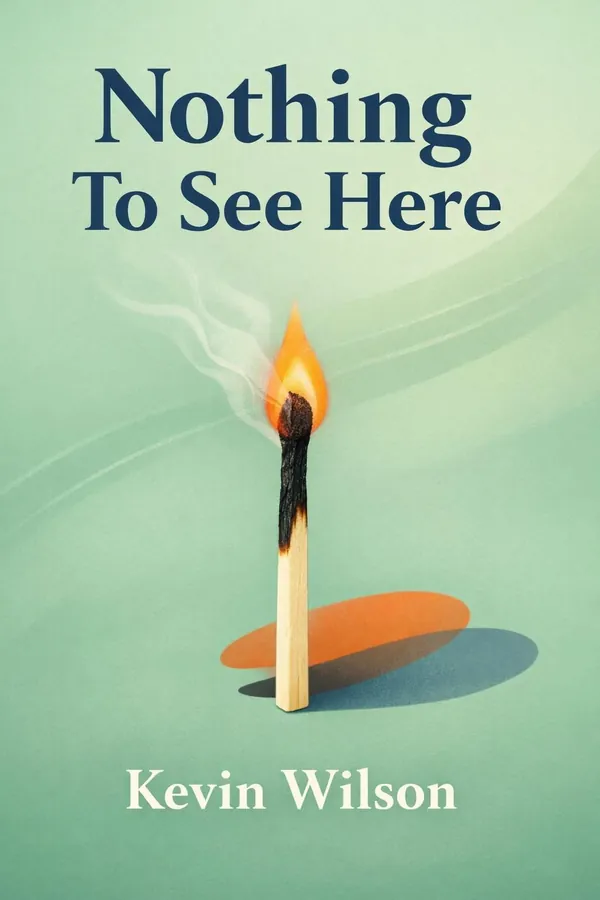
Nothing To See Here: Summary & Key Insights
by Kevin Wilson
 10 min3 chaptersAudio available
Key Takeaways from Nothing To See Here
Let me tell you a secret about growing up and getting by when life seems determined to burn you down.
Every story about friendship has its moment of imbalance, that defining tilt when one person realizes how much they’re being shaped by someone else’s privilege.
When Lillian arrives at the Franklin estate, she doesn’t expect the word “special” to mean combustion.
What Is Nothing To See Here About?
Nothing To See Here by Kevin Wilson is a fiction book. Nothing to See Here is a novel by American author Kevin Wilson, first published in 2019 by Ecco Press, an imprint of HarperCollins. It follows Lillian, who becomes the caretaker of two children who spontaneously combust when agitated. The story blends absurd humor and heartfelt emotion while exploring themes of friendship, class, and parenthood in contemporary American life.
This FizzRead summary covers all 3 key chapters of Nothing To See Here in approximately 10 minutes, distilling the most important ideas, arguments, and takeaways from Kevin Wilson's work. Also available as an audio summary and Key Quotes Podcast.
Nothing To See Here: Summary & Key Insights
Nothing to See Here is a novel by American author Kevin Wilson, first published in 2019 by Ecco Press, an imprint of HarperCollins. It follows Lillian, who becomes the caretaker of two children who spontaneously combust when agitated. The story blends absurd humor and heartfelt emotion while exploring themes of friendship, class, and parenthood in contemporary American life.
Who Should Read Nothing To See Here?
This book is perfect for anyone interested in fiction and looking to gain actionable insights in a short read. Whether you're a student, professional, or lifelong learner, the key ideas from Nothing To See Here by Kevin Wilson will help you think differently.
- ✓Readers who enjoy fiction and want practical takeaways
- ✓Professionals looking to apply new ideas to their work and life
- ✓Anyone who wants the core insights of Nothing To See Here in just 10 minutes
Want the full summary?
Get instant access to this book summary and 100K+ more with Fizz Moment.
Get Free SummaryAvailable on App Store • Free to download
Key Chapters
Let me tell you a secret about growing up and getting by when life seems determined to burn you down. *Nothing to See Here* began as a small, absurd idea: what if two children literally burst into flames when they got upset? But as I wrote, it became less about fire and more about the messy, radiant work of caring for people who are hard to love—or maybe just people the world refuses to understand. It’s a story about class, friendship, resentment, and the slow, fumbling discovery of your own worth.
I wanted to write from a voice that knew disappointment intimately, someone who had been shoved aside by circumstance but hadn’t lost the capacity to see wonder in the world. That voice belonged to Lillian Breaker, a woman whose life had gone sideways years ago and who didn’t expect it to ever straighten out. Her story begins in a Tennessee that I know well—a place thick with heat, where money and privilege draw invisible borders around people—and through her, I wanted to explore how someone without a safety net finds meaning, connection, and even joy.
When Madison Billings Reed, Lillian’s old roommate from boarding school, calls her years later with an unusual job offer—to take care of two children who spontaneously combust—it’s not just a strange favor. It’s an invitation into a world of polished façades and hidden suffering. Madison lives in luxury now, married to Jasper Roberts, a man on the verge of political power. The twins, Bessie and Roland, are his children from another relationship, inconveniently unmanageable but too dangerous to ignore.
In accepting to care for the twins, Lillian steps into an emotional fire as much as a literal one. The story that unfolds isn’t just about keeping two volatile kids safe; it’s about rediscovering one’s own capacity for love, shedding the shame attached to failure, and realizing that family can emerge from ashes if you have the courage to stay close when things ignite. If you listen closely, *Nothing to See Here* isn’t whispering about magic—it’s insisting that love is an act of endurance, that we are most ourselves when we refuse to turn away from what scares us.
So what’s in it for you? Maybe, like Lillian, you’ve felt small, left behind, resentful of people for whom things came easily. Maybe you’ve had to build a life with your bare hands and found it impossible to stop comparing yours to someone else’s. This book offers no shortcuts, but it might remind you that care—unpretentious, uncomfortable, ferociously loyal care—is a form of redemption. Watching Lillian find her fire could be an invitation for you to find your own.
Every story about friendship has its moment of imbalance, that defining tilt when one person realizes how much they’re being shaped by someone else’s privilege. For Lillian Breaker, that realization comes painfully early. She earns a scholarship to an elite boarding school, a place where her threadbare clothes and Tennessee accent mark her as an interloper. There, she meets Madison Billings Reed, effortlessly graceful, confident, and radiant with the kind of beauty that guarantees her the upper hand in any situation. Their friendship feels electric but uneasy—a mix of genuine connection and the quiet transaction between those who have and those who want to belong.
When a scandal breaks out involving Madison, Lillian takes the fall. She’s expelled, while Madison’s wealthy parents pull strings to protect their daughter. That expulsion is the pivot of Lillian’s life. One girl goes on to Yale, to political society, to the careful choreography of success; the other retreats to her mother’s house, to dead-end jobs and the slow erosion of expectation. Still, their bond doesn’t die. It becomes something else—strange, enduring, defined by Madison’s guilt and Lillian’s uneasy need to remain relevant in her orbit.
Years pass. Lillian’s life flattens into survival mode. She lives in her mother’s attic, answering letters from Madison that feel both affectionate and patronizing. Madison writes about her husband, Jasper Roberts, a rising political figure, and the fine house in Franklin. Lillian writes back with sardonic honesty, her bitterness safely sheathed in humor. Then one day, Madison’s letter tilts the balance again—a job offer that sounds absurd but laced with opportunity: come take care of Jasper’s two children. They’re different, she says, “special.” That one word stirs curiosity inside all of Lillian’s resentment. Maybe “special” means dangerous. Maybe it means a purpose strong enough to lift her out of her inertia.
This unequal friendship sets the emotional blueprint for the novel. Madison, polished yet hollow, seems to glitter precisely because Lillian’s world is dim. She is the embodiment of privilege: poised, self-serving, perpetually adrift in moral compromise, yet strangely magnetic. Lillian, in contrast, speaks in blunt sentences, grounded in disappointment but fiercely perceptive. The energy between them—half warmth, half manipulation—propels the story. To Lillian, Madison represents the life she wasn’t allowed to have; to Madison, Lillian is the part of her past that keeps her human. And when the children enter, this dynamic will face its reckoning.
When Lillian arrives at the Franklin estate, she doesn’t expect the word “special” to mean combustion. But Bessie and Roland, twin children of Jasper Roberts’s previous affair, quite literally catch fire when they become upset. It’s not a metaphor in their world—it’s spontaneous, spectacular, uncontrollable fire. The flames don’t burn them, but they destroy everything around them. They’re a public-relations nightmare for a man on the cusp of a Cabinet nomination. To the Roberts family, the twins are something that must be hidden.
Madison’s instructions are clear: keep the twins out of sight, under control, out of the papers. She can pay, and pay well. To Lillian, it’s both absurd and liberating—no one in their right mind would trust her with any child, much less two who spontaneously ignite. She accepts because she has nothing to lose. At least fire promises to break the monotony.
The first encounters are raw and feral. The children live braced for rejection. They’ve been passed between caretakers, treated like problems instead of people. Lillian’s instinct isn’t maternal, but it’s honest. She doesn’t flinch when the twins ignite; she doesn’t scold or retreat. Instead, she learns to manage their heat. They move to the estate’s guesthouse, a space far enough to protect the main house’s civility but close enough to remain under Madison’s invisible control.
It’s there, in that isolated bubble, that something resembling a family begins to form. Lillian learns to read their moods, to spot the tremor before the blaze. She keeps a spray bottle for emergencies, wet towels ready at all times, but mostly she gives them what no one else has offered—attention without fear. Slowly, the fire becomes less frequent. They burn, yes, but not from terror or rage; their combustion transforms into something almost beautiful, an emblem of feeling too much in a world that punishes intensity.
As the days blur together, Lillian’s sarcasm softens into affection. She feels an unfamiliar pull of purpose, a fierce instinct to protect. The twins test her—Roland withdraws into silence, Bessie lashes out—but through every burst of flame, she remains. They begin to trust that she won’t leave. Their connection thrives on this constancy, and in caring for them, Lillian begins to heal parts of herself she had long dismissed as broken.
The children’s fire becomes more than a condition; it’s a perfect metaphor for uncontrollable emotion, for the social discomfort of children who don’t fit tidy definitions. Wilson never treats their combustion as freakish. Instead, it’s rendered human, even holy—it’s simply the natural expression of people who have never been taught to hold their feelings in. Through that lens, Lillian’s bond with them isn’t miraculous; it’s revolutionary. Love, in her world, finally stops being conditional.
All Chapters in Nothing To See Here
About the Author
Kevin Wilson is an American novelist and short story writer recognized for his humorous yet emotionally perceptive portrayals of family life. Born in 1978 in Sewanee, Tennessee, he teaches English at the University of the South. His works include The Family Fang and Tunneling to the Center of the Earth.
Get This Summary in Your Preferred Format
Read or listen to the Nothing To See Here summary by Kevin Wilson anytime, anywhere. FizzRead offers multiple formats so you can learn on your terms — all free.
Available formats: App · Audio · PDF · EPUB — All included free with FizzRead
Download Nothing To See Here PDF and EPUB Summary
Key Quotes from Nothing To See Here
“Let me tell you a secret about growing up and getting by when life seems determined to burn you down.”
“Every story about friendship has its moment of imbalance, that defining tilt when one person realizes how much they’re being shaped by someone else’s privilege.”
“When Lillian arrives at the Franklin estate, she doesn’t expect the word “special” to mean combustion.”
Frequently Asked Questions about Nothing To See Here
Nothing To See Here by Kevin Wilson is a fiction book that explores key ideas across 3 chapters. Nothing to See Here is a novel by American author Kevin Wilson, first published in 2019 by Ecco Press, an imprint of HarperCollins. It follows Lillian, who becomes the caretaker of two children who spontaneously combust when agitated. The story blends absurd humor and heartfelt emotion while exploring themes of friendship, class, and parenthood in contemporary American life.
More by Kevin Wilson

You Might Also Like





Browse by Category
Ready to read Nothing To See Here?
Get the full summary and 100K+ more books with Fizz Moment.