
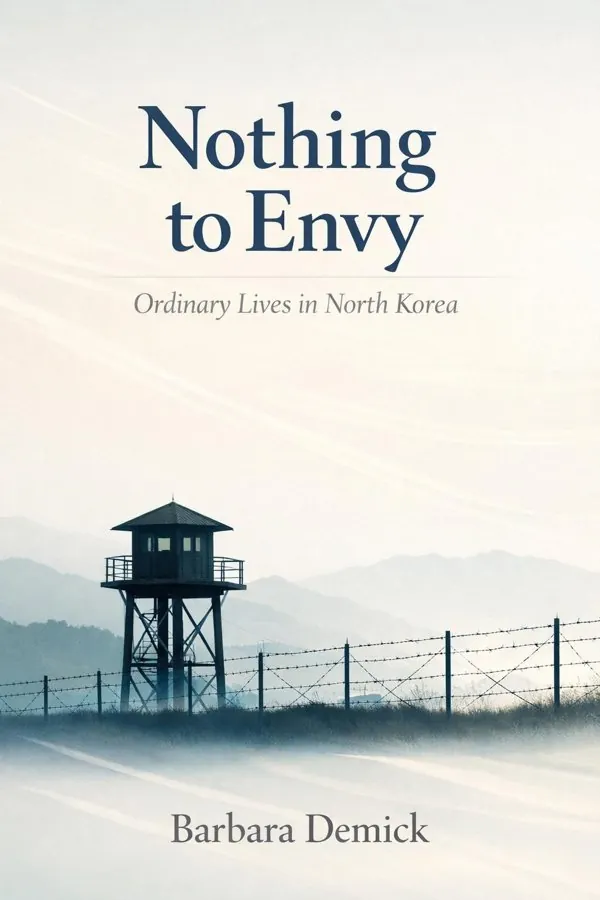
Nothing to Envy: Ordinary Lives in North Korea: Summary & Key Insights
 10 min8 chapters
What Is Nothing to Envy: Ordinary Lives in North Korea About?
Nothing to Envy: Ordinary Lives in North Korea by Barbara Demick is a politics book spanning 8 pages. Based on years of interviews and firsthand accounts, this nonfiction work portrays the everyday lives of six North Korean citizens living under the totalitarian regime. Barbara Demick reveals how ordinary people struggled to survive famine, repression, and isolation, offering a rare and intimate portrait of life inside one of the world’s most secretive nations.
This FizzRead summary covers all 8 key chapters of Nothing to Envy: Ordinary Lives in North Korea in approximately 10 minutes, distilling the most important ideas, arguments, and takeaways from Barbara Demick's work.
Nothing to Envy: Ordinary Lives in North Korea
Based on years of interviews and firsthand accounts, this nonfiction work portrays the everyday lives of six North Korean citizens living under the totalitarian regime. Barbara Demick reveals how ordinary people struggled to survive famine, repression, and isolation, offering a rare and intimate portrait of life inside one of the world’s most secretive nations.
Who Should Read Nothing to Envy: Ordinary Lives in North Korea?
This book is perfect for anyone interested in politics and looking to gain actionable insights in a short read. Whether you're a student, professional, or lifelong learner, the key ideas from Nothing to Envy: Ordinary Lives in North Korea by Barbara Demick will help you think differently.
- ✓Readers who enjoy politics and want practical takeaways
- ✓Professionals looking to apply new ideas to their work and life
- ✓Anyone who wants the core insights of Nothing to Envy: Ordinary Lives in North Korea in just 10 minutes
Want the full summary?
Get instant access to this book summary and 100K+ more with Fizz Moment.
Get Free SummaryAvailable on App Store • Free to download
Key Chapters
Chongjin was once a symbol of North Korea’s industrial prowess, a city built upon steel and strict obedience. When I first began tracing its story, defectors described a landscape of stark contradiction: factories falling silent under collapsing electricity while slogans proclaimed abundance and national glory. The isolation imposed on Chongjin’s residents was not just geographical—it was psychological. Most people believed that famine and hardship were temporary setbacks in their country’s march toward socialist perfection. The sea nearby, though filled with fish, was off-limits to ordinary citizens. Everything belonged to the state. Even the wind seemed to carry surveillance.
In the daily rhythm of Chongjin, there was a choreography to survival. Workers marched to their posts, children memorized hymns to Kim Il-sung and Kim Jong-il, and neighbors whispered carefully behind closed doors. The city’s architecture mirrored its society: uniform, gray, efficient. Chongjin’s citizens often knew nothing of the world beyond its borders. Rumors that reached them—from China or the South—were treated as dangerous fantasies. Yet even in this silence, desire persisted. Housewives collected scraps of metal to trade clandestinely; teachers rationed rice to feed students; young lovers found hidden corners to speak their hearts.
Portraits of the Kim family glowed on every wall, omnipresent reminders of fealty. Through the people of Chongjin, the larger paradox of North Korea came into view: devotion enforced as duty, and despair masked as discipline. By listening to their recollections years later, one thing became clear—Chongjin’s residents embodied the regime’s contradictions better than any speech ever could.
Among the stories that most deeply moved me was that of Mi-ran and Jun-sang, two young people whose relationship was born in secrecy. Mi-ran, a teacher, was devoted to her students but weary of the ideological lessons she had to deliver. Jun-sang was an intellectual, quietly analytical, torn between loyalty to the state and the undeniable truth of his lived experience. Their love unfolded under constant watch; a simple gesture could mean investigation, a misplaced word could attract suspicion. They met at dusk, by the banks of the river, inventing a private language of glances and silences.
Through their story, we glimpse the claustrophobic boundaries of personal freedom. In North Korea, emotions had to be censored just as ideas were. To love in this way required equal measures of courage and illusion. Mi-ran’s awakening began when she realized her students were fainting from hunger, not laziness. Jun-sang’s came when he crossed briefly into China, saw the world’s lights, and understood that his homeland’s darkness was not destiny.
Their relationship thus became symbolic—a quiet rebellion against the uniformity demanded by the regime. Even though they were cautious and rarely touched, their bond was a defiant testament that the human need for connection survives even in surveillance. When separation came, and one of them defected while the other remained, their memories became bridges. The simple act of remembering another person—without permission or propaganda—was itself resistance.
+ 6 more chapters — available in the FizzRead app
All Chapters in Nothing to Envy: Ordinary Lives in North Korea
About the Author
Barbara Demick is an American journalist and author known for her in-depth reporting on life under authoritarian regimes. A former Los Angeles Times correspondent in Seoul and Beijing, she has received numerous awards for international reporting, including the Samuel Johnson Prize and the Overseas Press Club Award.
Get This Summary in Your Preferred Format
Read or listen to the Nothing to Envy: Ordinary Lives in North Korea summary by Barbara Demick anytime, anywhere. FizzRead offers multiple formats so you can learn on your terms — all free.
Available formats: App · Audio · PDF · EPUB — All included free with FizzRead
Download Nothing to Envy: Ordinary Lives in North Korea PDF and EPUB Summary
Key Quotes from Nothing to Envy: Ordinary Lives in North Korea
“Chongjin was once a symbol of North Korea’s industrial prowess, a city built upon steel and strict obedience.”
“Among the stories that most deeply moved me was that of Mi-ran and Jun-sang, two young people whose relationship was born in secrecy.”
Frequently Asked Questions about Nothing to Envy: Ordinary Lives in North Korea
Nothing to Envy: Ordinary Lives in North Korea by Barbara Demick is a politics book that explores key ideas across 8 chapters. Based on years of interviews and firsthand accounts, this nonfiction work portrays the everyday lives of six North Korean citizens living under the totalitarian regime. Barbara Demick reveals how ordinary people struggled to survive famine, repression, and isolation, offering a rare and intimate portrait of life inside one of the world’s most secretive nations.
More by Barbara Demick

You Might Also Like

Antifa: The Anti-Fascist Handbook
Mark Bray
10 min
Attack from Within: How Disinformation Is Sabotaging America
Barbara McQuade
10 min
Coercion, Capital, and European States, AD 990–1992
Charles Tilly
10 min
Digital Democracy: Concepts, Methodologies, Tools, and Applications
Various Authors
10 min
Fascism
Stanley G. Payne
10 min
Fire And Fury: Inside The Trump White House
Michael Wolff
10 minBrowse by Category
Ready to read Nothing to Envy: Ordinary Lives in North Korea?
Get the full summary and 100K+ more books with Fizz Moment.