
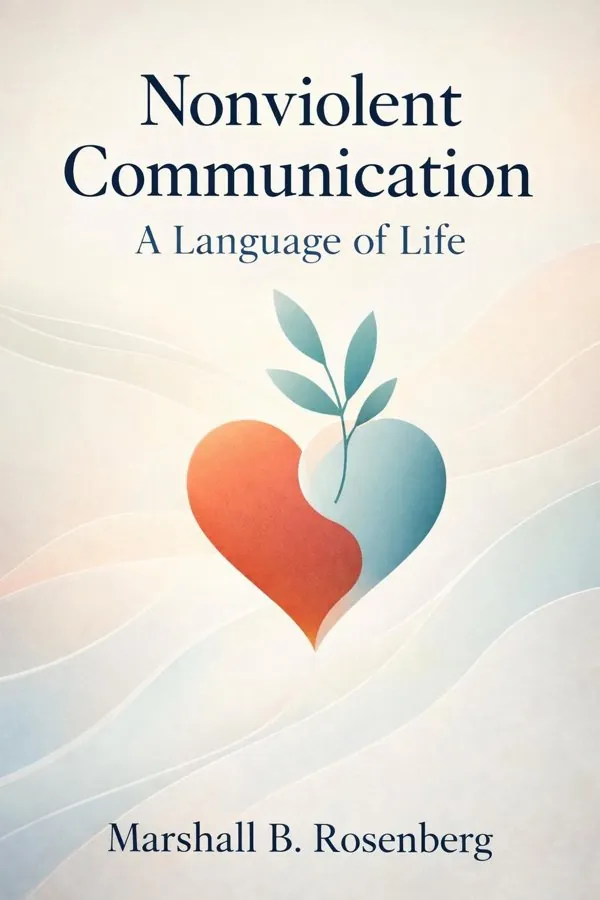
Nonviolent Communication: A Language of Life: Summary & Key Insights
 10 min5 chaptersAudio available
What Is Nonviolent Communication: A Language of Life About?
Nonviolent Communication: A Language of Life by Marshall B. Rosenberg is a communication book spanning 5 pages. Nonviolent Communication: A Language of Life es una guía fundamental para mejorar la empatía, la conexión y la resolución pacífica de conflictos. Marshall Rosenberg presenta un proceso de comunicación basado en la observación sin juicio, la expresión de sentimientos y necesidades, y la formulación de peticiones claras. El libro enseña cómo transformar la interacción humana para fomentar la comprensión mutua y la cooperación.
This FizzRead summary covers all 5 key chapters of Nonviolent Communication: A Language of Life in approximately 10 minutes, distilling the most important ideas, arguments, and takeaways from Marshall B. Rosenberg's work. Also available as an audio summary and Key Quotes Podcast.
Nonviolent Communication: A Language of Life
Nonviolent Communication: A Language of Life es una guía fundamental para mejorar la empatía, la conexión y la resolución pacífica de conflictos. Marshall Rosenberg presenta un proceso de comunicación basado en la observación sin juicio, la expresión de sentimientos y necesidades, y la formulación de peticiones claras. El libro enseña cómo transformar la interacción humana para fomentar la comprensión mutua y la cooperación.
Who Should Read Nonviolent Communication: A Language of Life?
This book is perfect for anyone interested in communication and looking to gain actionable insights in a short read. Whether you're a student, professional, or lifelong learner, the key ideas from Nonviolent Communication: A Language of Life by Marshall B. Rosenberg will help you think differently.
- ✓Readers who enjoy communication and want practical takeaways
- ✓Professionals looking to apply new ideas to their work and life
- ✓Anyone who wants the core insights of Nonviolent Communication: A Language of Life in just 10 minutes
Want the full summary?
Get instant access to this book summary and 100K+ more with Fizz Moment.
Get Free SummaryAvailable on App Store • Free to download
Key Chapters
When we engage in Nonviolent Communication, we begin by learning a new grammar of the heart—four interrelated components that help us express and receive messages free from coercion or judgment. The first is observation. To observe without evaluation is to see clearly, without adding the distortions of our interpretations. When we say to a child, 'You are lazy,' we make an evaluation that hurts. But if we say, 'I noticed you haven’t cleaned your room in two days,' we focus on observable facts and open the door to dialogue rather than defense. Observation trains us to describe what is happening rather than to label who someone is.
The second component is feeling. Most of us have been taught to disguise or suppress our emotions, or to mix them with thinking: 'I feel that you don’t care about me.' But this is not a feeling—it’s a judgment. Real feelings are sensations of our inner experience: sadness, joy, fear, peace, gratitude. When we learn to name feelings honestly, we begin to reconnect with our aliveness and vulnerability—the very qualities that allow trust to grow.
Third comes needs. Every feeling we have arises from needs that are either fulfilled or unfulfilled. When our needs for safety, love, or respect are met, we experience calm and joy. When they are not, we feel fear, anger, or sadness. Recognizing this allows us to move beyond blame. Instead of judging others as wrong, we can say, 'I feel hurt because I need acknowledgment,' which transforms accusation into self-awareness. Needs, in the NVC sense, are universal and shared; they are what unite us across differences.
Finally, we articulate requests. A request is not a demand; it is a clear, specific, and actionable invitation that honors freedom. When I say, 'Would you be willing to turn down the music so I can concentrate?' I am giving the other person a choice. Demands, by contrast, generate resistance because they threaten autonomy. The beauty of NVC is that, when all four components—observation, feeling, need, and request—work together, our language becomes a bridge instead of a barrier.
We live in cultures where moralistic judgments are woven into ordinary speech. We classify actions as right or wrong, people as good or bad, and then wonder why communication collapses. These habits, I discovered, are symptoms of what I call 'life-alienating communication,' rooted in centuries of dominance-based thinking. The more we judge, the further we move from connection.
Nonviolent Communication does not ask us to eliminate judgments altogether; rather, it teaches us to translate them into feelings and needs. When I notice myself thinking, 'That driver is inconsiderate,’ I can stop and ask, 'What am I feeling and needing right now?' Perhaps I feel anxious because I need safety. This shift from blame to self-awareness instantly changes the emotional charge. Similarly, when someone blames or criticizes me, I can choose to hear either the attack or the underlying need. When I listen for the need—for example, their desire for consideration or trust—the energy between us transforms.
In countless mediations, I have witnessed people move from entrenched hostility to genuine empathy by making this mental shift. A couple ready to divorce suddenly remembers their shared longing for respect. A parent and teenager who only shouted begin to see the fear and love behind their words. The practice of NVC dismantles defensiveness not through argument but through understanding. The moment we connect to needs, we lay down the weapons of judgment and begin to relate as equals in our shared humanity.
+ 3 more chapters — available in the FizzRead app
All Chapters in Nonviolent Communication: A Language of Life
About the Author
Marshall B. Rosenberg fue un psicólogo estadounidense y fundador del Center for Nonviolent Communication. Dedicó su vida a enseñar métodos de comunicación empática y resolución de conflictos en comunidades, escuelas y organizaciones de todo el mundo.
Get This Summary in Your Preferred Format
Read or listen to the Nonviolent Communication: A Language of Life summary by Marshall B. Rosenberg anytime, anywhere. FizzRead offers multiple formats so you can learn on your terms — all free.
Available formats: App · Audio · PDF · EPUB — All included free with FizzRead
Download Nonviolent Communication: A Language of Life PDF and EPUB Summary
Key Quotes from Nonviolent Communication: A Language of Life
“When we engage in Nonviolent Communication, we begin by learning a new grammar of the heart—four interrelated components that help us express and receive messages free from coercion or judgment.”
“We live in cultures where moralistic judgments are woven into ordinary speech.”
Frequently Asked Questions about Nonviolent Communication: A Language of Life
Nonviolent Communication: A Language of Life by Marshall B. Rosenberg is a communication book that explores key ideas across 5 chapters. Nonviolent Communication: A Language of Life es una guía fundamental para mejorar la empatía, la conexión y la resolución pacífica de conflictos. Marshall Rosenberg presenta un proceso de comunicación basado en la observación sin juicio, la expresión de sentimientos y necesidades, y la formulación de peticiones claras. El libro enseña cómo transformar la interacción humana para fomentar la comprensión mutua y la cooperación.
You Might Also Like

Magic Words: The Science and Secrets Behind Seven Words That Motivate, Engage, and Influence
Tim David
10 min
Talking Across The Divide: How to Communicate with People You Disagree with and Maybe Even Change the World
Justin Lee
10 min
The Exceptional Presenter: A Proven Formula to Open Up! and Own the Room
Timothy J. Koegel
10 min
4 Essential Keys to Effective Communication in Love, Life, Work--Anywhere!: Including the 12-Day Communication Challenge!
Bento C. Leal III
10 min
Active Listening Techniques: 30 Practical Tools to Hone Your Communication Skills
Nisha Gupta
10 min
Bargaining for Advantage: Negotiation Strategies for Reasonable People
G. Richard Shell
10 minBrowse by Category
Ready to read Nonviolent Communication: A Language of Life?
Get the full summary and 100K+ more books with Fizz Moment.