
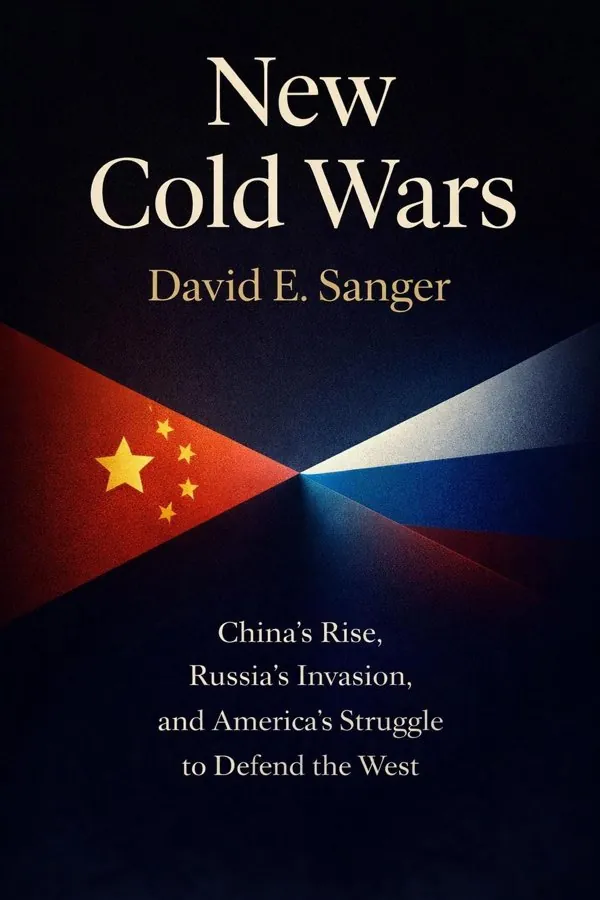
New Cold Wars: China's Rise, Russia's Invasion, and America's Struggle to Defend the West: Summary & Key Insights
 10 min7 chaptersAudio available
What Is New Cold Wars: China's Rise, Russia's Invasion, and America's Struggle to Defend the West About?
New Cold Wars: China's Rise, Russia's Invasion, and America's Struggle to Defend the West by David E. Sanger is a politics book spanning 7 pages. In 'New Cold Wars', David E. Sanger examines the geopolitical tensions reshaping the world order as China and Russia challenge the United States and its allies. Drawing on decades of reporting, Sanger explores how technological competition, military aggression, and ideological divides have ushered in a new era of global rivalry reminiscent of the Cold War, but far more complex and interconnected.
This FizzRead summary covers all 7 key chapters of New Cold Wars: China's Rise, Russia's Invasion, and America's Struggle to Defend the West in approximately 10 minutes, distilling the most important ideas, arguments, and takeaways from David E. Sanger's work. Also available as an audio summary and Key Quotes Podcast.
New Cold Wars: China's Rise, Russia's Invasion, and America's Struggle to Defend the West
In 'New Cold Wars', David E. Sanger examines the geopolitical tensions reshaping the world order as China and Russia challenge the United States and its allies. Drawing on decades of reporting, Sanger explores how technological competition, military aggression, and ideological divides have ushered in a new era of global rivalry reminiscent of the Cold War, but far more complex and interconnected.
Who Should Read New Cold Wars: China's Rise, Russia's Invasion, and America's Struggle to Defend the West?
This book is perfect for anyone interested in politics and looking to gain actionable insights in a short read. Whether you're a student, professional, or lifelong learner, the key ideas from New Cold Wars: China's Rise, Russia's Invasion, and America's Struggle to Defend the West by David E. Sanger will help you think differently.
- ✓Readers who enjoy politics and want practical takeaways
- ✓Professionals looking to apply new ideas to their work and life
- ✓Anyone who wants the core insights of New Cold Wars: China's Rise, Russia's Invasion, and America's Struggle to Defend the West in just 10 minutes
Want the full summary?
Get instant access to this book summary and 100K+ more with Fizz Moment.
Get Free SummaryAvailable on App Store • Free to download
Key Chapters
China’s transformation from a manufacturing hub to a complex technological and military superpower stands as one of history’s most consequential geopolitical shifts. Its economy has evolved from dependence on foreign investment to dominance in critical supply chains — rare earths, solar panels, and increasingly, semiconductors. Beneath that economic ascent lies a state project: to weave technology into national power. Huawei’s 5G networks, facial recognition systems, and state-supported AI models are not merely commercial triumphs; they are instruments of strategic influence.
In conversations with Pentagon analysts, I learned that the U.S. defense establishment sees Beijing’s modernization not only in its new hypersonic weapons or naval expansion, but also in how it has integrated civilian technology firms into military logistics and surveillance. This fusion of innovation and control allows China to compete globally while maintaining strict domestic oversight. Xi’s doctrine of 'military-civil fusion' is more than rhetoric — it is the architecture of national dominance.
What threatens democratic nations most is not China’s economic growth per se, but its capacity to use that growth to reshape international norms: who sets standards for technology, who controls data flows, and who decides what transparency means. For the United States, engaging with China requires a delicate balance — confronting habits of coercion without closing off the channels of cooperation that the global economy still demands.
+ 5 more chapters — available in the FizzRead app
All Chapters in New Cold Wars: China's Rise, Russia's Invasion, and America's Struggle to Defend the West
About the Author
David E. Sanger is an American journalist and author, known for his work as a national security correspondent for The New York Times. He has written extensively on foreign policy, nuclear proliferation, and cybersecurity, and is a three-time Pulitzer Prize winner.
Get This Summary in Your Preferred Format
Read or listen to the New Cold Wars: China's Rise, Russia's Invasion, and America's Struggle to Defend the West summary by David E. Sanger anytime, anywhere. FizzRead offers multiple formats so you can learn on your terms — all free.
Available formats: App · Audio · PDF · EPUB — All included free with FizzRead
Download New Cold Wars: China's Rise, Russia's Invasion, and America's Struggle to Defend the West PDF and EPUB Summary
Key Quotes from New Cold Wars: China's Rise, Russia's Invasion, and America's Struggle to Defend the West
“Over the past two decades, two leaders — Xi Jinping and Vladimir Putin — have redefined what authoritarianism looks like in a globalized world.”
“China’s transformation from a manufacturing hub to a complex technological and military superpower stands as one of history’s most consequential geopolitical shifts.”
Frequently Asked Questions about New Cold Wars: China's Rise, Russia's Invasion, and America's Struggle to Defend the West
New Cold Wars: China's Rise, Russia's Invasion, and America's Struggle to Defend the West by David E. Sanger is a politics book that explores key ideas across 7 chapters. In 'New Cold Wars', David E. Sanger examines the geopolitical tensions reshaping the world order as China and Russia challenge the United States and its allies. Drawing on decades of reporting, Sanger explores how technological competition, military aggression, and ideological divides have ushered in a new era of global rivalry reminiscent of the Cold War, but far more complex and interconnected.
You Might Also Like
Antifa: The Anti-Fascist Handbook
Mark Bray
10 min
Attack from Within: How Disinformation Is Sabotaging America
Barbara McQuade
10 min
Coercion, Capital, and European States, AD 990–1992
Charles Tilly
10 min
Digital Democracy: Concepts, Methodologies, Tools, and Applications
Various Authors
10 min
Fascism
Stanley G. Payne
10 min
Fire And Fury: Inside The Trump White House
Michael Wolff
10 minBrowse by Category
Ready to read New Cold Wars: China's Rise, Russia's Invasion, and America's Struggle to Defend the West?
Get the full summary and 100K+ more books with Fizz Moment.