
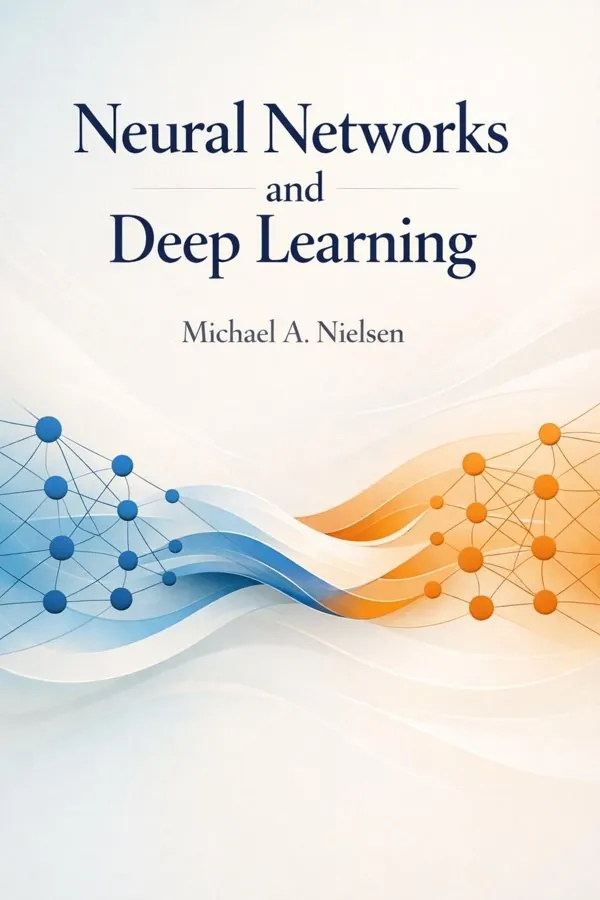
Neural Networks and Deep Learning: Summary & Key Insights
 10 min8 chaptersAudio available
What Is Neural Networks and Deep Learning About?
Neural Networks and Deep Learning by Michael A. Nielsen is a ai_ml book spanning 8 pages. This book provides an accessible introduction to the theory and practice of neural networks and deep learning. It explains key concepts such as gradient descent, backpropagation, and convolutional networks, using clear examples and Python code. The text emphasizes understanding the underlying principles rather than relying on complex mathematics, making it suitable for readers new to machine learning.
This FizzRead summary covers all 8 key chapters of Neural Networks and Deep Learning in approximately 10 minutes, distilling the most important ideas, arguments, and takeaways from Michael A. Nielsen's work. Also available as an audio summary and Key Quotes Podcast.
Neural Networks and Deep Learning
This book provides an accessible introduction to the theory and practice of neural networks and deep learning. It explains key concepts such as gradient descent, backpropagation, and convolutional networks, using clear examples and Python code. The text emphasizes understanding the underlying principles rather than relying on complex mathematics, making it suitable for readers new to machine learning.
Who Should Read Neural Networks and Deep Learning?
This book is perfect for anyone interested in ai_ml and looking to gain actionable insights in a short read. Whether you're a student, professional, or lifelong learner, the key ideas from Neural Networks and Deep Learning by Michael A. Nielsen will help you think differently.
- ✓Readers who enjoy ai_ml and want practical takeaways
- ✓Professionals looking to apply new ideas to their work and life
- ✓Anyone who wants the core insights of Neural Networks and Deep Learning in just 10 minutes
Want the full summary?
Get instant access to this book summary and 100K+ more with Fizz Moment.
Get Free SummaryAvailable on App Store • Free to download
Key Chapters
We begin by building a neural network that can recognize handwritten digits — a seemingly simple task with unexpectedly powerful lessons. The MNIST dataset, consisting of 28×28 pixel images of digits 0–9, is a natural playground for learning. Each image becomes a vector of 784 numbers, and the network’s task is to assign it to one of ten categories.
At first glance, this may appear like a standard classification problem. But what transforms it into something revolutionary is how we approach learning. Instead of prescribing explicit rules for recognizing digits — rules that would be impossibly complex — we allow the network to find patterns in data through experience. Each neuron computes a weighted sum of its inputs, applies a nonlinear activation function, and passes the result to the next layer. The entire network’s behavior is determined by the collective interaction of these neurons and, crucially, by the values of their weights and biases.
When we train the network, we are not manually programming logic for each digit. We are letting the system approximate an enormously complex function by adjusting these parameters to minimize errors in prediction. Through feedback and iteration, the network gradually shapes its internal representation of what ‘three-ness’ or ‘seven-ness’ looks like. This is the essence of machine learning: enabling a system to learn representations of data that are useful for the tasks we care about.
While such small networks may seem primitive by modern standards, they embody the core of deep learning’s power — the ability to automatically extract structure from raw information. Even before we introduce advanced methods, the humble digital neuron already captures the spirit of self-learning computation.
Once we can measure how wrong our network’s predictions are, we need a way to make it less wrong. That is the role of gradient descent, one of the most elegant tools in optimization. We define a cost function — a quantitative measure of how poorly the network performs over its training examples — and then we search for the set of weights and biases that minimizes this cost.
Intuitively, gradient descent imagines the cost function as a vast, high-dimensional surface. Each point corresponds to a particular configuration of parameters; our goal is to find the valley — the global minimum — where the cost is lowest. We move gradually in the direction of steepest descent, guided by gradients that tell us which way to go. Each small step reduces the cost, improving the network’s performance.
The beauty of this method lies in its universality. Gradient descent doesn’t care whether we are optimizing linear regression, a simple logistic classifier, or a complex deep network with millions of parameters. It harnesses the same principle: adjust parameters to reduce error, step by step, following the flow of information from data to model to outcome.
But because real data are vast, we rarely compute the gradient on the entire training set at once. Instead, we use stochastic gradient descent — estimating the gradient using small batches of data. This adds a degree of randomness that, rather than being a flaw, often helps the network escape shallow local minima and find better solutions. Learning, both biological and artificial, is rarely smooth; it is noisy, approximate, and surprisingly resilient.
+ 6 more chapters — available in the FizzRead app
All Chapters in Neural Networks and Deep Learning
About the Author
Michael A. Nielsen is a scientist, writer, and programmer known for his work in quantum computing and open science. He co-authored 'Quantum Computation and Quantum Information' and has contributed extensively to the popularization of deep learning and open research practices.
Get This Summary in Your Preferred Format
Read or listen to the Neural Networks and Deep Learning summary by Michael A. Nielsen anytime, anywhere. FizzRead offers multiple formats so you can learn on your terms — all free.
Available formats: App · Audio · PDF · EPUB — All included free with FizzRead
Download Neural Networks and Deep Learning PDF and EPUB Summary
Key Quotes from Neural Networks and Deep Learning
“We begin by building a neural network that can recognize handwritten digits — a seemingly simple task with unexpectedly powerful lessons.”
“Once we can measure how wrong our network’s predictions are, we need a way to make it less wrong.”
Frequently Asked Questions about Neural Networks and Deep Learning
Neural Networks and Deep Learning by Michael A. Nielsen is a ai_ml book that explores key ideas across 8 chapters. This book provides an accessible introduction to the theory and practice of neural networks and deep learning. It explains key concepts such as gradient descent, backpropagation, and convolutional networks, using clear examples and Python code. The text emphasizes understanding the underlying principles rather than relying on complex mathematics, making it suitable for readers new to machine learning.
More by Michael A. Nielsen
You Might Also Like
Life 3.0
Max Tegmark
10 min
Superintelligence
Nick Bostrom
10 min
TensorFlow in Action
Thushan Ganegedara
10 min
AI Made Simple: A Beginner’s Guide to Generative AI, ChatGPT, and the Future of Work
Rajeev Kapur
10 min
AI Snake Oil
Arvind Narayanan, Sayash Kapoor
10 min
AI Superpowers: China, Silicon Valley, and the New World Order
Kai-Fu Lee
10 minBrowse by Category
Ready to read Neural Networks and Deep Learning?
Get the full summary and 100K+ more books with Fizz Moment.