
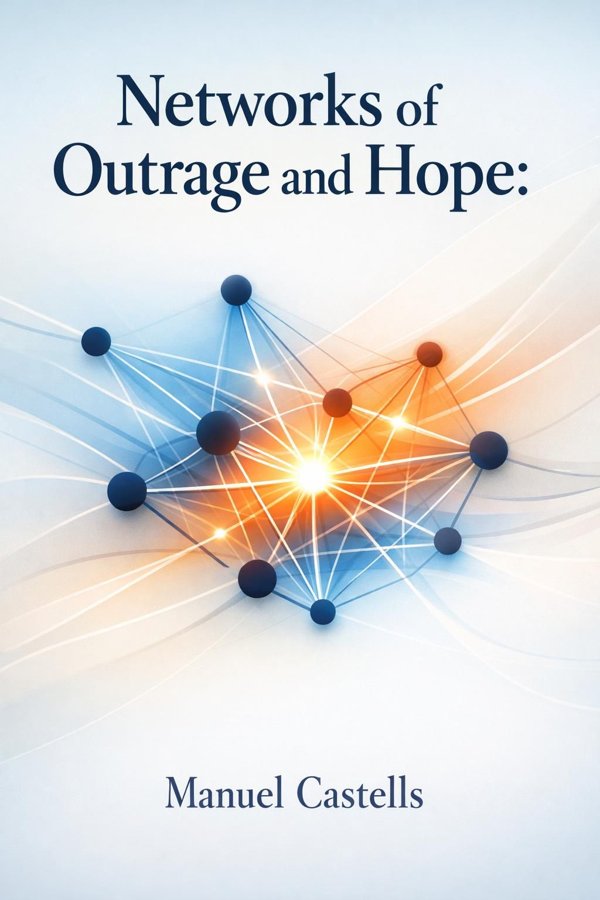
Networks of Outrage and Hope: Social Movements in the Internet Age: Summary & Key Insights
 10 min9 chaptersAudio available
What Is Networks of Outrage and Hope: Social Movements in the Internet Age About?
Networks of Outrage and Hope: Social Movements in the Internet Age by Manuel Castells is a sociology book spanning 9 pages. This book explores how social movements around the world have used the internet and digital communication technologies to organize, mobilize, and challenge power structures. Castells analyzes cases such as the Arab Spring, the Indignados movement in Spain, and Occupy Wall Street, showing how networked communication fosters collective action and political change in the digital era.
This FizzRead summary covers all 9 key chapters of Networks of Outrage and Hope: Social Movements in the Internet Age in approximately 10 minutes, distilling the most important ideas, arguments, and takeaways from Manuel Castells's work. Also available as an audio summary and Key Quotes Podcast.
Networks of Outrage and Hope: Social Movements in the Internet Age
This book explores how social movements around the world have used the internet and digital communication technologies to organize, mobilize, and challenge power structures. Castells analyzes cases such as the Arab Spring, the Indignados movement in Spain, and Occupy Wall Street, showing how networked communication fosters collective action and political change in the digital era.
Who Should Read Networks of Outrage and Hope: Social Movements in the Internet Age?
This book is perfect for anyone interested in sociology and looking to gain actionable insights in a short read. Whether you're a student, professional, or lifelong learner, the key ideas from Networks of Outrage and Hope: Social Movements in the Internet Age by Manuel Castells will help you think differently.
- ✓Readers who enjoy sociology and want practical takeaways
- ✓Professionals looking to apply new ideas to their work and life
- ✓Anyone who wants the core insights of Networks of Outrage and Hope: Social Movements in the Internet Age in just 10 minutes
Want the full summary?
Get instant access to this book summary and 100K+ more with Fizz Moment.
Get Free SummaryAvailable on App Store • Free to download
Key Chapters
Every historical era defines its own architecture of power. In the industrial age, centralized institutions—governments, corporations, and mass media—held control through hierarchical systems. The network era, however, operates under different principles. In networks, communication flows in multiple directions, interaction is multidimensional, and no single node controls the entire structure. This decentralized form is not only technical but social and political.
I argue that digital communication introduces a new form of what I call 'mass self-communication.' Unlike traditional mass media, where few transmit to many, digital networks enable many-to-many communication. Individuals can now create and share messages globally without mediation. Consequently, the traditional monopoly of information collapses. This shift transforms power relations. Power, which I define as the ability to shape human minds, now meets resistance from counterpower—the capacity of individuals and groups to resist domination through autonomous communication.
Identity formation is central to this transformation. In past social movements, collective identity was shaped through physical gatherings, ideological manifestos, or charismatic leadership. The networked movements of the digital age, however, construct identity through shared emotions and online interaction. Hashtags become banners of belonging; viral images evolve into symbols of collective memory. Through the network, isolated individuals find resonance—an emotional connection that transcends geography.
In this framework, the Internet is not merely a tool but a communicative environment. It enables horizontal, participatory, and instantaneous collaboration. Yet, it also amplifies tensions. Networks can empower but they can also fragment. The absence of central authority means cohesion must emerge from shared values rather than institutional discipline. The success of digital movements depends on their capacity to weave meaning and trust among diverse participants.
This theoretical foundation underpins all subsequent analysis. To understand contemporary movements, we must grasp their networked logic: spontaneous coordination through digital platforms, emotional mobilization through communication, and the continuous negotiation between autonomy and collective coherence. Moving forward, we shall see how these dynamics unfolded in concrete historical episodes—from Tunisia to New York—where citizens redefined not only political boundaries but the nature of public life itself.
The Arab Spring was the moment when this network logic exploded onto the global stage. Tunisia and Egypt in 2010–2011 demonstrated that authoritarian control could be pierced by digital communication. It began with outrage—provoked by police brutality, corruption, and economic inequality. When Mohamed Bouazizi, a young street vendor in Tunisia, set himself on fire in protest, the event became a viral symbol of systemic despair. Within days, videos, photographs, and testimonies circulated globally, coordinated through Facebook pages and Twitter feeds that bypassed state censorship.
I studied how these networks operated: they were fluid, non-hierarchical, and emotionally charged. They connected individuals who had never previously engaged in formal politics. The Internet provided not organization but coordination—a diffuse web of conversations that crystallized into street action. In Egypt, activists used Facebook to plan rallies while relying on text messaging to evade surveillance. When government forces shut down Internet access, networks adapted through offline coordination, showing that digital activism does not replace human courage but amplifies it.
The Arab Spring illustrated how digital channels could transform local struggles into global narratives. International media, drawn to the viral momentum of citizen videos, amplified the movement’s legitimacy. This interplay between online and traditional media is crucial; the networked uprising became visible and symbolically powerful because global audiences could witness it directly.
I recognize the limits too. Digital mobilization can overthrow regimes but not necessarily establish democratic institutions. The networks of revolt were more effective in destruction than in construction. Yet, their historical significance lies in proving that communication autonomy—people’s capacity to speak and organize outside official control—can destabilize authoritarian systems. It is the power of shared outrage transformed into collective hope, even when fragile.
+ 7 more chapters — available in the FizzRead app
All Chapters in Networks of Outrage and Hope: Social Movements in the Internet Age
About the Author
Manuel Castells is a Spanish sociologist renowned for his research on the information society, communication, and globalization. He is a professor of sociology and has authored influential works on the network society and the impact of technology on social structures.
Get This Summary in Your Preferred Format
Read or listen to the Networks of Outrage and Hope: Social Movements in the Internet Age summary by Manuel Castells anytime, anywhere. FizzRead offers multiple formats so you can learn on your terms — all free.
Available formats: App · Audio · PDF · EPUB — All included free with FizzRead
Download Networks of Outrage and Hope: Social Movements in the Internet Age PDF and EPUB Summary
Key Quotes from Networks of Outrage and Hope: Social Movements in the Internet Age
“Every historical era defines its own architecture of power.”
“The Arab Spring was the moment when this network logic exploded onto the global stage.”
Frequently Asked Questions about Networks of Outrage and Hope: Social Movements in the Internet Age
Networks of Outrage and Hope: Social Movements in the Internet Age by Manuel Castells is a sociology book that explores key ideas across 9 chapters. This book explores how social movements around the world have used the internet and digital communication technologies to organize, mobilize, and challenge power structures. Castells analyzes cases such as the Arab Spring, the Indignados movement in Spain, and Occupy Wall Street, showing how networked communication fosters collective action and political change in the digital era.
More by Manuel Castells
You Might Also Like

Between the World and Me
Ta-Nehisi Coates
10 min
Half the Sky
Nicholas D. Kristof, Sheryl WuDunn
10 min
Men Explain Things To Me
Rebecca Solnit
10 min
Rational Ritual
Michael Suk-Young Chwe
10 min
The New Jim Crow
Michelle Alexander
10 min
Beyond Culture
Edward T. Hall
10 minBrowse by Category
Ready to read Networks of Outrage and Hope: Social Movements in the Internet Age?
Get the full summary and 100K+ more books with Fizz Moment.