
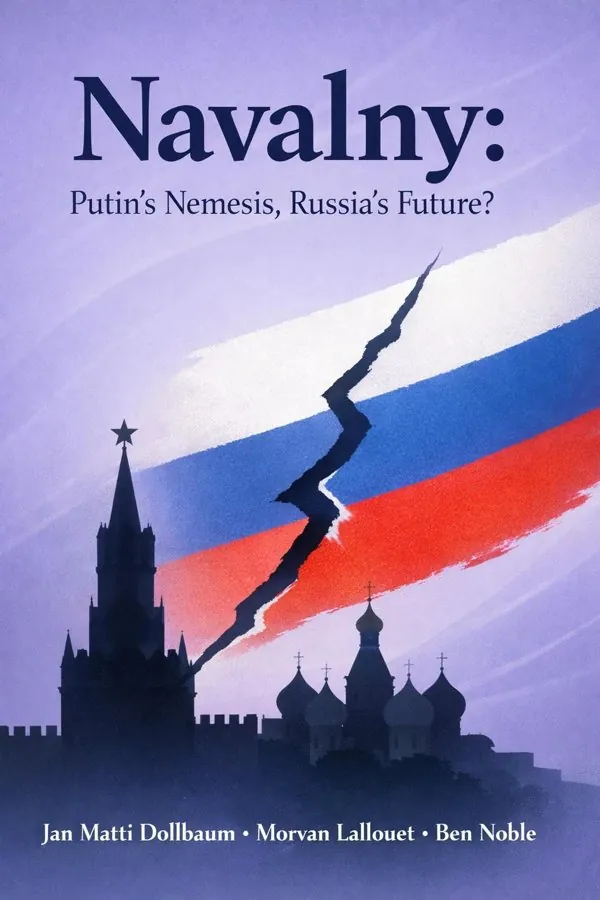
Navalny: Putin’s Nemesis, Russia’s Future?: Summary & Key Insights
by Jan Matti Dollbaum, Morvan Lallouet, Ben Noble
 10 min10 chaptersAudio available
Key Takeaways from Navalny: Putin’s Nemesis, Russia’s Future?
Political figures do not emerge from nowhere; they are products of historical transition.
Corruption is not just bad governance; in authoritarian systems, it is often the language through which power operates.
Charisma attracts attention, but organization sustains pressure.
Authoritarian regimes often tolerate symbolic dissent but react fiercely to opponents who become organizationally credible.
A flawed election is not the same as a meaningless one.
What Is Navalny: Putin’s Nemesis, Russia’s Future? About?
Navalny: Putin’s Nemesis, Russia’s Future? by Jan Matti Dollbaum, Morvan Lallouet, Ben Noble is a politics book spanning 10 pages. Alexei Navalny is often reduced to a symbol: anti-corruption crusader, Putin’s boldest critic, martyr of the Russian opposition. This book goes much deeper. In Navalny: Putin’s Nemesis, Russia’s Future?, Jan Matti Dollbaum, Morvan Lallouet, and Ben Noble examine Navalny not as a myth, but as a political actor shaped by Russia’s institutions, media system, protest cycles, and authoritarian constraints. They trace his evolution from lawyer and blogger to movement-builder, electoral challenger, and global emblem of resistance, while also confronting the tensions in his record, including ideological ambiguity and nationalist controversies. What makes the book especially valuable is its balance. The authors neither romanticize Navalny nor dismiss him; instead, they show why he mattered, how he operated, and what his rise reveals about modern Russia. Drawing on deep expertise in Russian politics and post-Soviet affairs, they place Navalny’s campaigns, investigations, poisoning, and imprisonment in broader context. The result is a rigorous yet accessible study of opposition under authoritarianism. For anyone trying to understand Putin’s Russia, the limits of dissent, and the political meaning of Navalny’s life, this book is essential reading.
This FizzRead summary covers all 10 key chapters of Navalny: Putin’s Nemesis, Russia’s Future? in approximately 10 minutes, distilling the most important ideas, arguments, and takeaways from Jan Matti Dollbaum, Morvan Lallouet, Ben Noble's work. Also available as an audio summary and Key Quotes Podcast.
Navalny: Putin’s Nemesis, Russia’s Future?
Alexei Navalny is often reduced to a symbol: anti-corruption crusader, Putin’s boldest critic, martyr of the Russian opposition. This book goes much deeper. In Navalny: Putin’s Nemesis, Russia’s Future?, Jan Matti Dollbaum, Morvan Lallouet, and Ben Noble examine Navalny not as a myth, but as a political actor shaped by Russia’s institutions, media system, protest cycles, and authoritarian constraints. They trace his evolution from lawyer and blogger to movement-builder, electoral challenger, and global emblem of resistance, while also confronting the tensions in his record, including ideological ambiguity and nationalist controversies.
What makes the book especially valuable is its balance. The authors neither romanticize Navalny nor dismiss him; instead, they show why he mattered, how he operated, and what his rise reveals about modern Russia. Drawing on deep expertise in Russian politics and post-Soviet affairs, they place Navalny’s campaigns, investigations, poisoning, and imprisonment in broader context. The result is a rigorous yet accessible study of opposition under authoritarianism. For anyone trying to understand Putin’s Russia, the limits of dissent, and the political meaning of Navalny’s life, this book is essential reading.
Who Should Read Navalny: Putin’s Nemesis, Russia’s Future??
This book is perfect for anyone interested in politics and looking to gain actionable insights in a short read. Whether you're a student, professional, or lifelong learner, the key ideas from Navalny: Putin’s Nemesis, Russia’s Future? by Jan Matti Dollbaum, Morvan Lallouet, Ben Noble will help you think differently.
- ✓Readers who enjoy politics and want practical takeaways
- ✓Professionals looking to apply new ideas to their work and life
- ✓Anyone who wants the core insights of Navalny: Putin’s Nemesis, Russia’s Future? in just 10 minutes
Want the full summary?
Get instant access to this book summary and 100K+ more with Fizz Moment.
Get Free SummaryAvailable on App Store • Free to download
Key Chapters
Political figures do not emerge from nowhere; they are products of historical transition. Alexei Navalny’s early life unfolded between two systems: the fading Soviet order and the unstable post-Soviet Russia that replaced it. Born in 1976 near Moscow, he came of age during a time when ideological certainty had collapsed, but no stable democratic culture had yet taken root. That background matters because Navalny’s political instincts were formed not in a mature democracy, but in a society where corruption, state power, and public cynicism often seemed inseparable.
The authors show that Navalny’s formative years help explain both his appeal and his methods. He belonged to a generation that saw the promises of the 1990s frustrated by economic disorder, elite capture, and the concentration of power under Vladimir Putin. Unlike older dissidents shaped by Soviet-era repression, Navalny developed in a more media-driven, entrepreneurial environment. He combined legal training, business experience, and digital fluency with a sharp understanding of how ordinary Russians talked about injustice in daily life.
This helps explain why Navalny’s politics rarely sounded abstract or academic. He did not primarily speak in the language of constitutional theory. He spoke about theft, lies, rigged opportunities, and unaccountable officials. His message resonated because it reflected lived frustrations that many Russians recognized immediately.
A practical lesson follows from this: successful political challengers often emerge not from ideological purity but from close contact with the contradictions of their society. To understand any opposition leader, look first at the system that shaped them. The actionable takeaway is to study biography as political context: when evaluating leaders, ask how their generation, institutions, and social environment molded the issues they choose to fight.
Corruption is not just bad governance; in authoritarian systems, it is often the language through which power operates. One of Navalny’s greatest innovations was to turn anti-corruption from a moral complaint into a political strategy. Through blogging, shareholder activism, and later the Anti-Corruption Foundation (FBK), he exposed how state-connected elites enriched themselves while presenting themselves as patriotic guardians of stability.
The book explains that this was effective because Navalny did more than accuse. He investigated. He documented. He translated opaque financial schemes into vivid, accessible stories. Lavish estates, hidden assets, shell companies, and lifestyle excess became evidence that the ruling system was not merely inefficient but fundamentally predatory. His investigations reached people who might never read policy papers but would watch a gripping online video about elite hypocrisy.
This strategy mattered because corruption in Russia was not peripheral; it was structural. By exposing specific cases, Navalny was also challenging the legitimacy of the entire political order. He suggested that the Kremlin’s promise of stability rested on theft protected from scrutiny. The authors show how this framing helped Navalny broaden his audience beyond liberal circles. People who distrusted ideology could still respond to the simple claim that officials were robbing the country.
There is a broader application here for activists, journalists, and civic organizations everywhere: complex systems of abuse become politically meaningful only when made legible to the public. Facts alone are not enough; they must be organized into narratives people can grasp. The actionable takeaway is to communicate accountability through concrete, relatable evidence. If you want citizens to care, show them not just that corruption exists, but how it touches real lives and distorts the rules for everyone.
Charisma attracts attention, but organization sustains pressure. A central contribution of this book is showing that Navalny’s significance lay not only in his personal visibility but in his effort to build a durable political infrastructure across Russia. Through regional штабs, volunteer networks, fundraising systems, investigative teams, and coordinated messaging, Navalny’s movement became more than a protest brand. It became one of the most serious attempts in contemporary Russia to construct a nationwide opposition apparatus.
This was remarkable in a system designed to prevent exactly that. Russian authoritarianism did not rely solely on censorship and arrests; it also fragmented society, discouraged coordination, and made sustained opposition costly. Navalny’s team responded by creating an ecosystem: local offices trained activists, digital platforms distributed content, and investigations connected local grievances to national politics. This allowed supporters in distant regions to feel part of a common struggle rather than isolated critics.
The authors also note the vulnerability of leader-centered movements. Navalny remained the indispensable face of the campaign, which gave the Kremlin a clear target. Yet his organization demonstrated that even under repression, structure matters. Volunteers could canvass, mobilize, and monitor. Supporters could donate small sums, creating not just funding but commitment. Regional activism gave the movement social depth beyond Moscow and St. Petersburg.
The practical insight is clear: durable opposition requires systems, routines, and local ownership. Whether in politics, advocacy, or civic work, a movement built only on inspiration will struggle to survive pressure. The actionable takeaway is to invest early in decentralized capacity. Build local nodes, train people, create repeatable processes, and make participation possible at many levels, so that a cause does not collapse when its most visible figure is attacked.
Authoritarian regimes often tolerate symbolic dissent but react fiercely to opponents who become organizationally credible. Navalny posed a special threat to the Kremlin not because he was the loudest critic, but because he increasingly looked like a plausible political contender. The book shows that his confrontation with the Russian state escalated as he moved from exposing wrongdoing to building electoral campaigns, mobilizing street protests, and generating genuine public recognition.
This distinction matters. Many governments can absorb criticism at the margins, especially if it remains fragmented or elite-focused. What becomes dangerous is an opposition figure who links moral critique to political coordination. Navalny did exactly that. His anti-corruption message gave him legitimacy; his campaigning gave that legitimacy structure. In response, the state used familiar authoritarian tools: legal harassment, selective prosecutions, media smears, restrictions on assembly, and eventually outright repression.
The authors are especially good at showing that these actions were not signs of confidence, but of insecurity. A strong regime does not need to constantly disqualify candidates, raid offices, and jail activists. Such measures reveal a fear that open competition might expose weakness beneath the surface of managed politics. Navalny’s treatment therefore tells readers as much about Putin’s system as it does about Navalny himself.
This insight applies beyond Russia. When institutions are manipulated to block specific challengers, the issue is no longer merely about one person’s fate; it concerns whether the political arena remains genuinely competitive. The actionable takeaway is to watch how power responds to challengers. The more aggressively a regime bends rules to stop peaceful competition, the more that behavior signals the fragility of its legitimacy.
A flawed election is not the same as a meaningless one. One of the book’s most valuable arguments is that Navalny treated elections in Russia not as fair contests, but as opportunities to expose the regime, test support, recruit activists, and expand political imagination. Even within manipulated institutions, campaigns could reveal public discontent and create moments when politics felt real.
Navalny’s 2013 Moscow mayoral race is a key example. Though the contest was unequal and media access restricted, his campaign energized volunteers, demonstrated unexpected support, and showed that a disciplined opposition could compete more effectively than the Kremlin preferred to admit. Later, when barred from the 2018 presidential election, Navalny still used the campaign period to organize, communicate, and sharpen his message. Exclusion itself became evidence of regime fear.
The book also explains the logic behind “Smart Voting,” Navalny’s tactical effort to coordinate votes behind the strongest non-Kremlin candidates. This was not a romantic belief in the electoral system. It was a pragmatic attempt to exploit cracks within it. By reducing opposition fragmentation, the strategy aimed to convert scattered dissatisfaction into measurable losses for the ruling party.
For readers interested in politics more broadly, this is a powerful reminder that institutions do not need to be fully democratic to become arenas of contestation. Even constrained procedures can educate citizens, build habits of participation, and embarrass those in power. The actionable takeaway is to think strategically about imperfect systems. If a structure cannot yet deliver full change, ask how it can still be used to organize people, reveal injustice, and accumulate pressure over time.
Sometimes the most revealing election is the one a candidate is prevented from entering. Navalny’s exclusion from the 2018 presidential contest became a defining demonstration of how the Russian system managed competition. The state justified his disqualification through legal mechanisms, but the broader political message was unmistakable: participation was permitted only on terms that did not endanger the incumbent order.
The authors show that this moment mattered because Navalny had already built campaign infrastructure, public recognition, and a clear claim to relevance. His supporters opened offices, collected signatures, and mobilized volunteers across the country. Even without appearing on the ballot, he turned the campaign into an instrument of political education. Russians could see the gap between the regime’s formal language about legality and the underlying reality of controlled outcomes.
The aftermath also demonstrated the adaptive quality of Navalny’s politics. Rather than treating exclusion as the end of the road, he used it to intensify criticism of the system and reinforce the argument that meaningful change would not come from passive acceptance. His movement continued to campaign, investigate, and organize. In that sense, being blocked from the election strengthened the case that Russia lacked genuine political pluralism.
For anyone studying constrained political systems, this episode illustrates how procedural rules can be weaponized while preserving a façade of normality. The actionable takeaway is to examine not just whether elections occur, but who is allowed to compete and under what conditions. Political systems reveal themselves as much through exclusion as through participation.
Repression can silence a person, but it can also transform their political significance. Navalny’s poisoning in 2020, his treatment in Germany, and his decision to return to Russia despite almost certain arrest marked a dramatic shift in how he was perceived. He was no longer simply the opposition’s most effective organizer; he became a symbol of personal courage in the face of a state willing to eliminate opponents.
The book emphasizes that these events should not be understood only emotionally. They changed the political meaning of Navalny’s career. The poisoning underscored the stakes of dissent under Putin’s rule, while his return challenged the logic of exile. By going back, Navalny rejected the idea that opposition must survive only from abroad. He turned his own body and fate into evidence of the regime’s brutality and fear.
At the same time, the authors caution against reducing everything to symbolism. Imprisonment weakened organizational capacity, disrupted networks, and intensified repression against allies. The movement paid a severe operational price. This dual reality is important: martyrdom can inspire, but it does not automatically generate effective political leverage.
The wider lesson is that authoritarian systems often overreach when confronting challengers, converting repression into moral exposure. But outrage alone is not strategy. The actionable takeaway is to distinguish between symbolic power and organizational power. Both matter, yet movements facing repression must think carefully about how to preserve institutions, leadership succession, and communication channels when their most visible figure is removed.
International attention can amplify a dissident, but it can also flatten them into a convenient symbol. Navalny became, especially after his poisoning and imprisonment, a global shorthand for resistance to Putin. That visibility mattered: it increased pressure on the Russian state, mobilized solidarity, and kept his case in public view. Yet the book cautions against turning Navalny into a simplified Western icon detached from the specific realities of Russian politics.
The authors show that Navalny’s international significance rests on a tension. Outside Russia, he is often framed primarily as a democratic hero confronting authoritarianism. Inside Russia, his meaning has always been more complex, shaped by domestic grievances, political language, media conditions, and contested ideological interpretations. To understand him properly, readers must hold both levels together: the universal and the local.
This point has wider relevance for how global audiences engage with opposition figures. External support can be valuable, but it can also unintentionally distort local politics, encourage moral simplification, or invite regimes to portray dissidents as foreign proxies. Navalny’s case demonstrates both the necessity and the limits of international solidarity.
A practical lesson emerges for readers, journalists, and policymakers: support should be informed, not symbolic alone. Pay attention to local context, domestic constituencies, and the actual mechanics of repression and resistance. The actionable takeaway is to avoid consuming political figures as myths. When a dissident becomes internationally famous, ask what their story reveals about the society they come from, not just the values outsiders want them to represent.
All Chapters in Navalny: Putin’s Nemesis, Russia’s Future?
About the Authors
Jan Matti Dollbaum is a political scientist whose work focuses on Russian politics, protest, and opposition movements. Morvan Lallouet is a researcher specializing in Russian and post-Soviet political affairs, with particular interest in power structures, political mobilization, and state-society relations. Ben Noble is a scholar of Russian politics and a lecturer at University College London, known for his research on authoritarian institutions, political behavior, and governance in contemporary Russia. Together, they bring a strong academic foundation to the study of Alexei Navalny, combining expertise in opposition politics, authoritarian systems, and Russian political development. Their collaboration makes this book especially credible: it blends careful research, contextual understanding, and accessible analysis to explain not only Navalny’s life and strategy, but also what his career reveals about Putin’s Russia and its uncertain future.
Get This Summary in Your Preferred Format
Read or listen to the Navalny: Putin’s Nemesis, Russia’s Future? summary by Jan Matti Dollbaum, Morvan Lallouet, Ben Noble anytime, anywhere. FizzRead offers multiple formats so you can learn on your terms — all free.
Available formats: App · Audio · PDF · EPUB — All included free with FizzRead
Download Navalny: Putin’s Nemesis, Russia’s Future? PDF and EPUB Summary
Key Quotes from Navalny: Putin’s Nemesis, Russia’s Future?
“Political figures do not emerge from nowhere; they are products of historical transition.”
“Corruption is not just bad governance; in authoritarian systems, it is often the language through which power operates.”
“Charisma attracts attention, but organization sustains pressure.”
“Authoritarian regimes often tolerate symbolic dissent but react fiercely to opponents who become organizationally credible.”
“A flawed election is not the same as a meaningless one.”
Frequently Asked Questions about Navalny: Putin’s Nemesis, Russia’s Future?
Navalny: Putin’s Nemesis, Russia’s Future? by Jan Matti Dollbaum, Morvan Lallouet, Ben Noble is a politics book that explores key ideas across 10 chapters. Alexei Navalny is often reduced to a symbol: anti-corruption crusader, Putin’s boldest critic, martyr of the Russian opposition. This book goes much deeper. In Navalny: Putin’s Nemesis, Russia’s Future?, Jan Matti Dollbaum, Morvan Lallouet, and Ben Noble examine Navalny not as a myth, but as a political actor shaped by Russia’s institutions, media system, protest cycles, and authoritarian constraints. They trace his evolution from lawyer and blogger to movement-builder, electoral challenger, and global emblem of resistance, while also confronting the tensions in his record, including ideological ambiguity and nationalist controversies. What makes the book especially valuable is its balance. The authors neither romanticize Navalny nor dismiss him; instead, they show why he mattered, how he operated, and what his rise reveals about modern Russia. Drawing on deep expertise in Russian politics and post-Soviet affairs, they place Navalny’s campaigns, investigations, poisoning, and imprisonment in broader context. The result is a rigorous yet accessible study of opposition under authoritarianism. For anyone trying to understand Putin’s Russia, the limits of dissent, and the political meaning of Navalny’s life, this book is essential reading.
You Might Also Like
Antifa: The Anti-Fascist Handbook
Mark Bray
10 min
Attack from Within: How Disinformation Is Sabotaging America
Barbara McQuade
10 min
Coercion, Capital, and European States, AD 990–1992
Charles Tilly
10 min
Digital Democracy: Concepts, Methodologies, Tools, and Applications
Various Authors
10 min
Fascism
Stanley G. Payne
10 min
Fire And Fury: Inside The Trump White House
Michael Wolff
10 minBrowse by Category
Ready to read Navalny: Putin’s Nemesis, Russia’s Future??
Get the full summary and 100K+ more books with Fizz Moment.