
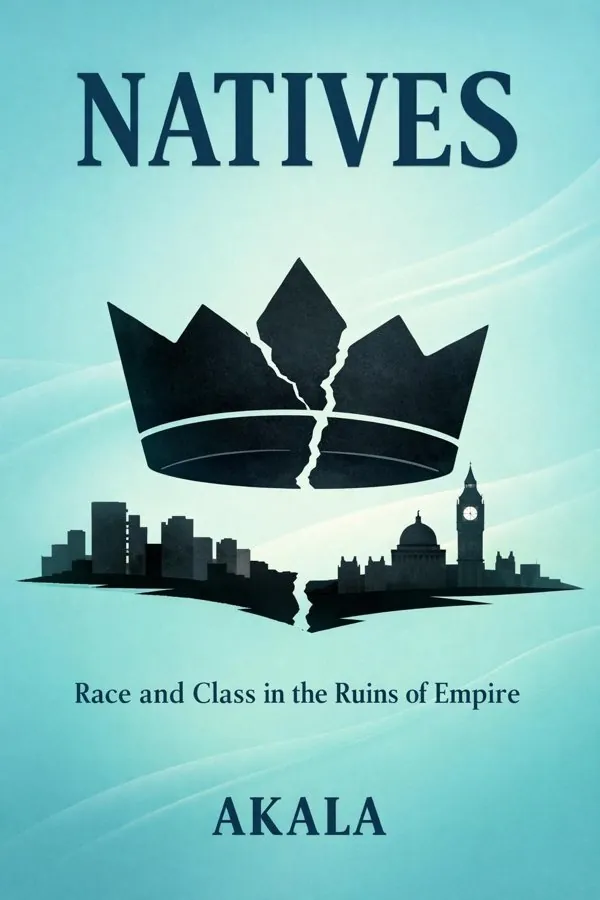
Natives: Race and Class in the Ruins of Empire: Summary & Key Insights
by Akala
 10 min10 chaptersAudio available
What Is Natives: Race and Class in the Ruins of Empire About?
Natives: Race and Class in the Ruins of Empire by Akala is a sociology book spanning 10 pages. Natives: Race and Class in the Ruins of Empire is a powerful non-fiction work by British writer and musician Akala. The book explores the intersections of race, class, and identity in modern Britain, drawing on the author’s personal experiences and historical analysis to examine how colonial legacies continue to shape social structures and perceptions. Akala combines memoir, political commentary, and cultural critique to challenge systemic racism and inequality in the United Kingdom.
This FizzRead summary covers all 10 key chapters of Natives: Race and Class in the Ruins of Empire in approximately 10 minutes, distilling the most important ideas, arguments, and takeaways from Akala's work. Also available as an audio summary and Key Quotes Podcast.
Natives: Race and Class in the Ruins of Empire
Natives: Race and Class in the Ruins of Empire is a powerful non-fiction work by British writer and musician Akala. The book explores the intersections of race, class, and identity in modern Britain, drawing on the author’s personal experiences and historical analysis to examine how colonial legacies continue to shape social structures and perceptions. Akala combines memoir, political commentary, and cultural critique to challenge systemic racism and inequality in the United Kingdom.
Who Should Read Natives: Race and Class in the Ruins of Empire?
This book is perfect for anyone interested in sociology and looking to gain actionable insights in a short read. Whether you're a student, professional, or lifelong learner, the key ideas from Natives: Race and Class in the Ruins of Empire by Akala will help you think differently.
- ✓Readers who enjoy sociology and want practical takeaways
- ✓Professionals looking to apply new ideas to their work and life
- ✓Anyone who wants the core insights of Natives: Race and Class in the Ruins of Empire in just 10 minutes
Want the full summary?
Get instant access to this book summary and 100K+ more with Fizz Moment.
Get Free SummaryAvailable on App Store • Free to download
Key Chapters
To understand today’s racial and class inequalities, we must start with empire itself. Britain’s global domination did not merely extract wealth; it manufactured hierarchies of human worth. The ideology that justified colonial slavery and conquest—white supremacy—did not dissolve with decolonization. It was absorbed into the cultural DNA of the nation. When I was in school, we learned about the ‘glory’ of the British Empire but never about the violence it entailed. No one mentioned that this same empire trafficked millions of Black and brown bodies or that the profits of slavery built British cities and funded institutions still standing today. The narrative of empire as benevolent—bringing civilization to the “savages”—continues to distort how we see race and class.
The forgotten truth is that empire was not only about race abroad; it shaped class at home. The same ruling classes who built wealth on colonial exploitation created rigid hierarchies within Britain, deciding who could be educated, who could own land, who could even dream. When Caribbean and South Asian workers came to rebuild Britain after World War II, they were invited as labor, not as citizens. The empire had ended in law, but its logic remained. My own grandparents, like many, arrived with hope only to find a society unwilling to see them as equals.
Understanding these historical foundations matters because we are living in the ruins of these systems. When people say ‘get over it,’ they ignore that we are governed by the descendants of those who wrote the empire’s laws, educated in schools designed to reproduce their worldview. Today’s inequalities are not accidents—they are continuities concealed beneath politeness. The first step in any honest conversation about race and class in Britain is to stop pretending that the empire is over.
Education was the first institution that forced me to confront what race and class truly meant. I remember being told that students like me didn’t belong in top sets, that we were troublemakers by default. I was a bright child, curious and articulate, but the school system had no room for someone like me to succeed on my own terms. This wasn’t overt hatred—it was a quieter bias, a presumption of inferiority that seeps into expectations. Teachers praised me for being ‘well spoken,’ as if speaking English fluently was a miracle for someone of Jamaican descent.
This shapes identity in profound ways. If you grow up constantly reminded of your difference, you begin to internalize those boundaries. For working-class kids, the story is that intelligence is unnatural; for Black kids, it’s that discipline is impossible. My later immersion in books, history, and philosophy was not encouraged by school but in defiance of it. Discovering thinkers like CLR James, Audre Lorde, and Malcolm X gave me a vocabulary for what I’d lived. They showed me that education, when liberated from the narrow confines of the British curriculum, can be a tool for emancipation rather than control.
The tragedy is that our schools remain one of the most racially unequal spaces in Britain. Exclusions disproportionately target Black boys. The curriculum still treats colonialism as footnote, not foundation. When young people don’t see themselves in the stories they’re told, they disengage—not because they lack potential, but because they can sense the lie. Reforming education isn’t just about adding ‘diversity.’ It’s about confronting whose version of reality we are teaching. My experience taught me that to reclaim knowledge is to reclaim identity—and that a just Britain begins in its classrooms.
+ 8 more chapters — available in the FizzRead app
All Chapters in Natives: Race and Class in the Ruins of Empire
About the Author
Akala is a British rapper, writer, and activist known for his incisive commentary on race, class, and social justice. He has received acclaim for his work in education and public discourse, including founding The Hip-hop Shakespeare Company. His writing and public speaking often address issues of inequality, history, and empowerment.
Get This Summary in Your Preferred Format
Read or listen to the Natives: Race and Class in the Ruins of Empire summary by Akala anytime, anywhere. FizzRead offers multiple formats so you can learn on your terms — all free.
Available formats: App · Audio · PDF · EPUB — All included free with FizzRead
Download Natives: Race and Class in the Ruins of Empire PDF and EPUB Summary
Key Quotes from Natives: Race and Class in the Ruins of Empire
“To understand today’s racial and class inequalities, we must start with empire itself.”
“Education was the first institution that forced me to confront what race and class truly meant.”
Frequently Asked Questions about Natives: Race and Class in the Ruins of Empire
Natives: Race and Class in the Ruins of Empire by Akala is a sociology book that explores key ideas across 10 chapters. Natives: Race and Class in the Ruins of Empire is a powerful non-fiction work by British writer and musician Akala. The book explores the intersections of race, class, and identity in modern Britain, drawing on the author’s personal experiences and historical analysis to examine how colonial legacies continue to shape social structures and perceptions. Akala combines memoir, political commentary, and cultural critique to challenge systemic racism and inequality in the United Kingdom.
You Might Also Like
Between the World and Me
Ta-Nehisi Coates
10 min
Half the Sky
Nicholas D. Kristof, Sheryl WuDunn
10 min
Men Explain Things To Me
Rebecca Solnit
10 min
Rational Ritual
Michael Suk-Young Chwe
10 min
The New Jim Crow
Michelle Alexander
10 min
Beyond Culture
Edward T. Hall
10 minBrowse by Category
Ready to read Natives: Race and Class in the Ruins of Empire?
Get the full summary and 100K+ more books with Fizz Moment.