
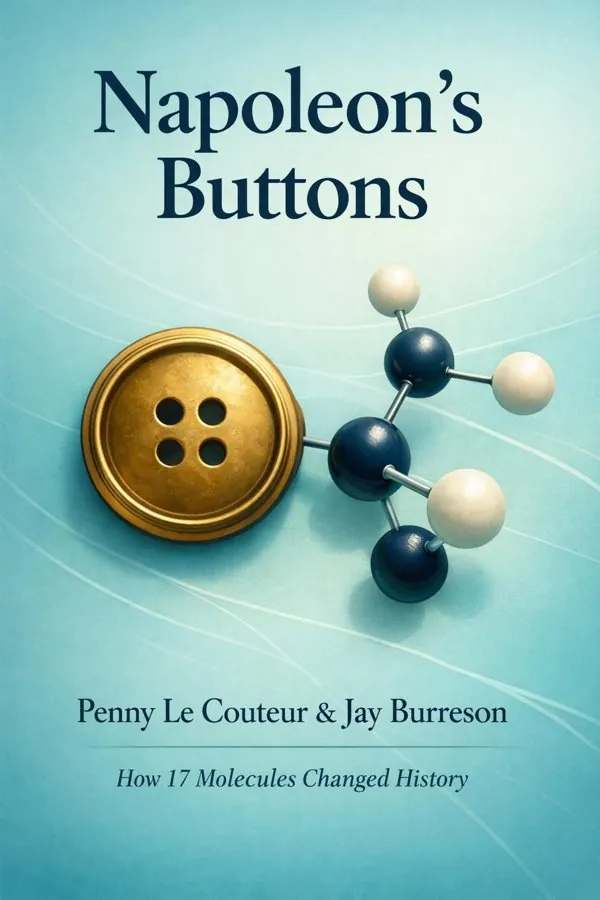
Napoleon’s Buttons: How 17 Molecules Changed History: Summary & Key Insights
by Penny Le Couteur, Jay Burreson
 10 min9 chaptersAudio available
Key Takeaways from Napoleon’s Buttons: How 17 Molecules Changed History
A craving for flavor helped redraw the map of the world.
Luxury is never just cultural; it is often molecular.
Sometimes history turns not on military brilliance but on a missing molecule.
A sweet molecule helped build a brutal world.
Civilization depends as much on structural molecules as on dramatic discoveries.
What Is Napoleon’s Buttons: How 17 Molecules Changed History About?
Napoleon’s Buttons: How 17 Molecules Changed History by Penny Le Couteur, Jay Burreson is a popular_sci book spanning 13 pages. History is usually told through emperors, wars, inventions, and revolutions. Napoleon’s Buttons asks us to look deeper—down to the molecular level. In this lively and accessible work, Penny Le Couteur and Jay Burreson show how chemistry has quietly directed the course of civilization. From the fragrant compounds in spices that launched global exploration to the proteins in silk that fueled ancient trade routes, from explosives that transformed warfare to antibiotics that redefined survival, the book reveals that small molecules often stand behind enormous historical change. What makes this book matter is its unusual perspective. It does not treat chemistry as an isolated academic subject, but as a force woven into economics, politics, medicine, fashion, empire, and everyday life. The authors connect molecular structure to human consequences in a way that makes both history and science feel immediate. Le Couteur, a chemist and gifted educator, and Burreson, a research chemist, bring scientific credibility along with a clear talent for storytelling. Their great achievement is making readers see that behind every major turning point may lie a molecule with the power to reshape the world.
This FizzRead summary covers all 9 key chapters of Napoleon’s Buttons: How 17 Molecules Changed History in approximately 10 minutes, distilling the most important ideas, arguments, and takeaways from Penny Le Couteur, Jay Burreson's work. Also available as an audio summary and Key Quotes Podcast.
Napoleon’s Buttons: How 17 Molecules Changed History
History is usually told through emperors, wars, inventions, and revolutions. Napoleon’s Buttons asks us to look deeper—down to the molecular level. In this lively and accessible work, Penny Le Couteur and Jay Burreson show how chemistry has quietly directed the course of civilization. From the fragrant compounds in spices that launched global exploration to the proteins in silk that fueled ancient trade routes, from explosives that transformed warfare to antibiotics that redefined survival, the book reveals that small molecules often stand behind enormous historical change.
What makes this book matter is its unusual perspective. It does not treat chemistry as an isolated academic subject, but as a force woven into economics, politics, medicine, fashion, empire, and everyday life. The authors connect molecular structure to human consequences in a way that makes both history and science feel immediate.
Le Couteur, a chemist and gifted educator, and Burreson, a research chemist, bring scientific credibility along with a clear talent for storytelling. Their great achievement is making readers see that behind every major turning point may lie a molecule with the power to reshape the world.
Who Should Read Napoleon’s Buttons: How 17 Molecules Changed History?
This book is perfect for anyone interested in popular_sci and looking to gain actionable insights in a short read. Whether you're a student, professional, or lifelong learner, the key ideas from Napoleon’s Buttons: How 17 Molecules Changed History by Penny Le Couteur, Jay Burreson will help you think differently.
- ✓Readers who enjoy popular_sci and want practical takeaways
- ✓Professionals looking to apply new ideas to their work and life
- ✓Anyone who wants the core insights of Napoleon’s Buttons: How 17 Molecules Changed History in just 10 minutes
Want the full summary?
Get instant access to this book summary and 100K+ more with Fizz Moment.
Get Free SummaryAvailable on App Store • Free to download
Key Chapters
A craving for flavor helped redraw the map of the world. One of the book’s most memorable insights is that molecules responsible for smell and taste—such as eugenol in cloves and cinnamaldehyde in cinnamon—were once powerful enough to motivate dangerous sea voyages, imperial competition, and economic transformation. What seems like a kitchen detail today was once a geopolitical obsession.
The authors explain that these spice molecules had unusual value because they were scarce, portable, and deeply desired. Their chemical structures produced aromas that made food more appealing, but spices also carried reputations for preserving meat, masking spoilage, and even offering medicinal benefits. Because Europe could not grow many of these plants, control of the spice trade became a strategic objective. This demand encouraged exploration, maritime innovation, and violent colonial expansion into Asia and the East Indies.
The practical lesson is easy to see: chemistry shapes markets whenever a molecule offers a combination of rarity and usefulness. We still see this today in pharmaceutical patents, lithium for batteries, and semiconductors for electronics. A small material advantage can create global competition.
By linking molecular structure to appetite, trade, and conquest, the book shows how chemistry can become destiny. The next time you smell cinnamon or cloves, remember that these pleasant compounds once helped launch fleets and fortunes.
Actionable takeaway: when studying any major historical trend, ask what physical material or chemical property made it economically irresistible.
Luxury is never just cultural; it is often molecular. Silk’s beauty and prestige arise from the unique properties of fibroin and sericin, proteins produced by silkworms. Le Couteur and Burreson use silk to demonstrate how a material’s microscopic structure can create enormous social and political consequences.
Fibroin gives silk its strength, smoothness, and shimmering appearance. Its long, orderly protein chains create a fiber that is both light and durable. Sericin acts like a natural glue, helping bind the fibers together. These chemical properties made silk unlike anything else available in the ancient world. As a result, silk became more than cloth: it became currency, tribute, status symbol, and strategic commodity.
This molecular advantage helped establish trade networks across Eurasia, most famously the Silk Road. Silk was valuable enough to move not only goods but also religions, technologies, languages, and diseases across continents. China’s efforts to protect sericulture show how often knowledge of materials becomes a source of political power. Industrial secrets are not a modern phenomenon.
The modern parallel is obvious in high-performance textiles, carbon fiber, and advanced biomaterials. Nations and firms still guard manufacturing techniques because materials with special molecular properties command high value.
Silk’s story reminds us that what people call “luxury” often begins as chemistry meeting craftsmanship. A fabric changed diplomacy because proteins happened to align in a remarkable way.
Actionable takeaway: pay attention to the materials behind prestige industries; their underlying chemistry often explains both their value and their strategic importance.
Sometimes history turns not on military brilliance but on a missing molecule. The chapter on ascorbic acid, better known as vitamin C, shows how the absence of one essential compound caused suffering on a vast scale. Scurvy weakened and killed sailors for centuries, limiting long-distance voyages and threatening naval power.
The chemistry matters because humans cannot synthesize vitamin C on their own. Without it, the body cannot properly produce collagen, a crucial structural protein in connective tissue. The result is bleeding gums, weakness, poor wound healing, and eventual death. Before this biochemical fact was understood, scurvy seemed mysterious and unstoppable. Ships could carry weapons, maps, and discipline, yet still fail because fresh fruits and vegetables were missing.
The practical impact was enormous. Naval expeditions, colonial enterprises, and commercial voyages depended on keeping crews healthy. Once citrus and other antiscorbutic foods became standard, nations could sustain longer journeys with fewer casualties. This gave strategic advantage to fleets that applied nutritional knowledge effectively.
The broader lesson is that public health often determines military and economic success more than people realize. Today, micronutrient deficiencies, sanitation failures, and preventable disease still shape productivity and resilience worldwide. Science changes history not only through dramatic inventions but also through basic understanding of human biology.
Scurvy’s defeat was a triumph of observation, chemistry, and disciplined application. A simple dietary intervention achieved what courage alone could not.
Actionable takeaway: never underestimate foundational health needs; in organizations and in life, performance collapses when basic biological requirements are ignored.
A sweet molecule helped build a brutal world. The book uses glucose, sucrose, and related carbohydrates to show that chemistry can sit at the center of both pleasure and exploitation. Sugar was not just a food; it was an energy source, a trade engine, and a driver of massive social systems, including plantation slavery.
Chemically, carbohydrates store accessible energy. That property made sugar immediately attractive to human taste and metabolism. As sugar cultivation expanded in the Caribbean and the Americas, European demand skyrocketed. Sweetness shifted from luxury to everyday habit, transforming diets, commerce, and labor systems. The molecular appeal of sugar translated into extraordinary profits, which in turn fueled colonial expansion and industrial capital.
The authors show how this story reaches beyond the table. Sugar linked agriculture, shipping, finance, and human coercion in one integrated system. A craving for sweetness helped sustain transatlantic slavery and the violent plantation economy. This is one of the book’s strongest themes: molecules are not morally neutral in their effects, because their uses become embedded in human institutions.
Today, carbohydrates remain central to global agriculture, food science, and health debates. We still wrestle with the consequences of producing cheap, energy-dense food at massive scale. From diabetes concerns to processed food economics, the history of sugar continues.
The chapter encourages a more honest way of thinking about everyday consumption. Common products often carry hidden chemical, social, and historical stories.
Actionable takeaway: examine the supply chains behind ordinary pleasures; understanding the chemistry is important, but understanding the human cost is essential.
Civilization depends as much on structural molecules as on dramatic discoveries. Cellulose, the main component of plant cell walls, may seem humble compared with explosives or medicines, yet it has shaped economies, communication, and daily life through materials such as cotton, paper, and early industrial fibers.
Its significance comes from molecular architecture. Cellulose is made of long chains of glucose units arranged in a way that gives plants rigidity and strength. Humans learned to process this abundant polymer into useful forms, especially cotton textiles and paper. Cotton transformed clothing and trade, while paper revolutionized administration, education, literature, and religion by making written communication more portable and scalable.
The chapter also points to darker implications. Cotton was central to industrial development and deeply tied to slavery, colonial agriculture, and mechanized production. Again, a molecule’s usefulness can amplify both prosperity and injustice. The same cellulose that makes soft fabric and durable paper also underpinned major labor systems and political conflicts.
Modern applications continue this legacy. Cellulose remains important in textiles, packaging, filtration, food additives, and efforts to create sustainable materials. In an age worried about plastic waste, renewable plant-based polymers have regained urgency.
This chapter broadens our sense of what counts as a world-changing substance. Not every transformative molecule explodes or cures disease. Some quietly become the infrastructure of ordinary life.
Actionable takeaway: look beyond flashy innovation and notice the foundational materials that support communication, clothing, and commerce; they often have the deepest historical influence.
Some of the most consequential chemicals are born where war and industry intersect. The book’s discussions of nitro compounds, phenol, and synthetic dyes reveal how efforts to make stronger explosives and brighter colors helped create modern industrial chemistry itself. This is a powerful reminder that scientific progress often emerges from unexpected and morally mixed motivations.
Nitro compounds store large amounts of chemical energy. That made them useful in explosives such as nitroglycerin and TNT, which transformed mining, engineering, and warfare. Mountains could be tunneled, railways extended, and battlefields made deadlier. Chemistry increased both constructive and destructive power.
Meanwhile, work on aromatic compounds and coal-tar derivatives led to breakthroughs in synthetic dyes. Before these discoveries, vivid colors often depended on expensive natural sources. Synthetic dyes made color cheaper, more consistent, and more widely available, changing fashion, manufacturing, and consumer culture. But the same chemical knowledge also fed pharmaceutical innovation and munitions production. Industrial chemistry did not develop in neat categories.
The practical lesson is that technological ecosystems are interconnected. Advances in one domain spill into others: military chemistry influences medicine, textile chemistry influences materials science, and waste products become new industries. Innovation rarely follows a single track.
This chapter helps readers see factories, laboratories, and battlefields as part of one historical network shaped by molecular behavior. It also invites reflection on the ethical ambiguity of discovery.
Actionable takeaway: when evaluating a new technology, consider its second- and third-order effects; chemical breakthroughs often reshape far more than their original intended use.
Progress is often measured by survival and suffering. In chapters on chlorine, morphine, and aspirin, the authors show how chemistry transformed daily life not only by enabling industries but by reducing disease and pain. These molecules changed what it meant to live in a city, survive surgery, or recover from illness.
Chlorine’s disinfecting power was revolutionary because it attacked pathogens in water supplies and public sanitation systems. Urbanization had made clean water a life-and-death issue. Once disinfection became reliable, cities could grow with less fear of cholera, typhoid, and other waterborne disease. This was chemistry operating as public infrastructure.
Morphine, derived from opium, revealed another side of molecular influence: the capacity to separate healing from agony. Its alkaloid structure made it an effective painkiller, especially important in surgery and battlefield medicine. Yet the same power carried risks of dependence and abuse. Aspirin likewise exemplified the transition from traditional remedies to more precise pharmaceuticals. It offered fever reduction, pain relief, and anti-inflammatory benefits in a stable, mass-producible form.
Together these examples show chemistry improving quality of life while also demanding responsible use. Medicine is never just efficacy; it is dosage, access, ethics, and education.
Today’s debates over opioids, vaccination, water systems, and over-the-counter drugs echo these earlier transformations. Molecular interventions remain among society’s most powerful tools.
Actionable takeaway: support evidence-based public health and informed medicine use; the greatest benefits of chemistry appear when individual treatment and collective systems work together.
Modern life feels natural only because we forget how artificial it is. The chapters on polymers, plastics, and silicon make clear that the contemporary world—from packaging to smartphones—rests on deliberate manipulation of molecular structure. Few readers finish these sections without seeing ordinary objects differently.
Synthetic polymers changed manufacturing because long-chain molecules could be engineered for flexibility, durability, insulation, transparency, or heat resistance. Plastics replaced scarcer or heavier materials and enabled cheap mass production. Their versatility transformed consumer goods, transportation, medicine, and household life. But the very stability that made plastics useful also created environmental persistence, turning a triumph of materials science into a long-term ecological challenge.
Silicon tells a parallel story of molecular utility becoming civilizational infrastructure. In purified and carefully structured form, silicon became the basis of semiconductors, allowing the control of electrical signals at astonishing scale. That made possible transistors, integrated circuits, computers, and the digital revolution. Here again, chemistry underlies what people often treat as purely technological or electronic progress.
The key insight is that modernity is a materials story. Information technology, convenience culture, and global communication all depend on atomic-level properties discovered, refined, and industrialized through chemistry.
This chapter also carries a practical warning. Every breakthrough material solves one problem while introducing another—waste, resource extraction, surveillance, energy demand, or inequality.
Actionable takeaway: become more chemically literate about the materials you rely on; understanding what things are made of leads to better choices about use, disposal, and innovation.
A chance event can change history, but only if someone understands what they are seeing. The book’s treatment of penicillin and antibiotics captures one of science’s most important truths: discovery is often a partnership between accident and interpretation. Mold growing in a dish did not save millions of lives by itself. Insight, persistence, and chemical development did.
Penicillin’s significance lies in its ability to interfere with bacterial cell-wall synthesis, making it selectively lethal to many harmful bacteria. Before antibiotics, infections that are now routine to treat could become fatal. Childbirth, surgery, battlefield injuries, and minor cuts all carried serious danger. Antibiotics altered medicine by turning bacterial infection from a constant threat into a manageable problem.
The historical implications are immense. War survival improved, hospital care advanced, life expectancy increased, and modern medical procedures became far more feasible. Yet the chapter also points toward a sobering modern lesson: every chemical victory can be temporary if overused. Bacteria evolve, and antibiotic resistance reminds us that molecular history is ongoing.
The broader practical application extends beyond medicine. Organizations often celebrate breakthroughs without appreciating the systems needed to scale them: purification, manufacturing, testing, and distribution. Penicillin succeeded because chemistry moved from observation to reproducible production.
This story is inspiring precisely because it is not magical. It shows how careful minds turn unexpected events into world-changing tools.
Actionable takeaway: cultivate curiosity and follow-through; breakthroughs often begin as anomalies that only disciplined attention can transform into lasting value.
All Chapters in Napoleon’s Buttons: How 17 Molecules Changed History
About the Authors
Penny Le Couteur is a Canadian chemist, educator, and science communicator known for making chemistry approachable for non-specialist readers. She has taught chemistry extensively and developed a reputation for connecting scientific principles to everyday life and historical events. Jay Burreson is a research chemist and writer with a strong interest in the broader cultural impact of science. Together, they combine technical expertise with narrative skill, showing how molecules shape trade, medicine, warfare, technology, and society. Their collaboration on Napoleon’s Buttons reflects a shared talent for translating complex chemical ideas into engaging stories. The result is a book that appeals to both curious general readers and students looking for a fresh, human-centered way to understand chemistry.
Get This Summary in Your Preferred Format
Read or listen to the Napoleon’s Buttons: How 17 Molecules Changed History summary by Penny Le Couteur, Jay Burreson anytime, anywhere. FizzRead offers multiple formats so you can learn on your terms — all free.
Available formats: App · Audio · PDF · EPUB — All included free with FizzRead
Download Napoleon’s Buttons: How 17 Molecules Changed History PDF and EPUB Summary
Key Quotes from Napoleon’s Buttons: How 17 Molecules Changed History
“A craving for flavor helped redraw the map of the world.”
“Luxury is never just cultural; it is often molecular.”
“Sometimes history turns not on military brilliance but on a missing molecule.”
“A sweet molecule helped build a brutal world.”
“Civilization depends as much on structural molecules as on dramatic discoveries.”
Frequently Asked Questions about Napoleon’s Buttons: How 17 Molecules Changed History
Napoleon’s Buttons: How 17 Molecules Changed History by Penny Le Couteur, Jay Burreson is a popular_sci book that explores key ideas across 9 chapters. History is usually told through emperors, wars, inventions, and revolutions. Napoleon’s Buttons asks us to look deeper—down to the molecular level. In this lively and accessible work, Penny Le Couteur and Jay Burreson show how chemistry has quietly directed the course of civilization. From the fragrant compounds in spices that launched global exploration to the proteins in silk that fueled ancient trade routes, from explosives that transformed warfare to antibiotics that redefined survival, the book reveals that small molecules often stand behind enormous historical change. What makes this book matter is its unusual perspective. It does not treat chemistry as an isolated academic subject, but as a force woven into economics, politics, medicine, fashion, empire, and everyday life. The authors connect molecular structure to human consequences in a way that makes both history and science feel immediate. Le Couteur, a chemist and gifted educator, and Burreson, a research chemist, bring scientific credibility along with a clear talent for storytelling. Their great achievement is making readers see that behind every major turning point may lie a molecule with the power to reshape the world.
You Might Also Like

Structures: Or Why Things Don"t Fall Down
J.E. Gordon
10 min
The Road to Wigan Pier
George Orwell
10 min
Bonk: The Curious Coupling of Science and Sex
Mary Roach
10 min
First Bite: How We Learn to Eat
Bee Wilson
10 min
In Pursuit Of The Unknown: 17 Equations That Changed The World
Ian Stewart
10 min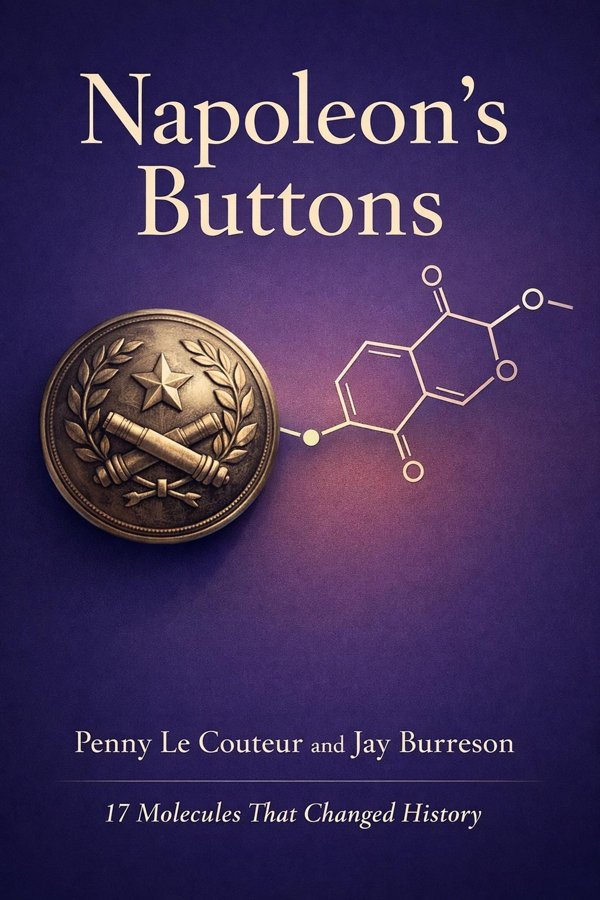
Napoleon's Buttons: 17 Molecules That Changed History
Penny Le Couteur and Jay Burreson
10 minBrowse by Category
Ready to read Napoleon’s Buttons: How 17 Molecules Changed History?
Get the full summary and 100K+ more books with Fizz Moment.