
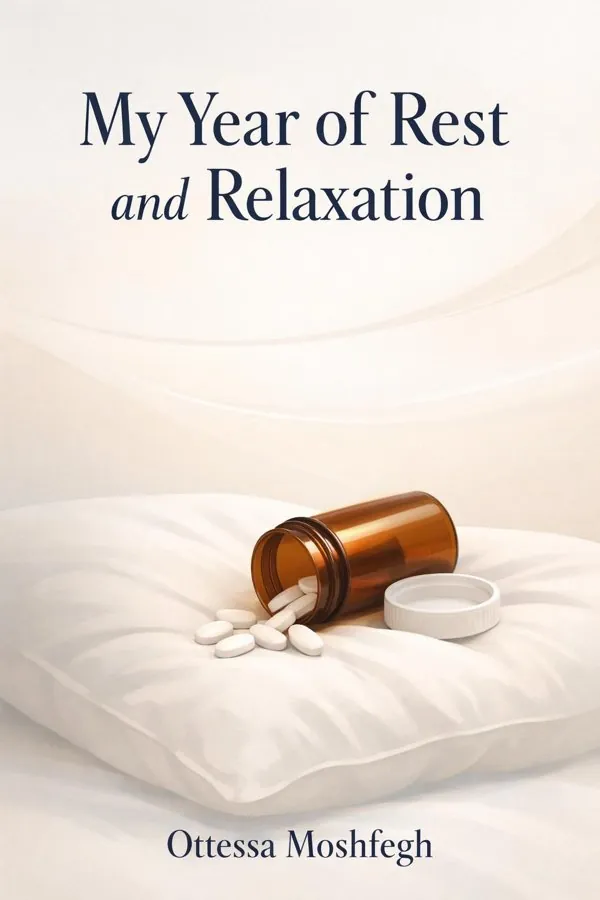
My Year of Rest and Relaxation: Summary & Key Insights
 10 min9 chaptersAudio available
Key Takeaways from My Year of Rest and Relaxation
One of the novel’s most disturbing insights is that comfort does not protect a person from spiritual vacancy.
The narrator does not want rest in any healthy sense; she wants erasure.
Authority becomes frightening when it is both incompetent and socially sanctioned.
Sometimes the people who irritate us most are the ones who expose what we refuse to see in ourselves.
A self cut off from others does not become pure; it becomes unstable.
What Is My Year of Rest and Relaxation About?
My Year of Rest and Relaxation by Ottessa Moshfegh is a bestsellers book spanning 5 pages. What if the most radical response to a hollow life was not self-improvement, ambition, or reinvention, but disappearance? Ottessa Moshfegh’s My Year of Rest and Relaxation takes that unsettling premise and turns it into a darkly funny, emotionally disorienting novel about a young woman who decides to sleep through nearly an entire year of her life. Set in New York City in 2000 and 2001, the story follows an unnamed, conventionally beautiful, financially secure Columbia graduate who has every visible marker of success and yet feels almost nothing. With the help of reckless medication, an absurdly negligent psychiatrist, and a growing detachment from reality, she attempts to withdraw from the world completely. What makes the novel so compelling is that it is never just about sleep. It is about grief without language, privilege without purpose, beauty without identity, and a culture that mistakes performance for meaning. Moshfegh is one of contemporary fiction’s most distinctive voices, known for her psychological precision, abrasive humor, and fearless interest in unattractive inner lives. In this novel, she creates a protagonist who is difficult, unforgettable, and disturbingly recognizable—a woman whose refusal to participate becomes its own form of critique.
This FizzRead summary covers all 9 key chapters of My Year of Rest and Relaxation in approximately 10 minutes, distilling the most important ideas, arguments, and takeaways from Ottessa Moshfegh's work. Also available as an audio summary and Key Quotes Podcast.
My Year of Rest and Relaxation
What if the most radical response to a hollow life was not self-improvement, ambition, or reinvention, but disappearance? Ottessa Moshfegh’s My Year of Rest and Relaxation takes that unsettling premise and turns it into a darkly funny, emotionally disorienting novel about a young woman who decides to sleep through nearly an entire year of her life. Set in New York City in 2000 and 2001, the story follows an unnamed, conventionally beautiful, financially secure Columbia graduate who has every visible marker of success and yet feels almost nothing. With the help of reckless medication, an absurdly negligent psychiatrist, and a growing detachment from reality, she attempts to withdraw from the world completely.
What makes the novel so compelling is that it is never just about sleep. It is about grief without language, privilege without purpose, beauty without identity, and a culture that mistakes performance for meaning. Moshfegh is one of contemporary fiction’s most distinctive voices, known for her psychological precision, abrasive humor, and fearless interest in unattractive inner lives. In this novel, she creates a protagonist who is difficult, unforgettable, and disturbingly recognizable—a woman whose refusal to participate becomes its own form of critique.
Who Should Read My Year of Rest and Relaxation?
This book is perfect for anyone interested in bestsellers and looking to gain actionable insights in a short read. Whether you're a student, professional, or lifelong learner, the key ideas from My Year of Rest and Relaxation by Ottessa Moshfegh will help you think differently.
- ✓Readers who enjoy bestsellers and want practical takeaways
- ✓Professionals looking to apply new ideas to their work and life
- ✓Anyone who wants the core insights of My Year of Rest and Relaxation in just 10 minutes
Want the full summary?
Get instant access to this book summary and 100K+ more with Fizz Moment.
Get Free SummaryAvailable on App Store • Free to download
Key Chapters
One of the novel’s most disturbing insights is that comfort does not protect a person from spiritual vacancy. The unnamed narrator begins the story in a position many people are taught to envy: she is young, beautiful, educated, thin, and financially insulated by inheritance. She lives alone in a desirable Manhattan apartment and has enough money to drift. Yet instead of fulfillment, she experiences a deadened, almost anesthetized existence. Her possessions, her routines, and even her own body feel emotionally remote. Moshfegh uses this contradiction to challenge a common cultural fantasy—that the right circumstances naturally produce happiness.
The narrator’s emptiness is not framed as simple boredom. It is tied to unresolved grief, profound alienation, and a sense that the social world around her is fake, repetitive, and spiritually bankrupt. Her job at a trendy gallery only sharpens this feeling. Everything is curated, performative, and marketable, including people. In such an environment, privilege becomes less a source of meaning than a buffer that allows her collapse to unfold in private.
This idea extends beyond the novel. Many people assume dissatisfaction must come from obvious deprivation, but emotional numbness can also emerge when a life is externally successful and internally unexamined. A person can be surrounded by options and still feel absent from themselves. The narrator exaggerates this truth to a shocking degree, but the emotional pattern is recognizable: when identity is built on appearance, status, or convenience, it can feel strangely unreal.
Actionable takeaway: Notice where you may be confusing comfort with meaning. Ask yourself not only whether your life looks successful, but whether it feels inhabited.
The narrator does not want rest in any healthy sense; she wants erasure. Her decision to spend a year sleeping through life is the novel’s central conceit, but it also functions as a profound metaphor. Sleep becomes her answer to consciousness itself—to memory, obligation, grief, social performance, and selfhood. Rather than change her life directly, she attempts to bypass it. Moshfegh presents this with deadpan humor, but beneath the comedy lies a serious question: what happens when a person no longer believes being awake is worth the effort?
The sleeping project is irrational, but it is also strangely logical within the narrator’s worldview. She imagines hibernation as a reset button, a way to emerge purified and renewed without having to endure the messy labor of healing. This fantasy is familiar in milder forms. People binge entertainment, overwork, overdrink, doom-scroll, or oversleep in order to mute consciousness. The difference is that the narrator turns ordinary avoidance into an extreme lifestyle experiment.
The novel refuses to romanticize withdrawal. As her sedation deepens, control deteriorates. She loses track of time, behavior, and even what she does while medicated. Instead of becoming more whole, she risks dissolving. In this way, Moshfegh exposes the seduction and danger of wanting transformation without participation. True rest can restore, but escapist rest can become self-annihilation.
For readers, this idea is useful because it invites a distinction between restoration and avoidance. Taking a break, sleeping more, or stepping back can be healthy. But when rest becomes a fantasy of not existing, it signals that something deeper needs attention.
Actionable takeaway: When you crave escape, ask whether you need renewal, boundaries, or real emotional care—not disappearance.
Authority becomes frightening when it is both incompetent and socially sanctioned. Dr. Tuttle, the narrator’s psychiatrist, is one of the novel’s most grotesquely comic creations: careless, distracted, wildly unprofessional, and absurdly generous with prescriptions. Her office is chaotic, her listening skills nearly nonexistent, and her judgments often ridiculous. Yet she holds institutional power, and that is what makes her more than a joke. Through Dr. Tuttle, Moshfegh satirizes a system in which medical legitimacy can coexist with negligence, vanity, and convenience.
The narrator seeks Dr. Tuttle not because she wants insight, but because she wants chemical permission to detach from life. Dr. Tuttle obliges. Instead of asking hard questions about grief, depression, dependency, or risk, she offers a pharmaceutical cascade. This relationship is transactional at its worst: one person wants oblivion, the other provides it under the banner of treatment. The result is both funny and deeply disturbing.
The broader point is not that psychiatry itself is useless, but that any helping profession can fail when it replaces care with shortcuts. People are vulnerable when in pain, and bad guidance—whether from a therapist, doctor, coach, or online guru—can intensify harm while sounding authoritative. The novel’s exaggeration highlights a real modern anxiety: systems designed to help us can become mechanical, inattentive, or driven by convenience.
In everyday life, this idea encourages discernment. Expertise matters, but credentials alone are not enough. Good care requires attentiveness, ethics, and responsiveness to the actual person in front of the professional. The narrator never receives that.
Actionable takeaway: Treat authority with respect, not surrender. If support feels careless, rushed, or dehumanizing, seek a second opinion and advocate for real care.
Sometimes the people who irritate us most are the ones who expose what we refuse to see in ourselves. Reva, the narrator’s only real friend, is needy, insecure, status-conscious, and often exhausting. The narrator judges her relentlessly, mocking her hunger for approval, her emotional dependence, and her obsession with men, beauty, and success. Yet Reva also serves as a mirror. She embodies a more visible, desperate version of the same culture the narrator claims to reject.
What makes Reva such an effective character is that she is both pathetic and poignant. She wants to be loved, admired, and chosen. She tries to manage herself into worthiness through cosmetics, effort, and social aspiration. Unlike the narrator, who has the privilege to withdraw, Reva continues performing need in public. Her vulnerability is embarrassing, but it is also human. The narrator’s cruelty toward her often reveals less about Reva’s flaws than about the narrator’s own emotional incapacity.
Their relationship shows how friendships can be built on imbalance, projection, and unconscious competition. One person uses the other as evidence of superiority; the other clings to the relationship because any connection feels better than abandonment. This dynamic appears far beyond the novel. Many people maintain relationships that are not openly loving but still psychologically useful, because they reinforce identity, provide comparison, or prevent loneliness.
Reva also complicates the novel’s moral landscape. She is not merely a foil but a person shaped by the same superficial world, only without the narrator’s insulation. Her striving may be sad, but it is also a survival strategy.
Actionable takeaway: Pay attention to the traits in others that trigger contempt. They may reveal insecurities, fears, or dependencies you have not fully acknowledged in yourself.
A self cut off from others does not become pure; it becomes unstable. As the narrator retreats into drugged isolation, time loses coherence and memory becomes unreliable. Days vanish. Episodes blur. She wakes to evidence of actions she does not remember, encounters fragments of a life she seems to have inhabited unconsciously, and begins to experience her own existence as discontinuous. Moshfegh turns isolation into a psychological experiment, showing that without relational feedback, habit, and sustained awareness, identity itself starts to fray.
This matters because the narrator initially imagines solitude as clarifying. She believes that by removing the demands of work, friendship, grooming, conversation, and public life, she can strip herself down to something authentic. But what she finds instead is not essence but absence. The self is not just an inner core waiting to be uncovered; it is also something maintained through memory, embodiment, routine, and interaction. When those supports disappear, continuity weakens.
The novel captures a truth many readers recognize in smaller forms. Extended withdrawal—whether through depression, burnout, addiction, or technological cocooning—can create a sensation of drifting out of one’s own life. People may lose track of days, neglect their bodies, feel detached from consequences, or struggle to reconnect with a coherent sense of purpose. Moshfegh amplifies this phenomenon until it becomes eerie and nearly surreal.
Yet the point is not that solitude is bad. Solitude can be restorative and necessary. The danger arises when isolation becomes the primary strategy for avoiding pain. Then it stops being reflective and becomes corrosive.
Actionable takeaway: If time is blurring and your life feels unreal, rebuild continuity with simple anchors—regular sleep, movement, human contact, and small acts of presence.
The world of the novel is filled with products, aesthetics, trends, and rituals of acquisition, but none of them can answer the narrator’s deeper emptiness. Manhattan in the novel is not just a backdrop; it is a machine of surfaces. Galleries, boutiques, luxury apartments, cosmetics, entertainment, and fashionable irony create an atmosphere in which identity can always be styled, purchased, or performed. Yet all this abundance feels curiously dead. Moshfegh suggests that a culture saturated with consumption may offer endless stimulation while starving the soul.
The narrator’s apartment, clothes, routines, and medications all become part of this critique. Even her attempt at total withdrawal is facilitated by commodities and systems of convenience. She is able to vanish because she has resources. The irony is sharp: she tries to reject the emptiness of modern life using the tools provided by that very emptiness. Her hibernation is not outside consumer culture but partly built by it.
This is one reason the novel continues to resonate. Many people live in environments where discomfort is quickly translated into a purchase, a treatment, a hack, a brand identity, or a new routine. While these things can be useful, they often promise more than they can deliver. Inner hunger cannot be fully solved by better curation. Meaning requires relationship, truthfulness, mourning, and some willingness to remain awake inside one’s own life.
The book does not offer a clean antidote, but it does expose the problem clearly. It reminds readers that endless options are not the same as nourishment.
Actionable takeaway: Before trying to buy, optimize, or aestheticize your way out of dissatisfaction, pause and ask what emotional or existential need is actually asking to be heard.
What looks like laziness or cynicism is often unprocessed sorrow in disguise. Beneath the narrator’s cruelty, boredom, and self-erasure lies grief—particularly over the deaths of her parents and the emotionally barren family life that preceded those losses. She rarely approaches this pain directly. Instead, she filters it through contempt, detachment, and sedation. Moshfegh’s achievement is to show how grief does not always appear as visible sadness. Sometimes it arrives as emotional flatness, hostility, indifference, or the wish to stop feeling anything at all.
The narrator’s parents were not sources of secure love, and that matters. Her grief is complicated by resentment, neglect, and emotional confusion. She has not simply lost people she adored; she has lost the possibility that they might one day become what she needed. That kind of grief can be especially difficult to name. It leaves people mourning not just the dead, but the unlived version of their own lives.
This helps explain why her hibernation fantasy carries such emotional force. Sleep promises relief from a mourning process she cannot articulate. If she cannot integrate the past, perhaps she can suspend herself until it loses power. But buried grief does not disappear just because consciousness fades. It remains in the body, in memory gaps, in disgust, and in the inability to attach.
Readers may recognize aspects of this pattern in themselves or others. Not all grief announces itself dramatically. Sometimes it appears as withdrawal, numbness, sarcasm, or chronic disengagement. Naming grief can be the beginning of movement.
Actionable takeaway: If your emotional life feels flat or unreachable, consider whether there is a loss—recent or old—that you have survived without truly mourning.
The novel’s ending reframes everything that came before by placing the narrator’s private withdrawal against a collective catastrophe. As the story moves toward September 11, 2001, the narrator’s year of self-imposed sleep collides with an event that shattered illusions of distance, irony, and invulnerability for many Americans, especially in New York. The contrast is deliberate and powerful: one woman tries to disappear from history, and history enters anyway.
This final turn does not magically redeem the narrator, nor does it reduce the novel to a lesson about tragedy. Instead, it changes the scale of the story. Her personal alienation, once so totalizing, is suddenly set within a broader human reality of mortality, vulnerability, and witness. The ending suggests that awakening is not always chosen. Sometimes reality breaks through the walls we build around ourselves.
Moshfegh handles this transition in a way that remains unsettling rather than sentimental. The narrator does not become conventionally healed. But she does seem to experience a shift in perception. The world is no longer merely a stage for disgust or avoidance. It becomes a place where other lives matter irreducibly, where disappearance has consequences, and where seeing can no longer be endlessly deferred.
For readers, this idea speaks to how private despair can be interrupted by events that restore perspective, however painfully. Personal numbness can make the self feel like the whole universe, but collective reality reminds us that we are bound to others in ways withdrawal cannot erase.
Actionable takeaway: Remember that perspective often returns through connection to realities larger than your own distress—community, history, service, or shared vulnerability.
All Chapters in My Year of Rest and Relaxation
About the Author
Ottessa Moshfegh is an American novelist and short story writer celebrated for her dark wit, psychological intensity, and singular narrative voice. Born in Boston, Massachusetts, she studied at Barnard College and later earned an MFA from Brown University. Her fiction often focuses on alienated, abrasive, or socially uncomfortable characters, exploring the uneasy spaces between desire, disgust, loneliness, and self-invention. She gained wide recognition with Eileen, which was shortlisted for the Man Booker Prize, and has since published several acclaimed works, including My Year of Rest and Relaxation, Death in Her Hands, Lapvona, and the story collection Homesick for Another World. Moshfegh is widely regarded as one of the most original voices in contemporary literary fiction, known for writing fearless, unsettling, and deeply perceptive prose.
Get This Summary in Your Preferred Format
Read or listen to the My Year of Rest and Relaxation summary by Ottessa Moshfegh anytime, anywhere. FizzRead offers multiple formats so you can learn on your terms — all free.
Available formats: App · Audio · PDF · EPUB — All included free with FizzRead
Download My Year of Rest and Relaxation PDF and EPUB Summary
Key Quotes from My Year of Rest and Relaxation
“One of the novel’s most disturbing insights is that comfort does not protect a person from spiritual vacancy.”
“The narrator does not want rest in any healthy sense; she wants erasure.”
“Authority becomes frightening when it is both incompetent and socially sanctioned.”
“Sometimes the people who irritate us most are the ones who expose what we refuse to see in ourselves.”
“A self cut off from others does not become pure; it becomes unstable.”
Frequently Asked Questions about My Year of Rest and Relaxation
My Year of Rest and Relaxation by Ottessa Moshfegh is a bestsellers book that explores key ideas across 9 chapters. What if the most radical response to a hollow life was not self-improvement, ambition, or reinvention, but disappearance? Ottessa Moshfegh’s My Year of Rest and Relaxation takes that unsettling premise and turns it into a darkly funny, emotionally disorienting novel about a young woman who decides to sleep through nearly an entire year of her life. Set in New York City in 2000 and 2001, the story follows an unnamed, conventionally beautiful, financially secure Columbia graduate who has every visible marker of success and yet feels almost nothing. With the help of reckless medication, an absurdly negligent psychiatrist, and a growing detachment from reality, she attempts to withdraw from the world completely. What makes the novel so compelling is that it is never just about sleep. It is about grief without language, privilege without purpose, beauty without identity, and a culture that mistakes performance for meaning. Moshfegh is one of contemporary fiction’s most distinctive voices, known for her psychological precision, abrasive humor, and fearless interest in unattractive inner lives. In this novel, she creates a protagonist who is difficult, unforgettable, and disturbingly recognizable—a woman whose refusal to participate becomes its own form of critique.
More by Ottessa Moshfegh

You Might Also Like
The Godfather
Mario Puzo
10 min
The Handmaid's Tale
Margaret Atwood
10 min
The Hunger Games
Suzanne Collins
10 min
The Nightingale
Kristin Hannah
10 min
The Seven Husbands of Evelyn Hugo
Taylor Jenkins Reid
10 min
Backwater Justice
Fern Michaels
10 minBrowse by Category
Ready to read My Year of Rest and Relaxation?
Get the full summary and 100K+ more books with Fizz Moment.