
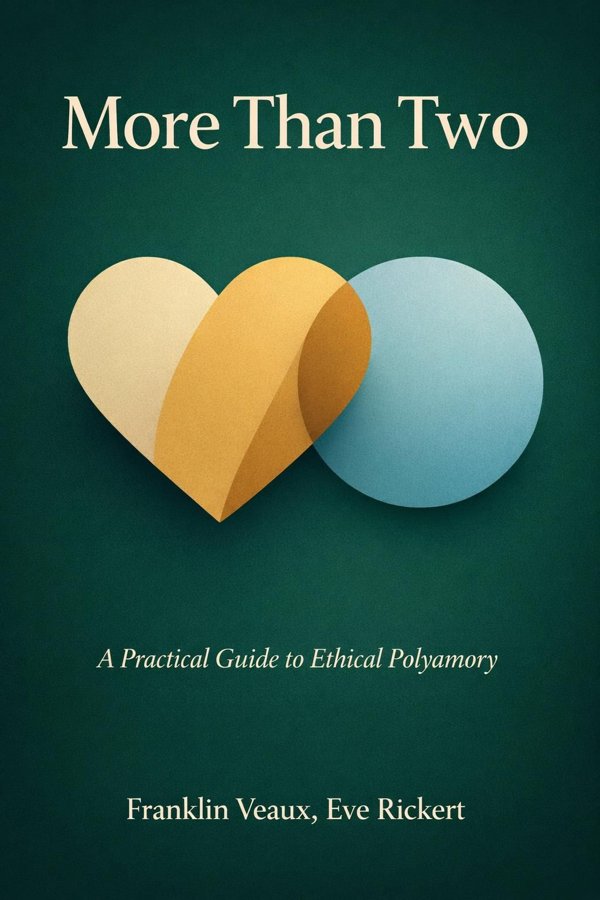
More Than Two: A Practical Guide to Ethical Polyamory: Summary & Key Insights
by Franklin Veaux, Eve Rickert
 10 min4 chaptersAudio available
What Is More Than Two: A Practical Guide to Ethical Polyamory About?
More Than Two: A Practical Guide to Ethical Polyamory by Franklin Veaux, Eve Rickert is a relationships book spanning 4 pages. More Than Two is a comprehensive guide to polyamory, offering practical advice on navigating multiple romantic relationships with honesty, integrity, and compassion. The book explores communication, boundaries, jealousy, and ethical considerations, providing real-world insights and personal experiences to help readers build healthy, consensual non-monogamous relationships.
This FizzRead summary covers all 4 key chapters of More Than Two: A Practical Guide to Ethical Polyamory in approximately 10 minutes, distilling the most important ideas, arguments, and takeaways from Franklin Veaux, Eve Rickert's work. Also available as an audio summary and Key Quotes Podcast.
More Than Two: A Practical Guide to Ethical Polyamory
More Than Two is a comprehensive guide to polyamory, offering practical advice on navigating multiple romantic relationships with honesty, integrity, and compassion. The book explores communication, boundaries, jealousy, and ethical considerations, providing real-world insights and personal experiences to help readers build healthy, consensual non-monogamous relationships.
Who Should Read More Than Two: A Practical Guide to Ethical Polyamory?
This book is perfect for anyone interested in relationships and looking to gain actionable insights in a short read. Whether you're a student, professional, or lifelong learner, the key ideas from More Than Two: A Practical Guide to Ethical Polyamory by Franklin Veaux, Eve Rickert will help you think differently.
- ✓Readers who enjoy relationships and want practical takeaways
- ✓Professionals looking to apply new ideas to their work and life
- ✓Anyone who wants the core insights of More Than Two: A Practical Guide to Ethical Polyamory in just 10 minutes
Want the full summary?
Get instant access to this book summary and 100K+ more with Fizz Moment.
Get Free SummaryAvailable on App Store • Free to download
Key Chapters
Ethical polyamory begins where fantasy meets responsibility. Too often people equate polyamory with limitless freedom, but that interpretation misses the central theme of this book: freedom without ethics becomes self-indulgence. The bedrock of polyamory is integrity, which in practice means radical consent, deep honesty, and intentional communication.
Consent is not simply the granting of permission—it’s a dynamic dialogue in which everyone involved retains full agency. In an ethical polyamorous connection, consent must be informed, authentic, and ongoing. You cannot ethically build a poly relationship on omissions or assumptions. Every partner deserves the knowledge required to make their own choices about what kind of relationships they want to be in.
Honesty, similarly, is not just the absence of lies but the active presence of transparency. It means telling the truth even when it’s uncomfortable, even when jealousy or fear whispers that silence would make things easier. Ethical polyamory asks us to show up as whole, sometimes messy, sometimes contradictory human beings—and trust that this vulnerability can lead to deeper intimacy.
Communication, the third pillar, is more than conversation. It is the ongoing practice of listening with empathy, speaking with clarity, and creating emotional safety for all participants. Good communication doesn’t guarantee that everything will be easy—it ensures that when conflict appears, it becomes an opportunity for truth rather than rupture. Living ethically in polyamory therefore requires cultivating a deep fluency in emotional language: learning to talk openly about needs, about boundaries, about change, and about fear.
It is tempting to treat these values as checkboxes. But ethics is not a checklist; it’s a way of being. A polyamorous relationship guided by these principles doesn’t aspire to perfection but to authenticity. That pursuit transforms polyamory from a lifestyle choice into an ethical path.
Jealousy is one of the most misunderstood emotions in the landscape of polyamory. Many newcomers regard it as an enemy to be defeated, imagining that enlightened polyamorous people should somehow transcend it. In our experience, jealousy is not a defect but a message—it tells us something about unmet needs, fears, or insecurities that require our attention.
The first step in working with jealousy is to own it. When our partner loves someone else, we may feel a sudden contraction: the fear of being replaced, diminished, or left behind. These feelings are valid, but they’re not prophecies. The mature response to jealousy begins with curiosity: “What is this feeling showing me about myself?” Once we stop blaming others for our emotions, we can use jealousy as compost—transforming pain into understanding.
Boundaries are the structures that allow love to exist safely. They are not walls but frameworks for self-respect. Negotiating boundaries in polyamory isn’t about controlling others; it’s about expressing what we need to feel secure and respected. That may include agreements about time management, health practices, or levels of disclosure. The key is that boundaries must emerge from self-knowledge, not from fear.
Through jealousy and the process of boundary-setting, polyamory becomes a crucible for personal growth. To engage ethically in multiple relationships requires emotional literacy—knowing our triggers, our desires, and our limits. Every challenging emotion becomes an invitation to learn. Love itself becomes an art of continuous refinement: a cycle of discovery, humility, and expansion.
+ 2 more chapters — available in the FizzRead app
All Chapters in More Than Two: A Practical Guide to Ethical Polyamory
About the Authors
Franklin Veaux is a writer and entrepreneur who has been active in the polyamory community for decades, known for his advocacy of ethical non-monogamy. Eve Rickert is a writer, editor, and publisher specializing in relationship and sexuality topics, co-founder of Thorntree Press.
Get This Summary in Your Preferred Format
Read or listen to the More Than Two: A Practical Guide to Ethical Polyamory summary by Franklin Veaux, Eve Rickert anytime, anywhere. FizzRead offers multiple formats so you can learn on your terms — all free.
Available formats: App · Audio · PDF · EPUB — All included free with FizzRead
Download More Than Two: A Practical Guide to Ethical Polyamory PDF and EPUB Summary
Key Quotes from More Than Two: A Practical Guide to Ethical Polyamory
“Ethical polyamory begins where fantasy meets responsibility.”
“Jealousy is one of the most misunderstood emotions in the landscape of polyamory.”
Frequently Asked Questions about More Than Two: A Practical Guide to Ethical Polyamory
More Than Two: A Practical Guide to Ethical Polyamory by Franklin Veaux, Eve Rickert is a relationships book that explores key ideas across 4 chapters. More Than Two is a comprehensive guide to polyamory, offering practical advice on navigating multiple romantic relationships with honesty, integrity, and compassion. The book explores communication, boundaries, jealousy, and ethical considerations, providing real-world insights and personal experiences to help readers build healthy, consensual non-monogamous relationships.
You Might Also Like

The 5 Love Languages
Gary Chapman
10 min
Men Are from Mars, Women Are from Venus
John Gray
10 min
She Comes First
Ian Kerner
10 min
No More Mr Nice Guy
Robert Glover
10 min
Hold Me Tight
Sue Johnson
10 min
Mating in Captivity
Esther Perel
10 minBrowse by Category
Ready to read More Than Two: A Practical Guide to Ethical Polyamory?
Get the full summary and 100K+ more books with Fizz Moment.