
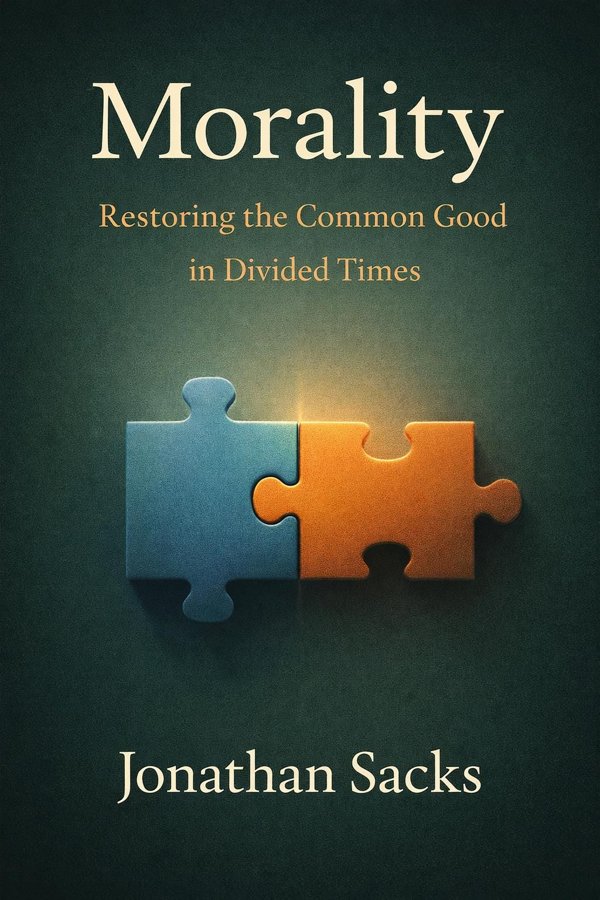
Morality: Restoring the Common Good in Divided Times: Summary & Key Insights
 10 min9 chaptersAudio available
What Is Morality: Restoring the Common Good in Divided Times About?
Morality: Restoring the Common Good in Divided Times by Jonathan Sacks is a ethics book spanning 9 pages. In this profound work, Rabbi Lord Jonathan Sacks explores the moral challenges of modern society, arguing that the loss of shared moral values has led to social fragmentation and loneliness. Drawing on philosophy, theology, and contemporary culture, Sacks calls for a renewal of moral responsibility and community to restore the common good.
This FizzRead summary covers all 9 key chapters of Morality: Restoring the Common Good in Divided Times in approximately 10 minutes, distilling the most important ideas, arguments, and takeaways from Jonathan Sacks's work. Also available as an audio summary and Key Quotes Podcast.
Morality: Restoring the Common Good in Divided Times
In this profound work, Rabbi Lord Jonathan Sacks explores the moral challenges of modern society, arguing that the loss of shared moral values has led to social fragmentation and loneliness. Drawing on philosophy, theology, and contemporary culture, Sacks calls for a renewal of moral responsibility and community to restore the common good.
Who Should Read Morality: Restoring the Common Good in Divided Times?
This book is perfect for anyone interested in ethics and looking to gain actionable insights in a short read. Whether you're a student, professional, or lifelong learner, the key ideas from Morality: Restoring the Common Good in Divided Times by Jonathan Sacks will help you think differently.
- ✓Readers who enjoy ethics and want practical takeaways
- ✓Professionals looking to apply new ideas to their work and life
- ✓Anyone who wants the core insights of Morality: Restoring the Common Good in Divided Times in just 10 minutes
Want the full summary?
Get instant access to this book summary and 100K+ more with Fizz Moment.
Get Free SummaryAvailable on App Store • Free to download
Key Chapters
The story of modernity is, in many ways, the story of the self. In the wake of the cultural revolutions of the 1960s, a profound shift occurred: collective identities — faith, family, nation — began to yield to the sovereignty of the individual. We celebrated autonomy, authenticity, and personal fulfillment. Music, advertising, and politics all began to echo the same refrain: ‘Be yourself.’ Yet this revolution of the self, for all its liberation, came at a cost. When 'I' becomes the center of moral gravity, 'We' begins to dissolve.
In earlier centuries, the individual was always nested within a larger moral ecology — family, neighborhood, community, congregation. These provided not only identity but moral boundaries. But once these structures faded, the self became both empowered and exposed. Consumerism promised happiness through freedom of choice; social movements demanded liberation from tradition; psychological theories replaced sin with self-esteem. For a time, it seemed the age of the self would fulfill humanity’s dream of complete emancipation. But emancipation without responsibility results not in freedom but fragmentation.
The rise of extreme individualism also transformed our social relations. Loneliness became a public epidemic. Marriage rates declined; civic engagement collapsed; trust in institutions withered. In this new moral landscape, the commitment to others seemed optional. As a rabbi, I saw how this shift affected not only religious life but the moral climate as a whole. Faith communities — once engines of moral meaning — became marginal, and moral discourse was privatized. Where once there was shared narrative, now there was infinite choice.
But the moral question remains: Can freedom survive without the habits of self-restraint and empathy that only communities cultivate? The age of the self tells us we owe nothing beyond our own desires. Yet when we look around at anxiety, division, and the brittle politics of identity, it is clear that we are starving for a sense of belonging. Moral renewal begins by recognizing that the self, for all its dignity, is never enough. We need the 'We' — the network of moral obligations that make us more than isolated seekers of pleasure. The next chapters explore how this 'We' was once sustained by social contracts, and why we must learn again how to build them.
+ 7 more chapters — available in the FizzRead app
All Chapters in Morality: Restoring the Common Good in Divided Times
About the Author
Rabbi Lord Jonathan Sacks (1948–2020) was a British philosopher, theologian, and the Chief Rabbi of the United Hebrew Congregations of the Commonwealth from 1991 to 2013. He was a prolific author and a leading voice on ethics, faith, and moral philosophy.
Get This Summary in Your Preferred Format
Read or listen to the Morality: Restoring the Common Good in Divided Times summary by Jonathan Sacks anytime, anywhere. FizzRead offers multiple formats so you can learn on your terms — all free.
Available formats: App · Audio · PDF · EPUB — All included free with FizzRead
Download Morality: Restoring the Common Good in Divided Times PDF and EPUB Summary
Key Quotes from Morality: Restoring the Common Good in Divided Times
“The story of modernity is, in many ways, the story of the self.”
“Civilization depends on invisible agreements — on a shared understanding that individuals, though free, owe something to the larger whole.”
Frequently Asked Questions about Morality: Restoring the Common Good in Divided Times
Morality: Restoring the Common Good in Divided Times by Jonathan Sacks is a ethics book that explores key ideas across 9 chapters. In this profound work, Rabbi Lord Jonathan Sacks explores the moral challenges of modern society, arguing that the loss of shared moral values has led to social fragmentation and loneliness. Drawing on philosophy, theology, and contemporary culture, Sacks calls for a renewal of moral responsibility and community to restore the common good.
You Might Also Like

What We Owe the Future
William MacAskill
10 min
Abortion
David Boonin
10 min
Blind Spots: Why We Fail to Do What's Right and What to Do About It
Max H. Bazerman, Ann E. Tenbrunsel
10 min
Digital Ethics: Research and Practice
Christopher Burr, Luciano Floridi (Editors)
10 min
Doing Good Better: Effective Altruism and a Radical New Way to Make a Difference
William MacAskill
10 min
Eating Animals
Jonathan Safran Foer
10 minBrowse by Category
Ready to read Morality: Restoring the Common Good in Divided Times?
Get the full summary and 100K+ more books with Fizz Moment.