
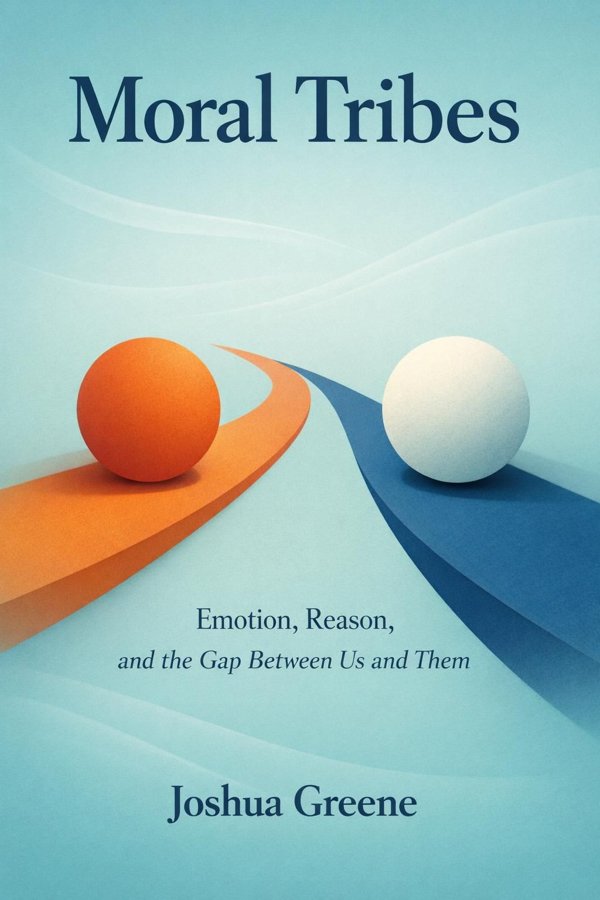
Moral Tribes: Emotion, Reason, and the Gap Between Us and Them: Summary & Key Insights
 10 min8 chaptersAudio available
What Is Moral Tribes: Emotion, Reason, and the Gap Between Us and Them About?
Moral Tribes: Emotion, Reason, and the Gap Between Us and Them by Joshua Greene is a western_phil book spanning 8 pages. Moral Tribes explores how human morality evolved to solve cooperation problems within groups but struggles to handle conflicts between groups. Greene, a psychologist and philosopher, integrates neuroscience, psychology, and philosophy to propose a utilitarian approach to bridge moral divides and promote global cooperation.
This FizzRead summary covers all 8 key chapters of Moral Tribes: Emotion, Reason, and the Gap Between Us and Them in approximately 10 minutes, distilling the most important ideas, arguments, and takeaways from Joshua Greene's work. Also available as an audio summary and Key Quotes Podcast.
Moral Tribes: Emotion, Reason, and the Gap Between Us and Them
Moral Tribes explores how human morality evolved to solve cooperation problems within groups but struggles to handle conflicts between groups. Greene, a psychologist and philosopher, integrates neuroscience, psychology, and philosophy to propose a utilitarian approach to bridge moral divides and promote global cooperation.
Who Should Read Moral Tribes: Emotion, Reason, and the Gap Between Us and Them?
This book is perfect for anyone interested in western_phil and looking to gain actionable insights in a short read. Whether you're a student, professional, or lifelong learner, the key ideas from Moral Tribes: Emotion, Reason, and the Gap Between Us and Them by Joshua Greene will help you think differently.
- ✓Readers who enjoy western_phil and want practical takeaways
- ✓Professionals looking to apply new ideas to their work and life
- ✓Anyone who wants the core insights of Moral Tribes: Emotion, Reason, and the Gap Between Us and Them in just 10 minutes
Want the full summary?
Get instant access to this book summary and 100K+ more with Fizz Moment.
Get Free SummaryAvailable on App Store • Free to download
Key Chapters
The story of human morality begins with cooperation. For our ancestors, living in small groups meant survival depended on individuals working together. Natural selection favored moral systems that promoted fairness, reciprocity, and loyalty within tribes. These evolved moral codes solved what game theorists call the “tragedy of the commons,” ensuring common goods—food, safety, reputation—were protected from exploitation. This is what I call commonsense morality.
Trouble arises when these moral systems, tuned to harmony within a group, meet competing moral systems from other groups. What looks moral inside a tribe may appear alien or cruel from outside it. The tragedy of commonsense morality is that systems meant to prevent conflict within groups create it between them. Think of religious disputes, political polarization, or cultural clashes over rights and duties. Each side sees itself as moral, guided by conscience, yet their moral convictions collide because evolution made us parochial: we extend empathy to our own but reserve suspicion for others.
Our ancestors did not need to cooperate globally; they needed to survive locally. Today, however, our moral problems—the climate crisis, resource distribution, technological ethics—transcend borders. Commonsense morality cannot guide us through these global tragedies of cooperation. It leaves us morally equipped for village life but not for life in the global village.
Neuroscience has opened a window into how our moral minds actually work. When we make moral judgments, different parts of the brain light up depending on the kind of problem we face. Quick, intuitive judgments—those flavored with emotion—engage brain regions like the amygdala and medial frontal cortex. These are the automatic processes that give rise to gut feelings of right and wrong. But when moral decisions demand reasoning—like when we weigh trade-offs or consider consequences—regions associated with controlled cognition, such as the dorsolateral prefrontal cortex, take the stage.
I describe this interaction as a dual-process model: the automatic mode and the manual mode. In the automatic mode, we respond quickly based on emotion; it is fast, efficient, and ancient. In the manual mode, we slow down, reflect, and compute; it is deliberate, flexible, and relatively new. Both systems have their virtues and vices. Automatic morality keeps us compassionate and loyal but can also make us dogmatic and biased. Manual reasoning allows impartiality but can be detached and overly abstract.
Understanding these two modes helps us make sense of our moral disagreements. Many of our moral clashes are not about facts but about which mode is doing the talking. Emotional intuitions evolved for small-scale problems; conscious reasoning must handle the global ones. For our species to progress morally, we need to engage that manual mode more often—to override gut parochialism with reflection that considers all people equally.
+ 6 more chapters — available in the FizzRead app
All Chapters in Moral Tribes: Emotion, Reason, and the Gap Between Us and Them
About the Author
Joshua Greene is an American psychologist, neuroscientist, and philosopher. He is a professor at Harvard University, known for his research on moral judgment, decision-making, and the intersection of psychology and ethics.
Get This Summary in Your Preferred Format
Read or listen to the Moral Tribes: Emotion, Reason, and the Gap Between Us and Them summary by Joshua Greene anytime, anywhere. FizzRead offers multiple formats so you can learn on your terms — all free.
Available formats: App · Audio · PDF · EPUB — All included free with FizzRead
Download Moral Tribes: Emotion, Reason, and the Gap Between Us and Them PDF and EPUB Summary
Key Quotes from Moral Tribes: Emotion, Reason, and the Gap Between Us and Them
“The story of human morality begins with cooperation.”
“Neuroscience has opened a window into how our moral minds actually work.”
Frequently Asked Questions about Moral Tribes: Emotion, Reason, and the Gap Between Us and Them
Moral Tribes: Emotion, Reason, and the Gap Between Us and Them by Joshua Greene is a western_phil book that explores key ideas across 8 chapters. Moral Tribes explores how human morality evolved to solve cooperation problems within groups but struggles to handle conflicts between groups. Greene, a psychologist and philosopher, integrates neuroscience, psychology, and philosophy to propose a utilitarian approach to bridge moral divides and promote global cooperation.
You Might Also Like

A Little History of Philosophy
Nigel Warburton
10 min
Areopagitica
John Milton
10 min
How To Think Like A Philosopher: Essential Principles For Clear Thinking
Peter Cave
10 min
Language, Truth and Logic
A. J. Ayer
10 min
The Age of Reason
Thomas Paine
10 min
The Essays
Michel De Montaigne
10 minBrowse by Category
Ready to read Moral Tribes: Emotion, Reason, and the Gap Between Us and Them?
Get the full summary and 100K+ more books with Fizz Moment.