
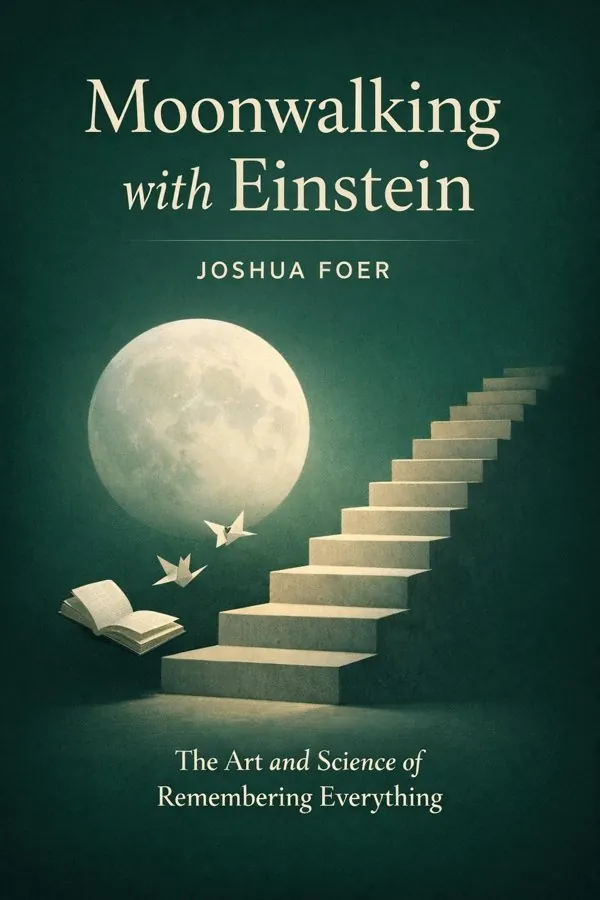
Moonwalking with Einstein: The Art and Science of Remembering Everything: Summary & Key Insights
by Joshua Foer
 10 min7 chaptersAudio available
What Is Moonwalking with Einstein: The Art and Science of Remembering Everything About?
Moonwalking with Einstein: The Art and Science of Remembering Everything by Joshua Foer is a popular_sci book spanning 7 pages. Moonwalking with Einstein is a narrative exploration of memory, blending science, history, and personal experience. Journalist Joshua Foer recounts his journey from covering the U.S. Memory Championship to training for it himself, uncovering the techniques of memory athletes and the cognitive science behind them. The book examines how memory shapes our identities and how ancient mnemonic methods can enhance modern life.
This FizzRead summary covers all 7 key chapters of Moonwalking with Einstein: The Art and Science of Remembering Everything in approximately 10 minutes, distilling the most important ideas, arguments, and takeaways from Joshua Foer's work. Also available as an audio summary and Key Quotes Podcast.
Moonwalking with Einstein: The Art and Science of Remembering Everything
Moonwalking with Einstein is a narrative exploration of memory, blending science, history, and personal experience. Journalist Joshua Foer recounts his journey from covering the U.S. Memory Championship to training for it himself, uncovering the techniques of memory athletes and the cognitive science behind them. The book examines how memory shapes our identities and how ancient mnemonic methods can enhance modern life.
Who Should Read Moonwalking with Einstein: The Art and Science of Remembering Everything?
This book is perfect for anyone interested in popular_sci and looking to gain actionable insights in a short read. Whether you're a student, professional, or lifelong learner, the key ideas from Moonwalking with Einstein: The Art and Science of Remembering Everything by Joshua Foer will help you think differently.
- ✓Readers who enjoy popular_sci and want practical takeaways
- ✓Professionals looking to apply new ideas to their work and life
- ✓Anyone who wants the core insights of Moonwalking with Einstein: The Art and Science of Remembering Everything in just 10 minutes
Want the full summary?
Get instant access to this book summary and 100K+ more with Fizz Moment.
Get Free SummaryAvailable on App Store • Free to download
Key Chapters
Early in my journey, I found myself looking backward rather than forward. To understand the modern art of memory, I needed to learn how memory had been honored in the past. In ancient Greece and Rome, memory was not just a mental skill—it was considered a moral and intellectual virtue. Orators like Cicero and Quintilian taught the ‘method of loci,’ a technique that relies on the power of spatial imagination. The premise was simple yet profound: to remember something, you imagine placing it along a familiar route—a palace, a road, a building—and then retrieve that image by walking mentally through that space.
This system transformed memory from a passive act into an active craft of visualization. I began constructing my own mind-palaces, linking abstract information with vivid images. Numbers became animals; names became striking visual scenes. The ancients understood what we often forget: that memory thrives on emotion and imagery, not on abstraction. Through these techniques, they trained minds to hold epic poems and entire speeches without written notes.
As I explored these traditions, I realized that our modern neglect of memorization had impoverished not just our recall, but our imagination itself. The ancients believed that memory and creativity were intertwined—what we remember shapes what we can invent. That philosophy soon became the beating heart of my training and research.
While history provided the craft, science offered the explanation. In speaking with cognitive scientists and neurologists, I learned that memory is not a single function but an intricate web of processes distributed throughout the brain. When we experience something, it doesn’t store neatly like a file on a hard drive—it’s disassembled and distributed across networks of perception, emotion, and context. Remembering is therefore a reconstruction, not a playback.
The hippocampus emerged as a critical player, acting as the spatial nexus of experience. This connection explained why memory athletes rely so heavily on spatial imagery—our brain is designed to remember places. Neuroscience confirmed what Cicero intuitively knew: spatial memory is the most durable kind of memory we possess.
But there was also a humbling revelation. Forgetting is not failure—it’s biological necessity. Memory works through selective reinforcement, pruning what’s unnecessary to preserve what matters. Virtually everything we are is filtered through that process. As I came to understand the cognitive limits and mechanisms of memory, I appreciated that training one’s recollection is not about fighting nature but about partnering with it—leveraging the neural architecture designed for imagery and emotion rather than rote repetition.
+ 5 more chapters — available in the FizzRead app
All Chapters in Moonwalking with Einstein: The Art and Science of Remembering Everything
About the Author
Joshua Foer is an American journalist and author whose work has appeared in National Geographic, The New York Times, and Slate. He is also a co-founder of Atlas Obscura and Sefaria. Moonwalking with Einstein is his first book, which became a New York Times bestseller.
Get This Summary in Your Preferred Format
Read or listen to the Moonwalking with Einstein: The Art and Science of Remembering Everything summary by Joshua Foer anytime, anywhere. FizzRead offers multiple formats so you can learn on your terms — all free.
Available formats: App · Audio · PDF · EPUB — All included free with FizzRead
Download Moonwalking with Einstein: The Art and Science of Remembering Everything PDF and EPUB Summary
Key Quotes from Moonwalking with Einstein: The Art and Science of Remembering Everything
“Early in my journey, I found myself looking backward rather than forward.”
“While history provided the craft, science offered the explanation.”
Frequently Asked Questions about Moonwalking with Einstein: The Art and Science of Remembering Everything
Moonwalking with Einstein: The Art and Science of Remembering Everything by Joshua Foer is a popular_sci book that explores key ideas across 7 chapters. Moonwalking with Einstein is a narrative exploration of memory, blending science, history, and personal experience. Journalist Joshua Foer recounts his journey from covering the U.S. Memory Championship to training for it himself, uncovering the techniques of memory athletes and the cognitive science behind them. The book examines how memory shapes our identities and how ancient mnemonic methods can enhance modern life.
You Might Also Like

Structures: Or Why Things Don"t Fall Down
J.E. Gordon
10 min
The Road to Wigan Pier
George Orwell
10 min
Bonk: The Curious Coupling of Science and Sex
Mary Roach
10 min
First Bite: How We Learn to Eat
Bee Wilson
10 min
In Pursuit Of The Unknown: 17 Equations That Changed The World
Ian Stewart
10 min
Napoleon's Buttons: 17 Molecules That Changed History
Penny Le Couteur and Jay Burreson
10 minBrowse by Category
Ready to read Moonwalking with Einstein: The Art and Science of Remembering Everything?
Get the full summary and 100K+ more books with Fizz Moment.