
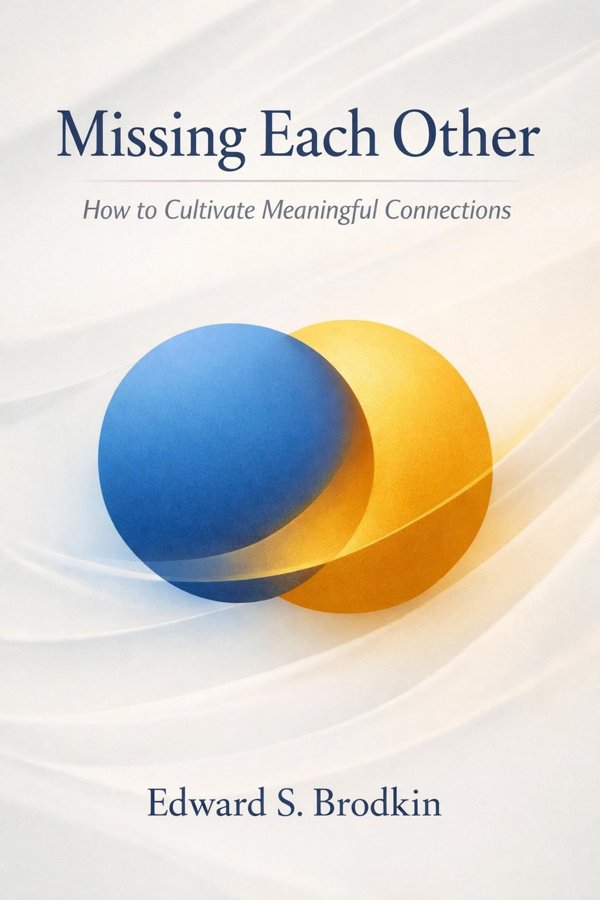
Missing Each Other: How to Cultivate Meaningful Connections: Summary & Key Insights
 10 min9 chaptersAudio available
What Is Missing Each Other: How to Cultivate Meaningful Connections About?
Missing Each Other: How to Cultivate Meaningful Connections by Edward S. Brodkin is a relationships book spanning 9 pages. This book explores the science and practice of human connection, offering readers practical tools to improve empathy, attunement, and communication. Drawing from psychology and neuroscience, Edward S. Brodkin and Ashley Pallathra present methods to help individuals build deeper, more meaningful relationships in both personal and professional contexts.
This FizzRead summary covers all 9 key chapters of Missing Each Other: How to Cultivate Meaningful Connections in approximately 10 minutes, distilling the most important ideas, arguments, and takeaways from Edward S. Brodkin's work. Also available as an audio summary and Key Quotes Podcast.
Missing Each Other: How to Cultivate Meaningful Connections
This book explores the science and practice of human connection, offering readers practical tools to improve empathy, attunement, and communication. Drawing from psychology and neuroscience, Edward S. Brodkin and Ashley Pallathra present methods to help individuals build deeper, more meaningful relationships in both personal and professional contexts.
Who Should Read Missing Each Other: How to Cultivate Meaningful Connections?
This book is perfect for anyone interested in relationships and looking to gain actionable insights in a short read. Whether you're a student, professional, or lifelong learner, the key ideas from Missing Each Other: How to Cultivate Meaningful Connections by Edward S. Brodkin will help you think differently.
- ✓Readers who enjoy relationships and want practical takeaways
- ✓Professionals looking to apply new ideas to their work and life
- ✓Anyone who wants the core insights of Missing Each Other: How to Cultivate Meaningful Connections in just 10 minutes
Want the full summary?
Get instant access to this book summary and 100K+ more with Fizz Moment.
Get Free SummaryAvailable on App Store • Free to download
Key Chapters
Attunement is the silent dance of human connection, rooted as much in our biology as in our emotional lives. From a scientific standpoint, when two people are attuned, their nervous systems subtly synchronize—heart rates, breathing patterns, brain activity—creating a physiological resonance. This is not poetic metaphor but measurable reality. In laboratory studies, pairs who reach attunement show synchronized brainwave patterns, suggesting that deep connection is not only emotional but neural. Building on decades of social neuroscience and psychology, we explore the concept of 'social homeostasis'—the idea that human beings regulate each other’s emotional states through continuous feedback. Just as the body maintains temperature balance, our minds seek balance through connection. When attunement occurs, we feel calm, understood, and safe. When it breaks down, even slightly, we experience a sense of isolation or tension. Psychologically, attunement demands three overlapping capacities: awareness of our internal states, accurate perception of others, and flexible responsiveness. This triad allows us to move fluidly between self and other, like musicians who can improvise because they’re deeply listening to their ensemble. Without this quality, relationships lose vitality, and communication becomes mechanical. Attunement also underlies empathy, though it’s more encompassing. Empathy lets us feel with another; attunement allows us to adapt and respond effectively. You can empathize yet remain distant; you can only attune when you’re fully engaged. By uniting science with personal skill, we can cultivate this responsiveness, transforming everyday interactions into moments of genuine contact.
Despite our innate capacity for attunement, modern life constantly undermines it. Chronic stress floods our nervous systems, keeping us in survival mode and numbing our sensitivity to subtle emotional cues. Distraction—from digital devices, multitasking, or unending internal chatter—fractures our attention. Miscommunication, rooted in assumptions and emotional reactivity, drives wedges even in the most caring relationships. Psychologically, the first barrier is self-absorption born of anxiety. When anxious, we retreat into ourselves, scanning for threats rather than attending to others. This shuts down the openness required for attunement. Another common obstacle is over-intellectualization: analyzing conversations rather than sensing them. Attunement operates below words, in the micro-movements of facial expression, tone, and rhythm. The book emphasizes slowing down—not just in pace but in presence. When we pause long enough to feel into another’s emotional landscape, we invite natural synchrony. Yet this is challenging in a culture that prizes speed and certainty. Communication falters because we respond before we’ve truly listened, interpret before we’ve observed, and defend before we’ve understood. Recognizing these tendencies is the first step to overcoming them. Emotional disconnection is not inevitable. By becoming aware of how stress and distraction interfere with our sense of others, we reclaim the possibility of genuine connection. The practice of attunement begins not with perfect techniques but with mindful noticing—catching moments of missing and gently returning to the shared space.
+ 7 more chapters — available in the FizzRead app
All Chapters in Missing Each Other: How to Cultivate Meaningful Connections
About the Author
Edward S. Brodkin, M.D., is an associate professor of psychiatry at the University of Pennsylvania and director of the Social Neuroscience Lab. His research focuses on social behavior, emotional intelligence, and the neural mechanisms underlying human connection.
Get This Summary in Your Preferred Format
Read or listen to the Missing Each Other: How to Cultivate Meaningful Connections summary by Edward S. Brodkin anytime, anywhere. FizzRead offers multiple formats so you can learn on your terms — all free.
Available formats: App · Audio · PDF · EPUB — All included free with FizzRead
Download Missing Each Other: How to Cultivate Meaningful Connections PDF and EPUB Summary
Key Quotes from Missing Each Other: How to Cultivate Meaningful Connections
“Attunement is the silent dance of human connection, rooted as much in our biology as in our emotional lives.”
“Despite our innate capacity for attunement, modern life constantly undermines it.”
Frequently Asked Questions about Missing Each Other: How to Cultivate Meaningful Connections
Missing Each Other: How to Cultivate Meaningful Connections by Edward S. Brodkin is a relationships book that explores key ideas across 9 chapters. This book explores the science and practice of human connection, offering readers practical tools to improve empathy, attunement, and communication. Drawing from psychology and neuroscience, Edward S. Brodkin and Ashley Pallathra present methods to help individuals build deeper, more meaningful relationships in both personal and professional contexts.
You Might Also Like

The 5 Love Languages
Gary Chapman
10 min
Men Are from Mars, Women Are from Venus
John Gray
10 min
She Comes First
Ian Kerner
10 min
No More Mr Nice Guy
Robert Glover
10 min
Hold Me Tight
Sue Johnson
10 min
Mating in Captivity
Esther Perel
10 minBrowse by Category
Ready to read Missing Each Other: How to Cultivate Meaningful Connections?
Get the full summary and 100K+ more books with Fizz Moment.