
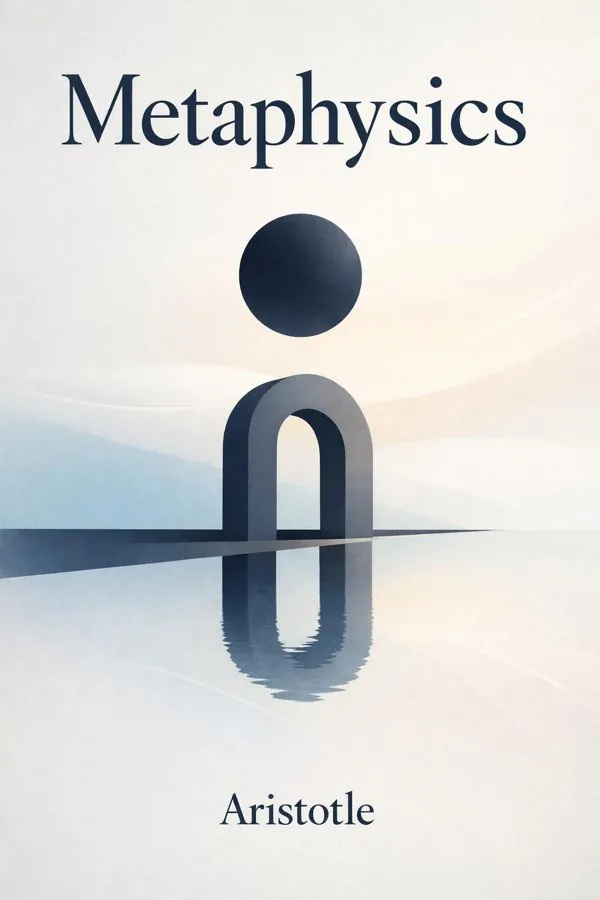
Metaphysics: Summary & Key Insights
by Aristotle
 10 min10 chaptersAudio available
Key Takeaways from Metaphysics
The deepest philosophical question is not what this or that thing is, but what it means for anything at all to be.
We do not really understand something until we can explain why it is the way it is.
Progress in philosophy begins when we take earlier answers seriously enough to criticize them well.
If reality were only a flow of qualities and events, nothing stable could be known.
Change is only intelligible if we can explain how something becomes what it was not, without coming from nothing.
What Is Metaphysics About?
Metaphysics by Aristotle is a western_phil book spanning 10 pages. Aristotle’s Metaphysics is one of the most ambitious books ever written: a sustained attempt to ask what reality is at its deepest level. Rather than studying one slice of the world, Aristotle investigates being itself—what it means for anything to exist, how things change, what makes something the kind of thing it is, and whether there is a highest principle behind all reality. Across its densely argued books, he develops ideas that shaped centuries of philosophy, theology, and science, including substance, causation, potentiality, actuality, and the concept of an unmoved mover. What makes the work enduring is not only its historical importance, but its clarity of purpose: Aristotle wants knowledge that reaches first principles, not surface descriptions. He examines earlier thinkers, challenges Plato’s theory of Forms, and builds a framework that still informs debates in metaphysics, ontology, logic, and philosophy of religion. Aristotle’s authority comes from his unmatched range as a philosopher and scientist. A student of Plato and one of the foundational thinkers of Western thought, he created concepts that remain indispensable for anyone trying to think carefully about reality.
This FizzRead summary covers all 10 key chapters of Metaphysics in approximately 10 minutes, distilling the most important ideas, arguments, and takeaways from Aristotle's work. Also available as an audio summary and Key Quotes Podcast.
Metaphysics
Aristotle’s Metaphysics is one of the most ambitious books ever written: a sustained attempt to ask what reality is at its deepest level. Rather than studying one slice of the world, Aristotle investigates being itself—what it means for anything to exist, how things change, what makes something the kind of thing it is, and whether there is a highest principle behind all reality. Across its densely argued books, he develops ideas that shaped centuries of philosophy, theology, and science, including substance, causation, potentiality, actuality, and the concept of an unmoved mover. What makes the work enduring is not only its historical importance, but its clarity of purpose: Aristotle wants knowledge that reaches first principles, not surface descriptions. He examines earlier thinkers, challenges Plato’s theory of Forms, and builds a framework that still informs debates in metaphysics, ontology, logic, and philosophy of religion. Aristotle’s authority comes from his unmatched range as a philosopher and scientist. A student of Plato and one of the foundational thinkers of Western thought, he created concepts that remain indispensable for anyone trying to think carefully about reality.
Who Should Read Metaphysics?
This book is perfect for anyone interested in western_phil and looking to gain actionable insights in a short read. Whether you're a student, professional, or lifelong learner, the key ideas from Metaphysics by Aristotle will help you think differently.
- ✓Readers who enjoy western_phil and want practical takeaways
- ✓Professionals looking to apply new ideas to their work and life
- ✓Anyone who wants the core insights of Metaphysics in just 10 minutes
Want the full summary?
Get instant access to this book summary and 100K+ more with Fizz Moment.
Get Free SummaryAvailable on App Store • Free to download
Key Chapters
The deepest philosophical question is not what this or that thing is, but what it means for anything at all to be. Aristotle calls metaphysics the study of “being qua being,” meaning being considered precisely as being, not as motion, number, life, or language. Every specialized discipline looks at one region of reality: physics studies moving bodies, biology studies living things, mathematics studies quantity. Metaphysics asks the more universal question that underlies them all: what do all beings have in common insofar as they are? This shift in focus gives philosophy its widest scope.
Aristotle does not mean that all beings are identical. “Being” is said in many ways: a tree, a number, a friendship, and a truth all exist differently. Still, they are not unrelated uses of the word. They are connected around central meanings, especially substance. This is why metaphysics must investigate the structure of existence itself, including identity, unity, cause, and essence. The subject is difficult because being is not a genus like “animal” or “color.” It is more basic than any category we use.
In everyday life, this perspective matters more than it seems. When you ask whether a company is still the same company after a merger, whether a person remains the same through change, or whether a digital file is the same object across copies, you are doing metaphysics. You are asking what kinds of being are involved and what makes identity persist.
Actionable takeaway: when facing a complex problem, pause before asking only practical questions and ask the metaphysical one underneath it: what exactly is the thing I am dealing with, and in what sense does it exist?
We do not really understand something until we can explain why it is the way it is. Aristotle’s famous doctrine of the four causes is his answer to what complete explanation requires. A thing can be understood through its material cause, formal cause, efficient cause, and final cause. The material cause is what it is made of. The formal cause is the structure or essence that makes it the kind of thing it is. The efficient cause is the source of change or production. The final cause is the end, goal, or purpose for the sake of which it exists.
Take a wooden table. Its material cause is the wood. Its formal cause is the design or arrangement that makes it a table rather than a pile of lumber. Its efficient cause is the carpenter who made it. Its final cause is the function it serves, such as supporting meals, work, or gathering. Aristotle’s insight is that explanation is layered. If you only identify the wood, you have not explained the table. If you only mention the carpenter, you have not explained why the object has this shape and use.
This framework extends far beyond ancient philosophy. In medicine, understanding a disease involves the body affected, the pathology, the trigger, and the aim of treatment. In business, a failing product can be examined in terms of resources, design, management decisions, and market purpose. In personal life, your habits also have causes: conditions, patterns, influences, and goals.
Actionable takeaway: when trying to understand a problem, use Aristotle’s four-cause checklist—what is it made of, what form does it have, what produced it, and what end does it serve?
Progress in philosophy begins when we take earlier answers seriously enough to criticize them well. A major part of Metaphysics is Aristotle’s engagement with his predecessors, from the Presocratics to Plato. He does not dismiss them as wrongheaded; he treats them as partial discoverers of truth. Earlier thinkers often identified one kind of cause while neglecting others. Some focused on matter, such as water or atoms. Others emphasized motion or opposition. Plato, Aristotle’s teacher, highlighted form and intelligibility through the theory of separate Forms. Aristotle’s own philosophy emerges by gathering what is right in these views while correcting their limits.
His sharpest critique is directed at Plato’s Forms. Aristotle argues that if Forms exist separately from sensible things, they fail to explain the things we encounter. Saying that a particular horse is a horse because it participates in Horse Itself does not clearly show how the individual horse exists, changes, or acts. The theory also risks duplicating reality instead of clarifying it: now we have both particular horses and a separate Form, but not a better account of either. Aristotle wants form to be immanent in things, not detached from them.
This habit of respectful criticism remains valuable. In politics, science, or organizational strategy, inherited ideas often contain part of the truth. The mistake is usually not total falsehood but one-sidedness. A material explanation without purpose, or an abstract principle without contact with reality, distorts understanding.
Actionable takeaway: when evaluating any theory, ask two questions Aristotle would approve of—what truth does it capture, and what dimension of reality does it leave out?
If reality were only a flow of qualities and events, nothing stable could be known. Aristotle introduces substance as the primary sense of being because it is what exists in its own right rather than merely in something else. A color exists in a surface, a mood in a person, a quantity in an object, but the person or object is the substance that underlies such attributes. Substance gives metaphysics its anchor. Without it, we would have change without anything that changes, properties without bearers, and predication without a subject.
Aristotle develops substance in a subtle way. A living human being is a substance, but so is not mere matter alone. Bronze is not yet a statue, and flesh is not yet a human being. Substance is closely tied to form and essence: what makes this thing the kind of thing it is. That is why Aristotle often treats form as more truly substance than matter. Matter provides the possibility of being something; form makes the thing actually be what it is.
This has practical relevance whenever we confuse surface features with underlying reality. In leadership, for instance, titles, dress, and communication style are attributes, but the “substance” of leadership lies in judgment, character, and the capacity to coordinate action toward a good end. In personal identity, hobbies and preferences may change while deeper structures of character endure.
Actionable takeaway: when assessing anything important—a person, institution, or idea—distinguish between accidental features and what is essential. Ask not only what qualities it has, but what it is in itself.
Change is only intelligible if we can explain how something becomes what it was not, without coming from nothing. Aristotle’s distinction between potentiality and actuality is his master key to this problem. Potentiality is a capacity or possibility rooted in a thing’s nature. Actuality is the fulfillment, realization, or exercised state of that capacity. An acorn is potentially an oak tree. A trained musician has the potential to perform; the performance is the actuality. This distinction explains both stability and change: a thing can remain itself while moving from an unrealized capacity to a realized state.
Aristotle uses this idea to reject two extremes. Against those who deny real change, he insists that actuality can emerge from potentiality. Against those who think anything can come from anything, he insists that potentiality is structured. An acorn can become a tree, not a horse. Possibility is not vague chaos; it is ordered by form and nature. This lets Aristotle explain motion, development, learning, and causation without making reality irrational.
The distinction remains powerful in modern life. Education is largely the art of bringing potential into act. A student has intellectual capacities not yet developed. A startup has potential value that must be actualized through design, discipline, and market fit. Even character works this way: courage is not merely an abstract trait but a developed capacity that becomes actual in action.
Actionable takeaway: stop judging yourself or others only by current performance. Ask what genuine potentials are present, what conditions support their development, and what concrete action would move them one step closer to actuality.
We constantly speak as if the world contains stable unities: one person, one species, one law, one idea. But what makes many parts one thing, or many individuals instances of one kind? Aristotle explores unity, identity, and universals to explain how thought and reality hang together. Unity is not mere numerical oneness; it often means an organized whole. A house is one not because its bricks are identical, but because they are structured into a single form. Identity likewise has layers. Something may remain the same substance while undergoing accidental change, such as a person aging while remaining that person.
Universals pose another challenge. When we call many animals “dogs,” what exactly is shared? Aristotle rejects Plato’s view that universals exist as separate entities apart from particulars. Instead, the universal is found in the particular as its intelligible form, and the mind abstracts it. We know what a dog is by grasping the form present across individual dogs, not by consulting a separate heavenly Dog Itself. This preserves both the reality of common natures and the concreteness of individual beings.
These issues shape practical thinking more than we notice. In law, policy, and management, classifications matter. When does a gig worker count as an employee? What makes a nation the same nation through constitutional change? In relationships, identity questions arise when someone says, “I’m not the same person I used to be.” Aristotle helps us sort what changed accidentally from what changed essentially.
Actionable takeaway: whenever a debate turns on labels or categories, ask what principle of unity is being assumed and whether the classification reflects the real form of the thing or just a convenient abstraction.
If everything moved were moved by something else, explanation would either regress forever or fail to reach a first principle. Aristotle argues that there must be a first unmoved mover: a reality that causes motion without itself being moved. This is not a mechanical push at the beginning of time, but a metaphysical principle that explains ongoing order and intelligibility. The unmoved mover moves as a final cause, as that which is desired, loved, or thought. It draws all things toward actuality and perfection.
Aristotle characterizes this highest reality as pure actuality, without potentiality. Anything with potentiality could be otherwise and would require explanation for its movement into act. The first principle must therefore be fully actual, eternal, and immaterial. Aristotle famously describes it as thought thinking itself—the perfect activity of intellect contemplating the highest object, which is itself. This divine reality is not a creator in the later Abrahamic sense, but it becomes enormously influential in theology and philosophy of religion.
Even outside theology, the idea has practical force. Human action is often moved not just by efficient causes but by ideals that attract us: truth, excellence, beauty, justice. A company may be animated less by orders than by a compelling mission. A person may become disciplined not because they are pushed from behind, but because they are pulled by a vision of the good life.
Actionable takeaway: identify the “final causes” that move your life. Ask what ultimate ideal your actions are really oriented toward, and whether that guiding object is worthy of your attention and effort.
Not all knowledge is equal in scope. Aristotle distinguishes metaphysics, or first philosophy, from the special sciences because it studies the most universal principles of reality. Physics investigates mobile beings. Mathematics studies quantity abstracted from motion. Biology studies living things. But metaphysics asks about substance, causation, unity, identity, and the highest beings. It does not replace the sciences; it grounds them by clarifying the assumptions they rely on.
For Aristotle, this makes metaphysics both the most abstract and, in one sense, the highest science. It seeks wisdom rather than merely useful knowledge. A craft can tell you how to build a bridge, and physics can describe force and motion, but metaphysics asks what causation itself is, what kind of reality laws have, and why intelligibility is possible at all. It investigates first principles that other disciplines presuppose but do not themselves justify.
This hierarchy is still relevant in an age of specialization. Data science can predict behavior, but cannot by itself tell us what counts as a person, whether values are reducible to preferences, or what makes an explanation satisfactory. Technology can optimize means while remaining silent about ends. Organizations often suffer when operational metrics crowd out foundational questions about mission, value, and human purpose.
Actionable takeaway: alongside technical expertise, cultivate “first-philosophy” thinking. In any field, step back regularly and ask what assumptions your work makes about reality, knowledge, and value—and whether those assumptions are coherent.
Reality is not a flat inventory of things but an ordered structure of different modes of being. Aristotle’s metaphysics suggests a hierarchy in which matter, form, life, soul, intellect, and the divine represent increasingly actual and intelligible levels of reality. Matter alone is pure potentiality; it becomes a definite being through form. Living things add powers of nutrition and reproduction. Animals add perception and desire. Human beings add rational intellect. Above all is the unmoved mover, pure actuality and pure thought.
This hierarchy should not be mistaken for contempt for the lower levels. Aristotle does not deny the reality of material things; he explains them as participating in form to different degrees. The point is that some beings are more self-explanatory, more unified, and more actual than others. A stone exists, but a living organism has a richer internal principle of activity. A rational mind can know not only things but truths about things. The hierarchy therefore reflects increasing complexity, interiority, and actuality.
In practical terms, this helps us resist reductionism. A human being is not adequately explained as a heap of chemicals, even though chemistry is involved. A work team is not just payroll data; it is an organized human community with aims, habits, and shared meaning. Not every level of reality can be reduced to the language of a lower one without loss.
Actionable takeaway: when analyzing any system, consider whether you are reducing a richer level of reality to a poorer one. Ask what forms, functions, and powers emerge at higher levels that matter for understanding the whole.
The desire to know is not a luxury for Aristotle; it is built into human nature. Metaphysics opens with the claim that all human beings by nature desire to know, and the entire work can be read as an account of what mature knowing looks like. Wisdom differs from mere information or practical skill. It seeks first causes and highest principles. The wise person does not simply know that something happens, but understands why it must be so and how it fits into the whole.
Aristotle also links wisdom to freedom. Practical arts are often pursued for the sake of something else: medicine for health, architecture for buildings, strategy for victory. But the highest knowledge is pursued for its own sake. This is why metaphysics, despite its difficulty, occupies a privileged place. It honors the distinctly human capacity to contemplate truth beyond immediate utility. In that sense, philosophy becomes not escapism but the fullest exercise of rational life.
This idea can transform modern habits shaped by speed and productivity. Many people become trapped in endless tasks, consuming information without understanding. Aristotle reminds us that a fulfilled life needs more than efficiency; it needs orientation toward truth. Asking deep questions about reality, purpose, and the good is not impractical. It is part of living well.
Actionable takeaway: set aside time for inquiry that is not immediately useful. Read, reflect, and ask foundational questions. Treat the pursuit of understanding not as a distraction from life, but as one of its highest expressions.
All Chapters in Metaphysics
About the Author
Aristotle (384–322 BCE) was one of the most influential philosophers in history. Born in Stagira in northern Greece, he studied for around twenty years in Plato’s Academy before developing his own distinct philosophical approach. He later became tutor to Alexander the Great and eventually founded the Lyceum in Athens, where he conducted research and taught across an extraordinary range of subjects. Aristotle wrote on logic, metaphysics, ethics, politics, rhetoric, poetry, psychology, and natural science, helping define the basic concepts of many disciplines. Unlike thinkers who focused mainly on abstract speculation, he combined conceptual rigor with close observation of the natural world. His work shaped ancient, medieval, and modern thought, influencing Islamic, Jewish, and Christian philosophy as well as later science. Metaphysics remains one of his most enduring contributions.
Get This Summary in Your Preferred Format
Read or listen to the Metaphysics summary by Aristotle anytime, anywhere. FizzRead offers multiple formats so you can learn on your terms — all free.
Available formats: App · Audio · PDF · EPUB — All included free with FizzRead
Download Metaphysics PDF and EPUB Summary
Key Quotes from Metaphysics
“The deepest philosophical question is not what this or that thing is, but what it means for anything at all to be.”
“We do not really understand something until we can explain why it is the way it is.”
“Progress in philosophy begins when we take earlier answers seriously enough to criticize them well.”
“If reality were only a flow of qualities and events, nothing stable could be known.”
“Change is only intelligible if we can explain how something becomes what it was not, without coming from nothing.”
Frequently Asked Questions about Metaphysics
Metaphysics by Aristotle is a western_phil book that explores key ideas across 10 chapters. Aristotle’s Metaphysics is one of the most ambitious books ever written: a sustained attempt to ask what reality is at its deepest level. Rather than studying one slice of the world, Aristotle investigates being itself—what it means for anything to exist, how things change, what makes something the kind of thing it is, and whether there is a highest principle behind all reality. Across its densely argued books, he develops ideas that shaped centuries of philosophy, theology, and science, including substance, causation, potentiality, actuality, and the concept of an unmoved mover. What makes the work enduring is not only its historical importance, but its clarity of purpose: Aristotle wants knowledge that reaches first principles, not surface descriptions. He examines earlier thinkers, challenges Plato’s theory of Forms, and builds a framework that still informs debates in metaphysics, ontology, logic, and philosophy of religion. Aristotle’s authority comes from his unmatched range as a philosopher and scientist. A student of Plato and one of the foundational thinkers of Western thought, he created concepts that remain indispensable for anyone trying to think carefully about reality.
More by Aristotle



You Might Also Like
A Little History of Philosophy
Nigel Warburton
10 min
Areopagitica
John Milton
10 min
How To Think Like A Philosopher: Essential Principles For Clear Thinking
Peter Cave
10 min
Language, Truth and Logic
A. J. Ayer
10 min
The Age of Reason
Thomas Paine
10 min
The Essays
Michel De Montaigne
10 minBrowse by Category
Ready to read Metaphysics?
Get the full summary and 100K+ more books with Fizz Moment.