
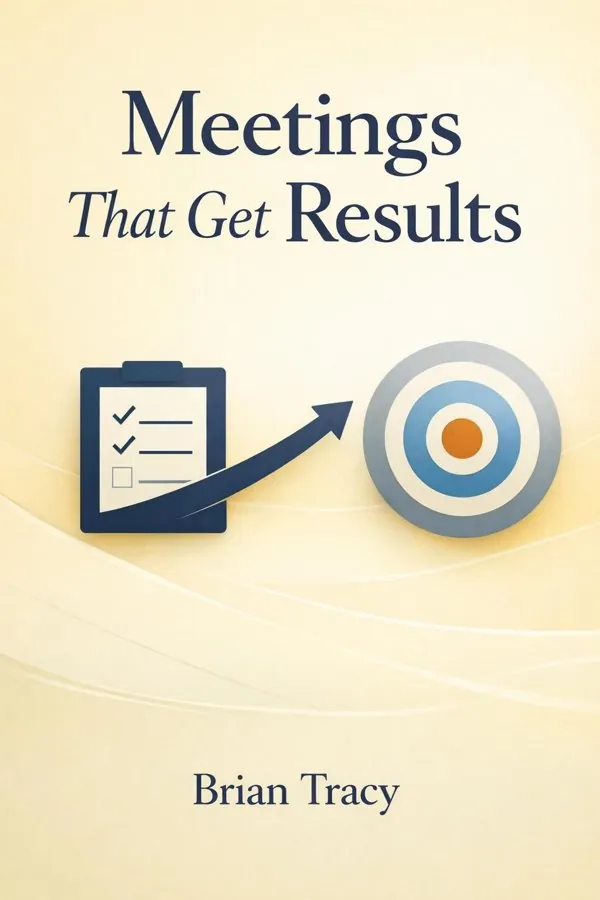
Meetings That Get Results: Summary & Key Insights
by Brian Tracy
 10 min11 chaptersAudio available
What Is Meetings That Get Results About?
Meetings That Get Results by Brian Tracy is a leadership book spanning 11 pages. In this concise guide, Brian Tracy provides practical strategies for planning and conducting meetings that are efficient, focused, and productive. The book outlines how to set clear objectives, create effective agendas, manage time, and ensure actionable outcomes, helping leaders and teams achieve better results through improved meeting practices.
This FizzRead summary covers all 11 key chapters of Meetings That Get Results in approximately 10 minutes, distilling the most important ideas, arguments, and takeaways from Brian Tracy's work. Also available as an audio summary and Key Quotes Podcast.
Meetings That Get Results
In this concise guide, Brian Tracy provides practical strategies for planning and conducting meetings that are efficient, focused, and productive. The book outlines how to set clear objectives, create effective agendas, manage time, and ensure actionable outcomes, helping leaders and teams achieve better results through improved meeting practices.
Who Should Read Meetings That Get Results?
This book is perfect for anyone interested in leadership and looking to gain actionable insights in a short read. Whether you're a student, professional, or lifelong learner, the key ideas from Meetings That Get Results by Brian Tracy will help you think differently.
- ✓Readers who enjoy leadership and want practical takeaways
- ✓Professionals looking to apply new ideas to their work and life
- ✓Anyone who wants the core insights of Meetings That Get Results in just 10 minutes
Want the full summary?
Get instant access to this book summary and 100K+ more with Fizz Moment.
Get Free SummaryAvailable on App Store • Free to download
Key Chapters
Every meeting begins not in the conference room but in your mind. Before you call one, you need a crystal-clear answer to the question: why are we meeting? Too many managers schedule meetings out of habit—because they always have one on Monday morning or because something feels unresolved. But the truth is, if there’s no clearly defined result you’re aiming for, there’s no reason to meet.
When I coach companies, I tell them that the best leaders treat meetings like investments. Each minute spent must yield measurable value in clarity, decision, or coordination. That value starts with defining the objective. Are we meeting to solve a problem, make a decision, or share information? Stay specific. “Update meeting” isn’t enough—the purpose should read more like, “To decide next quarter’s marketing priorities,” or “To finalize the rollout timeline.” Once the purpose is defined, it shapes everything that follows—the agenda, the attendees, the speaking order, even the tone.
When the purpose is vague, meetings drift. People arrive uncertain, speak unfocused thoughts, and leave without understanding what just happened. When the purpose is sharp, participants come prepared, the conversation stays aligned, and decisions are easier. I urge leaders to set desired outcomes before sending an invitation. Ask yourself: by the time this meeting ends, what do I want to be true that isn’t true yet? It might be a decision made, an action plan agreed upon, or an issue fully understood. That clarity generates energy—and it’s the first step toward results.
Preparation is where most meetings are won or lost. The simple truth is that an unprepared meeting can never be productive, no matter how skilled the facilitator. Effective planning begins with identifying who truly needs to be in the room. Not everyone who has an opinion needs to attend. Invite only those who are essential to the purpose and whose presence will drive the outcome. When people are in meetings where they add little value, they silently disengage. But when you bring together the right people for the right purpose, energy rises.
Once you’ve determined the participants, the next crucial step is developing a focused agenda. I’ve seen countless leaders send a one-line invitation with no structure, expecting things to flow naturally. That’s a mistake. A clear agenda is like a roadmap—it tells participants what’s ahead and how much distance you expect to cover. Each item should be tied to the meeting’s objective, and every point should have an owner responsible for briefing or leading that segment.
Send the agenda and any supporting materials ahead of time. This simple act has a monumental effect: when people digest information before the meeting, the collective time spent during discussion can focus on action and decision, not mere information exchange. At the start of my career, I used to spend half my meetings explaining data that could have been read in advance. Once I learned to circulate reports early, we cut meeting time in half and doubled our output.
A well-prepared meeting is a professional courtesy. It tells participants that you value their time and expect their best thinking. When everyone arrives informed and ready to contribute, the quality of conversation—and therefore the quality of results—rises dramatically.
+ 9 more chapters — available in the FizzRead app
All Chapters in Meetings That Get Results
About the Author
Brian Tracy is a Canadian-American motivational speaker, author, and business consultant known for his work in personal development, leadership, and sales training. He has written numerous bestselling books on success and productivity, including 'Eat That Frog!' and 'Goals!'.
Get This Summary in Your Preferred Format
Read or listen to the Meetings That Get Results summary by Brian Tracy anytime, anywhere. FizzRead offers multiple formats so you can learn on your terms — all free.
Available formats: App · Audio · PDF · EPUB — All included free with FizzRead
Download Meetings That Get Results PDF and EPUB Summary
Key Quotes from Meetings That Get Results
“Every meeting begins not in the conference room but in your mind.”
“Preparation is where most meetings are won or lost.”
Frequently Asked Questions about Meetings That Get Results
Meetings That Get Results by Brian Tracy is a leadership book that explores key ideas across 11 chapters. In this concise guide, Brian Tracy provides practical strategies for planning and conducting meetings that are efficient, focused, and productive. The book outlines how to set clear objectives, create effective agendas, manage time, and ensure actionable outcomes, helping leaders and teams achieve better results through improved meeting practices.
More by Brian Tracy

Eat That Frog
Brian Tracy
10 min
Maximum Achievement: Proven System of Strategies and Skills That Will Unlock Your Hidden Powers to Succeed
Brian Tracy
10 min
No Excuses!: The Power of Self-Discipline
Brian Tracy
10 min
The Psychology of Selling: Increase Your Sales Faster and Easier Than You Ever Thought Possible
Brian Tracy
10 minYou Might Also Like

Extreme Ownership
Jocko Willink
10 min
Dare to Lead
Brene Brown
10 min
Leaders Eat Last
Simon Sinek
10 min
The 21 Irrefutable Laws of Leadership
John Maxwell
10 min
Start With Why
Simon Sinek
10 min
How to Lead When You're Not in Charge
Clay Scroggins
10 minBrowse by Category
Ready to read Meetings That Get Results?
Get the full summary and 100K+ more books with Fizz Moment.