
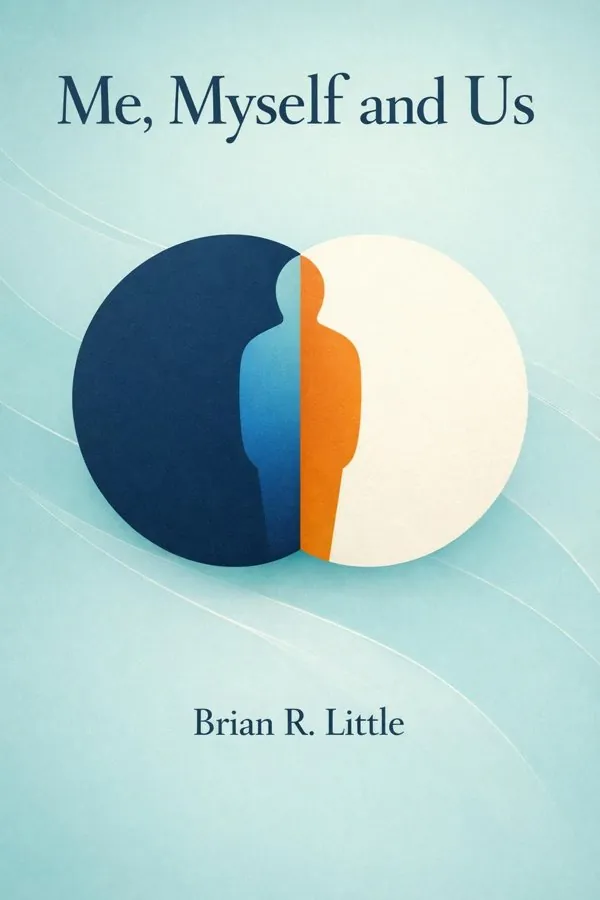
Me, Myself and Us: The Science of Personality and the Art of Well-Being: Summary & Key Insights
 10 min5 chaptersAudio available
What Is Me, Myself and Us: The Science of Personality and the Art of Well-Being About?
Me, Myself and Us: The Science of Personality and the Art of Well-Being by Brian R. Little is a psychology book spanning 5 pages. In this insightful work, psychologist Brian R. Little explores the science of personality and how our traits, projects, and social contexts shape who we are. Drawing on decades of research, he examines the balance between our fixed dispositions and our capacity for change, offering a nuanced understanding of individuality and well-being.
This FizzRead summary covers all 5 key chapters of Me, Myself and Us: The Science of Personality and the Art of Well-Being in approximately 10 minutes, distilling the most important ideas, arguments, and takeaways from Brian R. Little's work. Also available as an audio summary and Key Quotes Podcast.
Me, Myself and Us: The Science of Personality and the Art of Well-Being
In this insightful work, psychologist Brian R. Little explores the science of personality and how our traits, projects, and social contexts shape who we are. Drawing on decades of research, he examines the balance between our fixed dispositions and our capacity for change, offering a nuanced understanding of individuality and well-being.
Who Should Read Me, Myself and Us: The Science of Personality and the Art of Well-Being?
This book is perfect for anyone interested in psychology and looking to gain actionable insights in a short read. Whether you're a student, professional, or lifelong learner, the key ideas from Me, Myself and Us: The Science of Personality and the Art of Well-Being by Brian R. Little will help you think differently.
- ✓Readers who enjoy psychology and want practical takeaways
- ✓Professionals looking to apply new ideas to their work and life
- ✓Anyone who wants the core insights of Me, Myself and Us: The Science of Personality and the Art of Well-Being in just 10 minutes
Want the full summary?
Get instant access to this book summary and 100K+ more with Fizz Moment.
Get Free SummaryAvailable on App Store • Free to download
Key Chapters
To talk about personality with any depth, we need a shared language. In psychological science, the most widely accepted framework is the Big Five model, which describes five broad domains of personality traits: openness, conscientiousness, extraversion, agreeableness, and neuroticism. Think of these five dimensions not as rigid boxes but as continua—spectrums along which each of us can be placed.
This model arose from decades of empirical research. By analyzing the adjectives people use to describe one another across cultures and languages, psychologists discovered recurring clusters that consistently mapped onto these five traits. It isn’t perfect—no model can capture the full richness of human individuality—but it provides a structure from which we can examine the everyday variations that make us who we are.
Each trait carries trade-offs. High openness fuels creativity, curiosity, and intellectual exploration, but it may also breed restlessness or distraction. Conscientiousness brings reliability and discipline, yet in excess it can slide into rigid perfectionism. Extraversion energizes social engagement and leadership, but introverts often bring deep thoughtfulness and emotional resilience of their own. Agreeableness fosters warmth and cooperation, while low agreeableness can sometimes mean the courage to challenge consensus. Neuroticism, our emotional sensitivity, protects us by alerting us to threats but can also make us vulnerable to stress.
Seeing yourself through this lens isn’t about labeling; it’s about liberation through understanding. When you grasp your trait patterns, you begin to see why certain environments invigorate you while others drain you. For instance, an extravert may feel alive in the hum of a busy office, while an introvert finds focus in solitude. Such preferences aren’t deficiencies—they are signatures of the self. The more you recognize these dispositions, the better you can design your life, projects, and relationships to align with them.
Beyond our stable traits lie the things we care about—the projects that give structure to our days and meaning to our lives. Whether you are completing a dissertation, nurturing a friendship, mastering a sport, or raising a child, you are engaged in what I call personal projects. These undertakings are the engines of personality in motion. They are where traits and context collide.
My research into personal projects began with a simple observation: when people talk about what truly matters to them, their eyes light up, their tone changes, and their personality seems to come alive. Projects are central to our psychological well-being because they represent our active striving in the world. They reveal not just what we do, but who we aspire to be.
A conscientious person may structure their day around ordered, efficient projects, while someone high in openness might juggle a variety of creative and exploratory ventures. But what truly fascinates me is how we use our agency to shape these projects in alignment—or sometimes in defiance—of our underlying traits. An introverted teacher may take on the project of becoming more engaging in the classroom, not because it feels natural, but because it fulfills a deeply held value: the desire to inspire students.
The quality of our personal projects strongly influences our happiness. Projects that are congruent with our core traits and values tend to nourish us. Those imposed on us by others, or undertaken under duress, often diminish well-being. Recognizing this opens a profound avenue of self-management: we can choose projects that honor both our traits and our evolving sense of purpose.
+ 3 more chapters — available in the FizzRead app
All Chapters in Me, Myself and Us: The Science of Personality and the Art of Well-Being
About the Author
Brian R. Little is a Canadian psychologist and professor known for his pioneering research on personality and personal projects. He has taught at Harvard University and the University of Cambridge, and his work bridges psychology and philosophy to illuminate the complexities of human individuality.
Get This Summary in Your Preferred Format
Read or listen to the Me, Myself and Us: The Science of Personality and the Art of Well-Being summary by Brian R. Little anytime, anywhere. FizzRead offers multiple formats so you can learn on your terms — all free.
Available formats: App · Audio · PDF · EPUB — All included free with FizzRead
Download Me, Myself and Us: The Science of Personality and the Art of Well-Being PDF and EPUB Summary
Key Quotes from Me, Myself and Us: The Science of Personality and the Art of Well-Being
“To talk about personality with any depth, we need a shared language.”
“Beyond our stable traits lie the things we care about—the projects that give structure to our days and meaning to our lives.”
Frequently Asked Questions about Me, Myself and Us: The Science of Personality and the Art of Well-Being
Me, Myself and Us: The Science of Personality and the Art of Well-Being by Brian R. Little is a psychology book that explores key ideas across 5 chapters. In this insightful work, psychologist Brian R. Little explores the science of personality and how our traits, projects, and social contexts shape who we are. Drawing on decades of research, he examines the balance between our fixed dispositions and our capacity for change, offering a nuanced understanding of individuality and well-being.
You Might Also Like
The Body Keeps the Score
Bessel van der Kolk
10 min
Surrounded by Idiots
Thomas Erikson
10 min
Emotional Intelligence
Daniel Goleman
10 min
Attached
Amir Levine
10 min
Why Does He Do That
Lundy Bancroft
10 min
Women Who Run with the Wolves
Clarissa Pinkola Estés
10 minBrowse by Category
Ready to read Me, Myself and Us: The Science of Personality and the Art of Well-Being?
Get the full summary and 100K+ more books with Fizz Moment.