
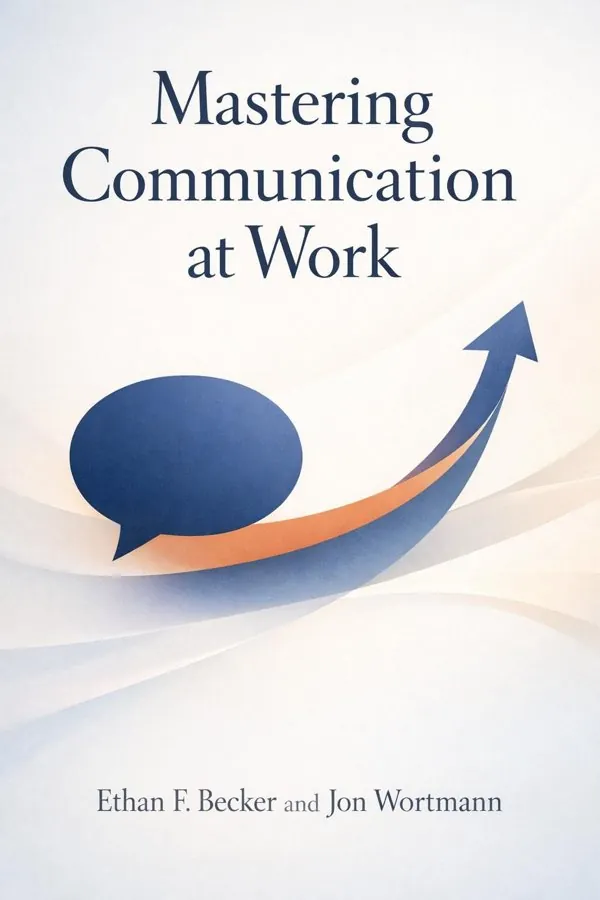
Mastering Communication at Work: How to Lead, Manage, and Influence: Summary & Key Insights
by Ethan F. Becker, Jon Wortmann
 10 min5 chaptersAudio available
What Is Mastering Communication at Work: How to Lead, Manage, and Influence About?
Mastering Communication at Work: How to Lead, Manage, and Influence by Ethan F. Becker and Jon Wortmann is a communication book spanning 5 pages. Mastering Communication at Work provides practical strategies for improving communication skills in professional settings. The book focuses on how to lead, manage, and influence others through effective speaking, listening, and interpersonal techniques. It offers actionable tools for handling difficult conversations, motivating teams, and building trust in the workplace.
This FizzRead summary covers all 5 key chapters of Mastering Communication at Work: How to Lead, Manage, and Influence in approximately 10 minutes, distilling the most important ideas, arguments, and takeaways from Ethan F. Becker and Jon Wortmann's work. Also available as an audio summary and Key Quotes Podcast.
Mastering Communication at Work: How to Lead, Manage, and Influence
Mastering Communication at Work provides practical strategies for improving communication skills in professional settings. The book focuses on how to lead, manage, and influence others through effective speaking, listening, and interpersonal techniques. It offers actionable tools for handling difficult conversations, motivating teams, and building trust in the workplace.
Who Should Read Mastering Communication at Work: How to Lead, Manage, and Influence?
This book is perfect for anyone interested in communication and looking to gain actionable insights in a short read. Whether you're a student, professional, or lifelong learner, the key ideas from Mastering Communication at Work: How to Lead, Manage, and Influence by Ethan F. Becker and Jon Wortmann will help you think differently.
- ✓Readers who enjoy communication and want practical takeaways
- ✓Professionals looking to apply new ideas to their work and life
- ✓Anyone who wants the core insights of Mastering Communication at Work: How to Lead, Manage, and Influence in just 10 minutes
Want the full summary?
Get instant access to this book summary and 100K+ more with Fizz Moment.
Get Free SummaryAvailable on App Store • Free to download
Key Chapters
To master communication, you must first understand it as a process rather than a performance. At its foundation, communication is the flow of meaning between people. Every conversation involves a sender, a message, a receiver, and the loop of feedback that ensures understanding. Problems arise whenever one part of this loop goes unacknowledged.
Consider this: when you say something, you are not just transmitting information; you are also managing how it will be received. The listener filters your message through their own emotions, expectations, and prior experiences. Effective communicators anticipate these filters. They prepare messages that are not only clear but also considerate of how someone else will hear them.
Feedback closes the loop. It tells you whether your message was heard in the way you intended. Too often, professionals end conversations thinking agreement has been reached, only to discover later that misunderstanding prevailed. We encourage leaders to view feedback not as correction, but as confirmation. The moment someone says, “So what you’re saying is…” you are witnessing the real power of feedback at work.
In this chapter, we also emphasize emotional awareness. The best communicators are attuned not just to words but to moods—the subtle cues that reveal whether your listener is open or closed. Emotions drive how information travels; therefore, mastering tone, body language, and word choice is essential. The ability to regulate your own emotion—your calmness during conflict, your warmth when sharing a tough message—determines whether your words land as intended.
This process model becomes the foundation for everything else in the book: communication is not a single act but a continuous cycle of sending, receiving, and adjusting.
In every workplace, communication barriers exist—not because people want to misunderstand each other, but because perceptions, pressures, and assumptions interfere. Some barriers are structural: unclear hierarchies, competing agendas, or lack of context. Others are personal: anxiety, impatience, or cultural differences. The first step toward mastery is to recognize these obstacles without resentment.
We often tell clients that clarity is kindness. Vagueness, on the other hand, leaves people confused and defensive. When you sense miscommunication, resist the urge to repeat yourself louder. Instead, analyze the barrier. Is your listener overwhelmed? Distracted? Resistant? Adaptability is the communicator’s most valuable skill. The leaders who thrive are those who adjust—not their integrity, but their delivery.
Understanding communication styles helps you bridge these differences. Some people respond to emotion, others to data. Some value speed and action; others prefer reflection and certainty. Adapting your tone, pacing, and language to these preferences is not manipulation—it is respect. We teach executives to treat communication like navigation: you stay oriented toward your goal, but you adjust course according to the terrain.
For example, giving instructions to a results-driven sales team requires energy and brevity. Presenting a vision to engineers calls for precision and logic. Persuading senior leaders may require storytelling that links your idea to the organization’s larger purpose. Each situation demands a flexible application of your authentic self. The moment you stop shaping your message to your audience, you forfeit influence.
When you can adapt gracefully, your relationships strengthen. People feel you truly see them, and that feeling unlocks collaboration. That is how communication transcends barriers—it becomes connection.
+ 3 more chapters — available in the FizzRead app
All Chapters in Mastering Communication at Work: How to Lead, Manage, and Influence
About the Authors
Ethan F. Becker is a communication coach and president of The Speech Improvement Company, specializing in executive communication training. Jon Wortmann is an executive coach and speaker with experience in leadership development and organizational communication.
Get This Summary in Your Preferred Format
Read or listen to the Mastering Communication at Work: How to Lead, Manage, and Influence summary by Ethan F. Becker and Jon Wortmann anytime, anywhere. FizzRead offers multiple formats so you can learn on your terms — all free.
Available formats: App · Audio · PDF · EPUB — All included free with FizzRead
Download Mastering Communication at Work: How to Lead, Manage, and Influence PDF and EPUB Summary
Key Quotes from Mastering Communication at Work: How to Lead, Manage, and Influence
“To master communication, you must first understand it as a process rather than a performance.”
“In every workplace, communication barriers exist—not because people want to misunderstand each other, but because perceptions, pressures, and assumptions interfere.”
Frequently Asked Questions about Mastering Communication at Work: How to Lead, Manage, and Influence
Mastering Communication at Work: How to Lead, Manage, and Influence by Ethan F. Becker and Jon Wortmann is a communication book that explores key ideas across 5 chapters. Mastering Communication at Work provides practical strategies for improving communication skills in professional settings. The book focuses on how to lead, manage, and influence others through effective speaking, listening, and interpersonal techniques. It offers actionable tools for handling difficult conversations, motivating teams, and building trust in the workplace.
You Might Also Like

Magic Words: The Science and Secrets Behind Seven Words That Motivate, Engage, and Influence
Tim David
10 min
Talking Across The Divide: How to Communicate with People You Disagree with and Maybe Even Change the World
Justin Lee
10 min
The Exceptional Presenter: A Proven Formula to Open Up! and Own the Room
Timothy J. Koegel
10 min
4 Essential Keys to Effective Communication in Love, Life, Work--Anywhere!: Including the 12-Day Communication Challenge!
Bento C. Leal III
10 min
Active Listening Techniques: 30 Practical Tools to Hone Your Communication Skills
Nisha Gupta
10 min
Bargaining for Advantage: Negotiation Strategies for Reasonable People
G. Richard Shell
10 minBrowse by Category
Ready to read Mastering Communication at Work: How to Lead, Manage, and Influence?
Get the full summary and 100K+ more books with Fizz Moment.