
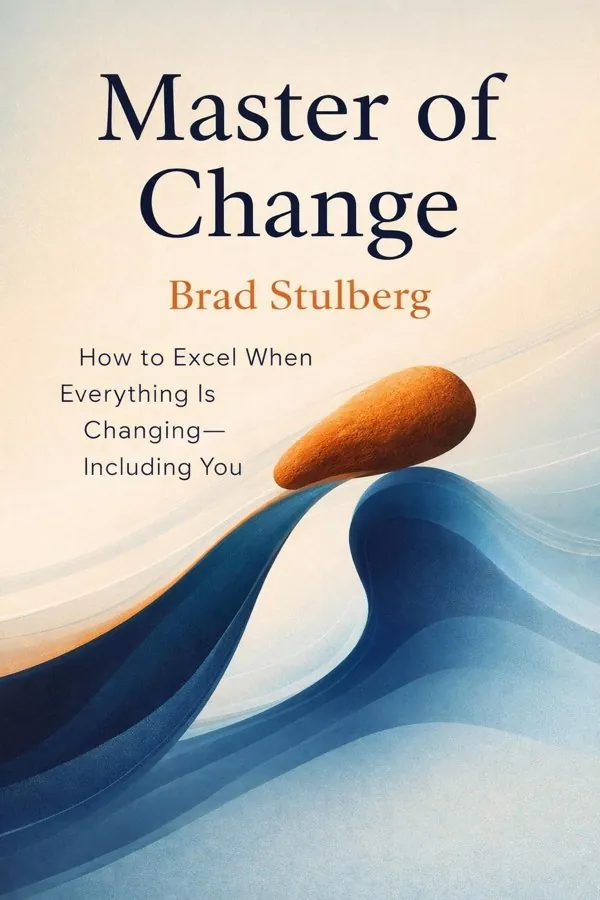
Master of Change: How to Excel When Everything Is Changing—Including You: Summary & Key Insights
 10 min10 chaptersAudio available
Key Takeaways from Master of Change: How to Excel When Everything Is Changing—Including You
One of the book’s most liberating ideas is that change is not a detour from life; it is life itself.
A hidden source of struggle during transition is our attachment to a fixed identity.
The central concept of the book is rugged flexibility, a phrase that captures the paradox of thriving through change.
Change often feels chaotic, but Stulberg explains that many transitions unfold in recognizable phases.
When the outside world becomes unstable, the answer is not to control everything around us but to cultivate steadiness within.
What Is Master of Change: How to Excel When Everything Is Changing—Including You About?
Master of Change: How to Excel When Everything Is Changing—Including You by Brad Stulberg is a mindset book spanning 10 pages. Most people treat change like a temporary storm: something to endure until life returns to normal. Brad Stulberg argues that this mindset is exactly what makes change so painful. In Master of Change, he shows that flux is not the exception to life but its baseline condition. Careers shift, relationships evolve, bodies age, goals change, and even our sense of self is constantly being revised. The challenge, then, is not to avoid change but to build the inner capacity to meet it well. Drawing from psychology, neuroscience, philosophy, contemplative traditions, and stories from athletes, executives, artists, and everyday people, Stulberg introduces a powerful framework he calls rugged flexibility. It is the ability to stay grounded without becoming rigid, and to adapt without losing yourself. This balance matters more than ever in a world defined by uncertainty, disruption, and continuous reinvention. Stulberg writes with unusual authority because he combines deep research with practical coaching experience. The result is a thoughtful, highly usable guide for anyone navigating transition, loss, ambition, burnout, identity shifts, or the simple reality of becoming someone new over time.
This FizzRead summary covers all 10 key chapters of Master of Change: How to Excel When Everything Is Changing—Including You in approximately 10 minutes, distilling the most important ideas, arguments, and takeaways from Brad Stulberg's work. Also available as an audio summary and Key Quotes Podcast.
Master of Change: How to Excel When Everything Is Changing—Including You
Most people treat change like a temporary storm: something to endure until life returns to normal. Brad Stulberg argues that this mindset is exactly what makes change so painful. In Master of Change, he shows that flux is not the exception to life but its baseline condition. Careers shift, relationships evolve, bodies age, goals change, and even our sense of self is constantly being revised. The challenge, then, is not to avoid change but to build the inner capacity to meet it well.
Drawing from psychology, neuroscience, philosophy, contemplative traditions, and stories from athletes, executives, artists, and everyday people, Stulberg introduces a powerful framework he calls rugged flexibility. It is the ability to stay grounded without becoming rigid, and to adapt without losing yourself. This balance matters more than ever in a world defined by uncertainty, disruption, and continuous reinvention.
Stulberg writes with unusual authority because he combines deep research with practical coaching experience. The result is a thoughtful, highly usable guide for anyone navigating transition, loss, ambition, burnout, identity shifts, or the simple reality of becoming someone new over time.
Who Should Read Master of Change: How to Excel When Everything Is Changing—Including You?
This book is perfect for anyone interested in mindset and looking to gain actionable insights in a short read. Whether you're a student, professional, or lifelong learner, the key ideas from Master of Change: How to Excel When Everything Is Changing—Including You by Brad Stulberg will help you think differently.
- ✓Readers who enjoy mindset and want practical takeaways
- ✓Professionals looking to apply new ideas to their work and life
- ✓Anyone who wants the core insights of Master of Change: How to Excel When Everything Is Changing—Including You in just 10 minutes
Want the full summary?
Get instant access to this book summary and 100K+ more with Fizz Moment.
Get Free SummaryAvailable on App Store • Free to download
Key Chapters
One of the book’s most liberating ideas is that change is not a detour from life; it is life itself. Much of our suffering comes from assuming that stability is the natural order and that disruption is an unwanted interruption. Stulberg challenges this belief by showing that change operates at every level of existence. Cells regenerate, emotions rise and fall, organizations evolve, relationships deepen or dissolve, and cultures continuously shift. When we expect permanence from an impermanent world, we set ourselves up for frustration.
This reframing matters because it changes how we interpret uncertainty. Instead of seeing change as evidence that something has gone wrong, we can begin to see it as the normal process of living, growing, and adapting. A career pivot, a move to a new city, becoming a parent, recovering from an injury, or grieving a loss are not anomalies. They are expressions of the fact that life is dynamic.
In practical terms, this mindset can reduce resistance. A manager facing team restructuring, for example, may stop asking, “How do I get back to the old normal?” and start asking, “What is this moment asking of me now?” A person dealing with aging may stop mourning a past identity and begin building new forms of strength and meaning.
The key is not to romanticize all change. Some transitions are painful and unfair. But even then, accepting that change is inevitable allows us to respond more wisely and less reactively.
Actionable takeaway: When facing a difficult transition, stop asking how to restore the past and instead ask, “Given that change is part of life, what is the most skillful next step I can take?”
A hidden source of struggle during transition is our attachment to a fixed identity. We tell ourselves stories about who we are: the high performer, the caregiver, the athlete, the expert, the provider, the independent one. These identities can give us direction and confidence, but they can also become cages. Stulberg argues that to navigate change well, we must hold identity with more openness and less rigidity.
This does not mean becoming rootless or inauthentic. It means recognizing that the self is not a finished product. Who you were at twenty cannot be exactly who you are at forty. The traits and roles that once served you may no longer fit the life you are living. Problems arise when we keep trying to force an old identity onto a new reality.
Consider an executive who loses a senior role and feels not only financially threatened but existentially shaken. The pain often comes not just from losing the job but from losing the identity attached to it. Or think of a former athlete whose body no longer performs the same way. If self-worth was built entirely around physical excellence, aging can feel like erasure. Stulberg suggests that growth requires grieving identities that no longer serve us while making room for new ones.
A healthier identity is one based less on specific labels and more on enduring values such as curiosity, courage, generosity, craftsmanship, or service. Roles may change, but values can remain steady anchors.
Actionable takeaway: Write down three roles you strongly identify with, then ask, “If this role changed tomorrow, what deeper value would still remain?” Build your identity around those values rather than around temporary labels.
The central concept of the book is rugged flexibility, a phrase that captures the paradox of thriving through change. Too much rigidity makes us brittle. Too much flexibility makes us unstable. What we need instead is an inner structure strong enough to provide grounding and loose enough to allow adaptation.
Stulberg contrasts rugged flexibility with two common but ineffective responses to upheaval. The first is fragility: becoming overwhelmed, defensive, or immobilized by change. The second is pseudo-resilience: appearing tough by denying vulnerability, refusing support, or clinging harder to control. Rugged flexibility offers a better path. It means staying rooted in values, purpose, and self-awareness while adjusting behavior, expectations, and identity to meet new realities.
Imagine a founder whose business model stops working. Rigidity would mean insisting on the old strategy despite clear evidence. Aimless flexibility would mean constantly chasing new directions without conviction. Rugged flexibility means staying true to the company’s mission while changing tactics, structure, and timelines. The same principle applies personally. After a breakup, a health diagnosis, or a failed goal, the question becomes: what do I need to preserve, and what do I need to revise?
This skill can be developed through reflection, emotional regulation, community support, and repeated practice in uncertainty. It is not a personality trait reserved for a lucky few. It is a capacity built over time through how we interpret challenges and how we respond to them.
Actionable takeaway: In any period of change, make two lists: “What must stay steady?” and “What must adapt?” Use the first to define your grounding and the second to guide your flexibility.
Change often feels chaotic, but Stulberg explains that many transitions unfold in recognizable phases. Understanding this can reduce confusion and shame. Instead of assuming that struggle means failure, we can see it as part of the process. Though transitions vary, they often include disruption, disorientation, adaptation, and integration.
The disruption phase begins when the old pattern no longer holds. This might be a job loss, relocation, illness, divorce, or even a positive event like a promotion or becoming a parent. Then comes disorientation, the unsettling middle space where old habits no longer fit but new ones have not yet formed. This phase can feel messy, anxious, and unproductive. Stulberg emphasizes that this middle zone is not a problem to rush through; it is where transformation happens.
Adaptation follows as new routines, stories, and capabilities begin to emerge. Over time, these become integrated into a revised sense of self. Yet even integration is not permanent. New changes will eventually reopen the cycle. This insight helps us treat transitions as recurring features of life rather than one-time crises.
A practical example is someone moving from individual contributor to manager. At first, they may rely on the same habits that made them successful before, only to find those habits ineffective. The in-between period may feel uncomfortable and incompetent. But with patience, support, and practice, a new leadership identity forms.
Actionable takeaway: When in upheaval, identify your phase: disruption, disorientation, adaptation, or integration. Naming your phase can replace self-criticism with perspective and help you choose the right response for where you actually are.
When the outside world becomes unstable, the answer is not to control everything around us but to cultivate steadiness within. Stulberg argues that grounding practices are essential because they give us something reliable to return to amid uncertainty. These practices do not remove change, but they prevent us from being completely swept away by it.
Grounding can take many forms: meditation, prayer, journaling, exercise, sleep routines, time in nature, breathwork, or simply a consistent morning ritual. The common thread is repetition. These practices remind the nervous system that not everything is chaos. They create a rhythm that supports clear thinking, emotional regulation, and wise action.
Stulberg also emphasizes values-based grounding. Beyond habits, we need principles that orient us when circumstances shift. If you know that honesty, service, and disciplined effort matter to you, then even when plans collapse, you still have a compass. Without grounding, people often seek relief through impulsive decisions, distraction, or overwork. With grounding, they are more likely to pause, reflect, and choose deliberately.
For example, someone navigating unemployment may not be able to control the market, but they can still control their daily structure: wake time, exercise, job-search blocks, and meaningful connection with others. A parent in a stressful season may not eliminate uncertainty, but can anchor family life through shared meals, bedtime rituals, and moments of presence.
Actionable takeaway: Choose one physical grounding practice and one values-based grounding practice to repeat daily for two weeks. Keep them simple enough that you can maintain them even on hard days.
Many people think resilience means holding on tighter. Stulberg argues that real resilience often requires release. We suffer not only because circumstances change, but because we cling to old plans, expectations, identities, and timelines. Letting go is difficult because it can feel like surrender or defeat. In reality, it is often the beginning of a more honest and workable life.
Acceptance is central here. Acceptance does not mean liking what happened or refusing to improve it. It means acknowledging reality as it is, not as we wish it were. Only from that place can effective action begin. If you keep arguing with what has already happened, your energy gets trapped in resistance rather than redirected toward adaptation.
This is especially important after loss or disappointment. A person whose marriage ends may keep replaying how things should have been. An entrepreneur whose company fails may stay attached to a version of success that no longer exists. A patient with chronic illness may continue measuring life against former capacity. Letting go does not erase grief. It allows grief to move rather than harden into bitterness.
Stulberg’s insight is that release creates room. When we stop gripping the past, we can notice new options, identities, and forms of meaning. This process is often gradual and nonlinear. Some days acceptance feels available; other days it does not. That is normal.
Actionable takeaway: Complete the sentence, “I am suffering because I am still holding on to…” Then ask, “What would accepting reality today make possible?” Use the answer to guide one concrete action.
A major myth of modern self-help is that strength is an individual achievement. Stulberg pushes back against this by showing that adaptation is deeply social. During periods of change, people often isolate because they feel ashamed, confused, or afraid of burdening others. Yet isolation tends to magnify distress. Community, by contrast, provides perspective, regulation, and belonging.
Humans are relational creatures. Our nervous systems calm in the presence of trusted others. We make better meaning of our experiences when we can speak them aloud and be witnessed without judgment. Community also protects us from self-distorting narratives. Left alone, a setback can easily become “I am a failure.” In conversation, it may become “I am going through a hard transition.” That difference matters.
Support does not have to mean a huge network. It can be one friend, a therapist, a coach, a spiritual group, a running club, or a family ritual. What matters is genuine connection. In organizations, leaders can build this kind of resilience by normalizing uncertainty, encouraging honest dialogue, and making mutual support part of team culture rather than a private afterthought.
Consider someone recovering from burnout. Alone, they may interpret rest as weakness. In a supportive environment, they may learn that healing requires boundaries, recovery, and self-respect. Or think of a person moving through grief. Community does not remove pain, but it keeps pain from becoming exile.
Actionable takeaway: Identify two people you can be honest with during change. Reach out to one this week, not to report success, but to share what is actually hard and what kind of support would help.
Change becomes more bearable when it is connected to meaning. Stulberg argues that purpose is not merely a motivational slogan; it is a stabilizing force. When external conditions become uncertain, a sense of deeper purpose helps us endure discomfort, make wiser decisions, and keep moving without collapsing into cynicism or drift.
Importantly, purpose need not be grand or permanent. It does not require a dramatic life mission. It can be simple, local, and evolving: raising children well, serving clients with integrity, creating useful work, helping a community, learning deeply, or being a steady friend. What matters is that purpose points beyond ego and immediate comfort.
Without purpose, change can feel random and depleting. With purpose, even painful effort can feel coherent. A medical resident may tolerate exhausting training because it serves the larger aim of becoming a compassionate physician. A person rebuilding after divorce may find direction in becoming a more present parent. Someone recovering from injury may shift from chasing former performance to mentoring others through similar setbacks.
Purpose also protects against the trap of treating every change as a referendum on personal worth. If your aim is contribution rather than constant self-validation, you are less likely to be derailed by temporary setbacks. Purpose provides continuity even when identity and circumstances evolve.
Actionable takeaway: Write one sentence beginning with, “In this season of change, what matters most is…” Revisit it each morning for a week and use it to guide one decision per day.
One of the most practical insights in Master of Change is that adaptability can be trained before life forces it upon us. We often wait until a major disruption to develop resilience, but Stulberg suggests that small, voluntary challenges build the capacity to handle larger, involuntary ones. In other words, change-readiness is a practice.
This can look like deliberately stepping outside comfort zones, experimenting with new routines, taking breaks from constant certainty, or learning to tolerate not knowing. Examples include trying a new skill where you are not instantly competent, taking reflective pauses before reacting, changing a rigid routine, or having difficult conversations you have been avoiding. These experiences teach the mind and body that unfamiliarity is survivable.
The goal is not chaos for its own sake. It is to become less dependent on perfect conditions. A leader who occasionally invites feedback they may not like becomes more able to handle criticism during crisis. A professional who experiments with identity beyond work may cope better if a career change becomes necessary. A person who practices rest and boundaries before burnout hits is less likely to break when stress rises.
This idea mirrors physical training. You do not prepare for a marathon by waiting for race day. Similarly, you do not prepare for change by pretending life will stay fixed. Small acts of adaptive practice increase confidence, self-trust, and emotional range.
Actionable takeaway: Choose one small discomfort to practice this week, such as asking for feedback, trying something new, or changing a routine. Treat it as adaptability training rather than as a test of performance.
The final lesson is subtle but powerful: mastery of change does not mean transcending difficulty or becoming endlessly optimized. It means integrating experience so that change deepens you rather than fragments you. Stulberg warns against chasing a fantasy in which every challenge leads to immediate reinvention and constant upward progress. Real growth is slower, more human, and often uneven.
Integration means making sense of what happened, incorporating what you learned, and allowing the experience to reshape your life in honest ways. It is the process by which pain becomes wisdom, disruption becomes perspective, and uncertainty becomes maturity. This does not mean every event contains a hidden gift, nor that suffering should be glorified. It means that when change occurs, we have the opportunity to metabolize it instead of merely surviving it.
For example, someone who goes through burnout may emerge not just with better time management but with a transformed relationship to ambition. A person who experiences illness may develop more compassion, clearer priorities, and a less brittle identity. Integration turns events into insight and insight into character.
This is where the book’s ideas come together. Change is constant. Identity evolves. Rugged flexibility helps us stay grounded while adapting. Community, purpose, acceptance, and practice all support the process. The end goal is not control. It is wholeness within motion.
Actionable takeaway: After any significant transition, ask yourself three questions: “What ended? What began? What in me is different now?” Write down the answers to help convert experience into integrated growth.
All Chapters in Master of Change: How to Excel When Everything Is Changing—Including You
About the Author
Brad Stulberg is an American author, coach, and speaker whose work focuses on performance, mental health, resilience, and sustainable success. He is widely known for translating research from psychology, neuroscience, and behavioral science into practical advice for everyday life. Stulberg has written several influential books, including Peak Performance, The Practice of Groundedness, and Master of Change. His essays and commentary have appeared in major publications such as The New York Times, The Wall Street Journal, and New York magazine. In addition to writing, he coaches executives, entrepreneurs, athletes, and leaders on how to pursue excellence without sacrificing well-being. His work stands out for balancing ambition with wisdom, and discipline with humanity.
Get This Summary in Your Preferred Format
Read or listen to the Master of Change: How to Excel When Everything Is Changing—Including You summary by Brad Stulberg anytime, anywhere. FizzRead offers multiple formats so you can learn on your terms — all free.
Available formats: App · Audio · PDF · EPUB — All included free with FizzRead
Download Master of Change: How to Excel When Everything Is Changing—Including You PDF and EPUB Summary
Key Quotes from Master of Change: How to Excel When Everything Is Changing—Including You
“One of the book’s most liberating ideas is that change is not a detour from life; it is life itself.”
“A hidden source of struggle during transition is our attachment to a fixed identity.”
“The central concept of the book is rugged flexibility, a phrase that captures the paradox of thriving through change.”
“Change often feels chaotic, but Stulberg explains that many transitions unfold in recognizable phases.”
“When the outside world becomes unstable, the answer is not to control everything around us but to cultivate steadiness within.”
Frequently Asked Questions about Master of Change: How to Excel When Everything Is Changing—Including You
Master of Change: How to Excel When Everything Is Changing—Including You by Brad Stulberg is a mindset book that explores key ideas across 10 chapters. Most people treat change like a temporary storm: something to endure until life returns to normal. Brad Stulberg argues that this mindset is exactly what makes change so painful. In Master of Change, he shows that flux is not the exception to life but its baseline condition. Careers shift, relationships evolve, bodies age, goals change, and even our sense of self is constantly being revised. The challenge, then, is not to avoid change but to build the inner capacity to meet it well. Drawing from psychology, neuroscience, philosophy, contemplative traditions, and stories from athletes, executives, artists, and everyday people, Stulberg introduces a powerful framework he calls rugged flexibility. It is the ability to stay grounded without becoming rigid, and to adapt without losing yourself. This balance matters more than ever in a world defined by uncertainty, disruption, and continuous reinvention. Stulberg writes with unusual authority because he combines deep research with practical coaching experience. The result is a thoughtful, highly usable guide for anyone navigating transition, loss, ambition, burnout, identity shifts, or the simple reality of becoming someone new over time.
More by Brad Stulberg

You Might Also Like

Browse by Category
Ready to read Master of Change: How to Excel When Everything Is Changing—Including You?
Get the full summary and 100K+ more books with Fizz Moment.