
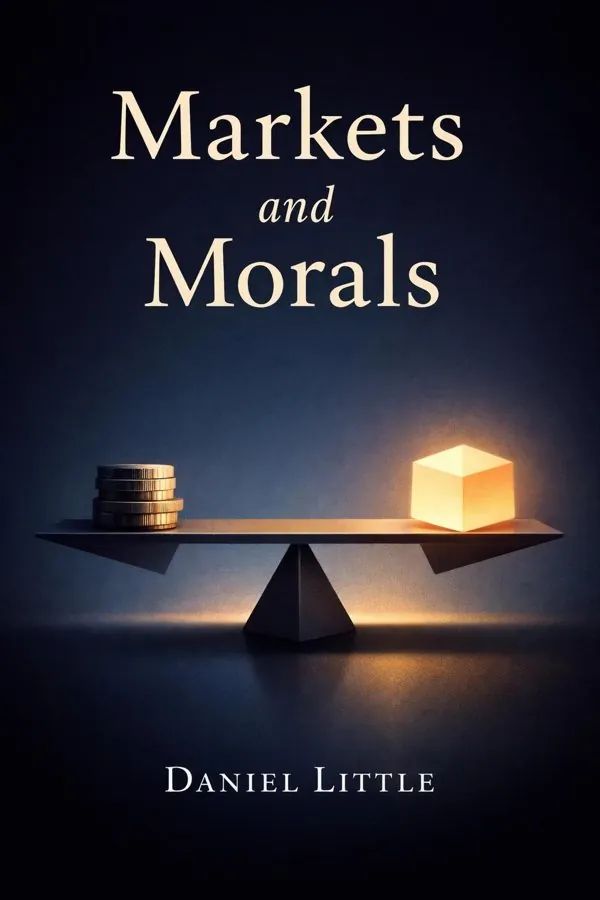
Markets and Morals: Summary & Key Insights
 10 min10 chaptersAudio available
What Is Markets and Morals About?
Markets and Morals by Daniel Little is a ethics book spanning 10 pages. This book explores the relationship between economic systems and moral philosophy, examining how markets influence ethical behavior and social justice. Daniel Little analyzes the moral foundations of capitalism, the ethical implications of market outcomes, and the tension between efficiency and fairness in modern economies.
This FizzRead summary covers all 10 key chapters of Markets and Morals in approximately 10 minutes, distilling the most important ideas, arguments, and takeaways from Daniel Little's work. Also available as an audio summary and Key Quotes Podcast.
Markets and Morals
This book explores the relationship between economic systems and moral philosophy, examining how markets influence ethical behavior and social justice. Daniel Little analyzes the moral foundations of capitalism, the ethical implications of market outcomes, and the tension between efficiency and fairness in modern economies.
Who Should Read Markets and Morals?
This book is perfect for anyone interested in ethics and looking to gain actionable insights in a short read. Whether you're a student, professional, or lifelong learner, the key ideas from Markets and Morals by Daniel Little will help you think differently.
- ✓Readers who enjoy ethics and want practical takeaways
- ✓Professionals looking to apply new ideas to their work and life
- ✓Anyone who wants the core insights of Markets and Morals in just 10 minutes
Want the full summary?
Get instant access to this book summary and 100K+ more with Fizz Moment.
Get Free SummaryAvailable on App Store • Free to download
Key Chapters
To understand the moral dimensions of market life, we must trace their intellectual lineage. Classical economics did not emerge in moral isolation; Adam Smith, David Hume, and John Stuart Mill all operated within a framework that viewed economic behavior as a branch of moral philosophy. In *The Theory of Moral Sentiments*, Smith characterized individuals not as isolated profit-seekers but as beings guided by sympathy—the ability to imagine and respond to the emotions of others. The moral order was natural, grounded in human sociability, and only later did Smith show, in *The Wealth of Nations*, how these sentiments structured the functioning of the market.
The invisible hand, often misinterpreted as the pure justification of self-interest, was for Smith a metaphor of moral harmony: individuals, acting within the bounds of justice and virtue, might contribute unintentionally to the social good. But crucially, that unintended benefit could only arise when moral sentiments already constrain selfish impulses. When later economists abstracted markets from this ethical heritage, they stripped the system of its normative foundation, leaving us with an efficiency-driven mechanism that seems autonomous from human values.
In revisiting these traditions, I argue that the history of economic thought must be read as an unfolding moral drama—one that began with a belief in communal virtue and slowly drifted toward technical rationality. The Enlightenment’s faith in reason fostered optimism that human freedom and prosperity could harmonize, yet as industrialization deepened, we saw freedom transform into a license for exploitation. This tension sets the stage for the modern moral dilemma of capitalism: whether the pursuit of wealth can remain consistent with the pursuit of virtue.
The moral appeal of capitalism rests on its promise of autonomy, choice, and voluntary cooperation. At its best, the market embodies respect for individual agency—the right of each person to pursue her vision of the good life. This voluntarist ideal anchors capitalism within the moral philosophy of liberalism, where consent and non-coercion form the bedrock of ethical legitimacy.
Yet autonomy alone cannot bear the full moral weight of economic order. Freedom of choice must be meaningful, not merely formal. When poverty or inequality strips individuals of genuine alternatives, the supposed voluntariness of market exchange becomes hollow. I contend that capitalism must be justified not only in terms of liberty but also in terms of moral equality—recognition of each participant in the market as an equal moral agent deserving respect and fair opportunity.
Moreover, the pursuit of profit involves moral responsibility. A market devoid of ethical norms tends toward exploitation, environmental degradation, and disregard for human welfare. The defense of capitalism as a system of mutual benefit presupposes a moral culture of trust, honesty, and fairness—elements that cannot be generated by market incentives alone but must be cultivated within social institutions and personal character.
Thus, the moral foundation of capitalism requires balance: liberty must coexist with justice, autonomy with solidarity. To see this is to recover the moral heart of modern economics and to recognize that market success cannot be ethically neutral. Every transaction expresses a choice not only about value but about what we value.
+ 8 more chapters — available in the FizzRead app
All Chapters in Markets and Morals
About the Author
Daniel Little is an American philosopher and social scientist known for his work in the philosophy of social science, ethics, and economic theory. He has served as a professor at the University of Michigan–Dearborn and has written extensively on moral reasoning and social explanation.
Get This Summary in Your Preferred Format
Read or listen to the Markets and Morals summary by Daniel Little anytime, anywhere. FizzRead offers multiple formats so you can learn on your terms — all free.
Available formats: App · Audio · PDF · EPUB — All included free with FizzRead
Download Markets and Morals PDF and EPUB Summary
Key Quotes from Markets and Morals
“To understand the moral dimensions of market life, we must trace their intellectual lineage.”
“The moral appeal of capitalism rests on its promise of autonomy, choice, and voluntary cooperation.”
Frequently Asked Questions about Markets and Morals
Markets and Morals by Daniel Little is a ethics book that explores key ideas across 10 chapters. This book explores the relationship between economic systems and moral philosophy, examining how markets influence ethical behavior and social justice. Daniel Little analyzes the moral foundations of capitalism, the ethical implications of market outcomes, and the tension between efficiency and fairness in modern economies.
You Might Also Like
What We Owe the Future
William MacAskill
10 min
Abortion
David Boonin
10 min
Blind Spots: Why We Fail to Do What's Right and What to Do About It
Max H. Bazerman, Ann E. Tenbrunsel
10 min
Digital Ethics: Research and Practice
Christopher Burr, Luciano Floridi (Editors)
10 min
Doing Good Better: Effective Altruism and a Radical New Way to Make a Difference
William MacAskill
10 min
Eating Animals
Jonathan Safran Foer
10 minBrowse by Category
Ready to read Markets and Morals?
Get the full summary and 100K+ more books with Fizz Moment.