
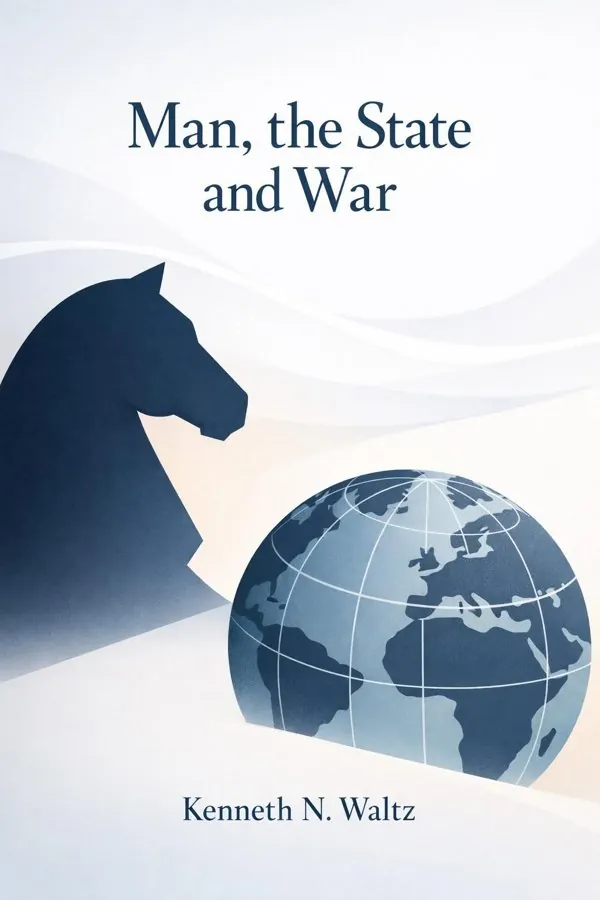
Man, the State and War: A Theoretical Analysis: Summary & Key Insights
 10 min9 chaptersAudio available
What Is Man, the State and War: A Theoretical Analysis About?
Man, the State and War: A Theoretical Analysis by Kenneth N. Waltz is a politics book spanning 9 pages. This seminal work by Kenneth N. Waltz explores the causes of war through three distinct levels of analysis: the individual, the state, and the international system. Waltz examines how human nature, the internal organization of states, and the anarchic structure of the international system each contribute to the persistence of conflict. The book lays the foundation for modern realist theory in international relations and remains a cornerstone of political science scholarship.
This FizzRead summary covers all 9 key chapters of Man, the State and War: A Theoretical Analysis in approximately 10 minutes, distilling the most important ideas, arguments, and takeaways from Kenneth N. Waltz's work. Also available as an audio summary and Key Quotes Podcast.
Man, the State and War: A Theoretical Analysis
This seminal work by Kenneth N. Waltz explores the causes of war through three distinct levels of analysis: the individual, the state, and the international system. Waltz examines how human nature, the internal organization of states, and the anarchic structure of the international system each contribute to the persistence of conflict. The book lays the foundation for modern realist theory in international relations and remains a cornerstone of political science scholarship.
Who Should Read Man, the State and War: A Theoretical Analysis?
This book is perfect for anyone interested in politics and looking to gain actionable insights in a short read. Whether you're a student, professional, or lifelong learner, the key ideas from Man, the State and War: A Theoretical Analysis by Kenneth N. Waltz will help you think differently.
- ✓Readers who enjoy politics and want practical takeaways
- ✓Professionals looking to apply new ideas to their work and life
- ✓Anyone who wants the core insights of Man, the State and War: A Theoretical Analysis in just 10 minutes
Want the full summary?
Get instant access to this book summary and 100K+ more with Fizz Moment.
Get Free SummaryAvailable on App Store • Free to download
Key Chapters
Our first image begins with the oldest and most persistent explanation of war: that conflict originates in human nature. Since the time of classical philosophers, men have asked whether war arises from the evil impulses of the human heart or from the limitations imposed by our imperfect reason. I have examined the views of theologians and thinkers such as St. Augustine, who saw war as the consequence of original sin, and modern thinkers like Reinhold Niebuhr, who understood aggression as a reflection of the tension between man’s moral ideals and his finite capacities. They converge in an understanding that the potential for conflict lies within every individual.
When we attribute war to human nature, we are tempted to believe that improving the moral fiber of men could lead to lasting peace. But history mocks this hope. If war depends upon the vices of individuals, how do we explain its organization on vast scales, its persistence across epochs and cultures? Men differ widely in temperament; some are gentle, others cruel. The question, then, is not why certain individuals fight, but why whole nations collectively engage in war.
This image is insightful but incomplete. It makes us aware of our flaws, but it cannot explain recurring patterns of organized conflict despite the moral progress of man. Even societies composed of kind, rational individuals find themselves drawn into wars they did not seek. Thus, we must move beyond moral psychology to examine the structures through which men act collectively. Human nature sets the conditions, but it does not constitute the mechanism.
It is seductive to imagine that the improvement of man can cure the maladies of politics. Philosophy, literature, and religion are full of appeals to moral reform as the path to peace. But when we test this hypothesis against reality, it collapses. The persistence of conflict across centuries shows that no degree of moral restraint or education eliminates warfare. The problem lies not only within man’s passions but within the arrangements that translate those passions into action.
Even if every individual preferred peace, the structure of international life could still compel competition. Wars are not merely private quarrels enlarged—they are products of collective decisions shaped by incentives, fears, and uncertainties that exceed personal morality. To conclude that war is an expression of human nature is to stop inquiry at the surface. We may understand aggression in the individual, but we cannot deduce the probability of war among nations from psychology alone.
Thus, I argue that the first image provides an important beginning but an unsatisfactory end. We require a more institutional lens to see how human impulses are organized, restrained, or unleashed by systems of governance.
+ 7 more chapters — available in the FizzRead app
All Chapters in Man, the State and War: A Theoretical Analysis
About the Author
Kenneth Neal Waltz (1924–2013) was an American political scientist and one of the most influential figures in the field of international relations. He is best known for developing neorealism, or structural realism, which emphasizes the anarchic structure of the international system as the primary determinant of state behavior. Waltz served as a professor at Columbia University and the University of California, Berkeley, and authored several landmark works including 'Theory of International Politics'.
Get This Summary in Your Preferred Format
Read or listen to the Man, the State and War: A Theoretical Analysis summary by Kenneth N. Waltz anytime, anywhere. FizzRead offers multiple formats so you can learn on your terms — all free.
Available formats: App · Audio · PDF · EPUB — All included free with FizzRead
Download Man, the State and War: A Theoretical Analysis PDF and EPUB Summary
Key Quotes from Man, the State and War: A Theoretical Analysis
“Our first image begins with the oldest and most persistent explanation of war: that conflict originates in human nature.”
“It is seductive to imagine that the improvement of man can cure the maladies of politics.”
Frequently Asked Questions about Man, the State and War: A Theoretical Analysis
Man, the State and War: A Theoretical Analysis by Kenneth N. Waltz is a politics book that explores key ideas across 9 chapters. This seminal work by Kenneth N. Waltz explores the causes of war through three distinct levels of analysis: the individual, the state, and the international system. Waltz examines how human nature, the internal organization of states, and the anarchic structure of the international system each contribute to the persistence of conflict. The book lays the foundation for modern realist theory in international relations and remains a cornerstone of political science scholarship.
You Might Also Like
Antifa: The Anti-Fascist Handbook
Mark Bray
10 min
Attack from Within: How Disinformation Is Sabotaging America
Barbara McQuade
10 min
Coercion, Capital, and European States, AD 990–1992
Charles Tilly
10 min
Digital Democracy: Concepts, Methodologies, Tools, and Applications
Various Authors
10 min
Fascism
Stanley G. Payne
10 min
Fire And Fury: Inside The Trump White House
Michael Wolff
10 minBrowse by Category
Ready to read Man, the State and War: A Theoretical Analysis?
Get the full summary and 100K+ more books with Fizz Moment.