
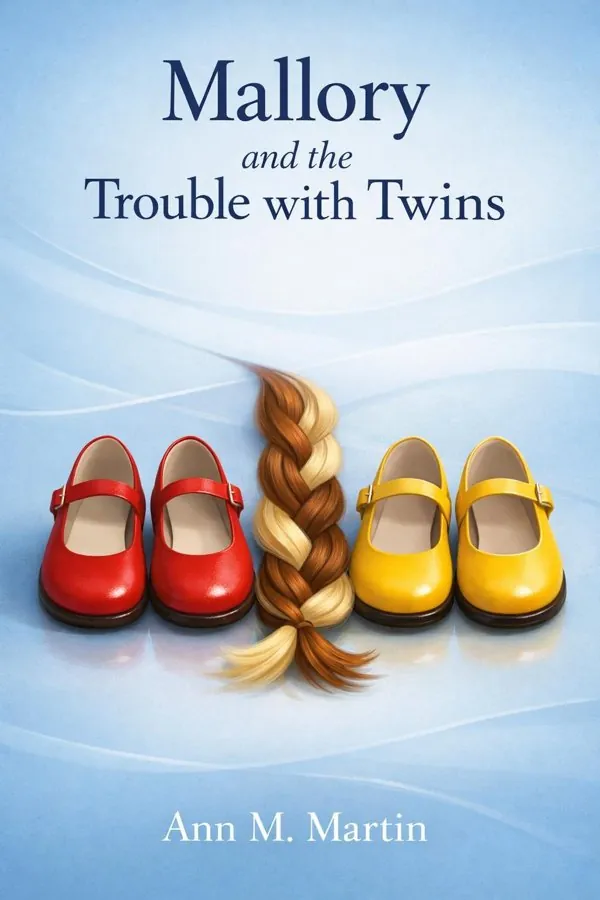
Mallory and the Trouble with Twins: Summary & Key Insights
 10 min3 chaptersAudio available
What Is Mallory and the Trouble with Twins About?
Mallory and the Trouble with Twins by Ann M. Martin is a bestsellers book spanning 3 pages. Mallory Pike joins the Baby-Sitters Club and faces her first big challenge when she agrees to babysit identical twins Marilyn and Carolyn Arnold. The twins’ constant pranks and confusing behavior make Mallory question her babysitting skills, but she learns valuable lessons about patience, individuality, and understanding children’s personalities.
This FizzRead summary covers all 3 key chapters of Mallory and the Trouble with Twins in approximately 10 minutes, distilling the most important ideas, arguments, and takeaways from Ann M. Martin's work. Also available as an audio summary and Key Quotes Podcast.
Mallory and the Trouble with Twins
Mallory Pike joins the Baby-Sitters Club and faces her first big challenge when she agrees to babysit identical twins Marilyn and Carolyn Arnold. The twins’ constant pranks and confusing behavior make Mallory question her babysitting skills, but she learns valuable lessons about patience, individuality, and understanding children’s personalities.
Who Should Read Mallory and the Trouble with Twins?
This book is perfect for anyone interested in bestsellers and looking to gain actionable insights in a short read. Whether you're a student, professional, or lifelong learner, the key ideas from Mallory and the Trouble with Twins by Ann M. Martin will help you think differently.
- ✓Readers who enjoy bestsellers and want practical takeaways
- ✓Professionals looking to apply new ideas to their work and life
- ✓Anyone who wants the core insights of Mallory and the Trouble with Twins in just 10 minutes
Want the full summary?
Get instant access to this book summary and 100K+ more with Fizz Moment.
Get Free SummaryAvailable on App Store • Free to download
Key Chapters
Becoming an official member of the Baby-Sitters Club was one of the biggest thrills of my life. I’d looked up to Kristy, Claudia, Mary Anne, and Stacey for so long—they seemed so confident, so organized, and so connected with the kids they cared for. When they finally voted me in, it felt like stepping into a world of responsibility and trust. But as soon as the excitement settled, reality kicked in. Every member had to prove she could handle tough babysitting jobs, and my first major assignment would set the tone for how they saw me.
Enter the Arnold family. Mrs. Arnold had two daughters—Marilyn and Carolyn—identical twins who could switch places faster than anyone could blink. I still remember the day I walked into their house, my arms packed with coloring books and craft supplies, feeling ready for anything. The first hour was fine—they were polite, curious, and seemed eager to play. But before long, things started getting… confusing. One twin would tell me she was Marilyn. The next minute, she’d insist she was Carolyn. They were masters at swapping places, subtly changing earrings or ribbons to make me question everything. I laughed it off at first, but soon their pranks started wearing me down.
The deeper frustration wasn’t just about being fooled; it was about feeling inadequate. I wanted to be the kind of sitter who noticed everything, who could manage even the most chaotic kids. But Marilyn and Carolyn were different—they didn’t want to be managed. They wanted to be understood. And I couldn’t yet see that part of the problem wasn’t their behavior—it was the world adults had built around them.
Their parents, well-meaning but particular, loved dressing them identically. Matching dresses, matching hairstyles, even matching speech patterns. They treated their daughters as if they were a perfect pair rather than two unique people. No wonder the girls leaned into tricks and confusion—it was their only way to assert control. I learned this slowly, through long afternoons of babysitting where my patience stretched thinner than I expected. Every mistake taught me something. Every prank reminded me that beneath that identical surface were two imaginations yearning to be recognized separately. It was the beginning of an important lesson—sometimes, when you try to treat everyone the same, you end up missing who they truly are.
I began paying closer attention—not just to what Marilyn and Carolyn looked like, but to how they *felt*. In quiet moments, when the mischief calmed, I started to see hints of difference. Marilyn moved with a kind of grace, drawn to the piano or to singing softly under her breath. Her world was gentle, rhythmic, and precise. Carolyn, on the other hand, loved adventures; she asked endless questions and had a fascination with how things worked. Where Marilyn dreamed in melodies, Carolyn dreamed in experiments.
It was like watching color seep through a black-and-white sketch. The more I saw their differences, the more I understood that their identical appearances weren’t the problem—it was everyone’s assumption that those appearances defined them. The girls mirrored each other because that’s what they were taught to do. Once I began treating them as individuals, they started opening up. Marilyn told me about her favorite composers; Carolyn showed me a miniature telescope she’d built. Through these interactions, I realized how quickly children retreat into sameness when adults fail to notice who they are.
Even so, change didn’t come easily. When I gently suggested they might dress differently—just once, so it would be easier for me to tell them apart—they resisted. They’d been told for years that their sameness was special. Breaking that pattern felt like betrayal. I had to learn to be patient, to make discovery feel safe instead of forced. So I focused on their interests rather than their appearances. I spent afternoons listening to Marilyn play piano, asking Carolyn questions about the stars, helping each one pursue her chosen joys without pressing too hard. Slowly, the twins began to separate—not as rivals, but as sisters who enjoyed each other’s differences.
I remember one moment vividly—Marilyn sitting at the piano, Carolyn humming beside her, both smiling, both comfortable in their own skin. That was the moment I realized how powerful individuality really is. My job wasn’t to make them different for convenience. It was to help them see that being different from one another made them complete.
+ 1 more chapters — available in the FizzRead app
All Chapters in Mallory and the Trouble with Twins
About the Author
Ann M. Martin is an American author best known for creating The Baby-Sitters Club series, which has sold millions of copies worldwide. Born in Princeton, New Jersey, she began her career as an editor before writing full-time. Her works often explore friendship, family, and growing up.
Get This Summary in Your Preferred Format
Read or listen to the Mallory and the Trouble with Twins summary by Ann M. Martin anytime, anywhere. FizzRead offers multiple formats so you can learn on your terms — all free.
Available formats: App · Audio · PDF · EPUB — All included free with FizzRead
Download Mallory and the Trouble with Twins PDF and EPUB Summary
Key Quotes from Mallory and the Trouble with Twins
“Becoming an official member of the Baby-Sitters Club was one of the biggest thrills of my life.”
“I began paying closer attention—not just to what Marilyn and Carolyn looked like, but to how they *felt*.”
Frequently Asked Questions about Mallory and the Trouble with Twins
Mallory and the Trouble with Twins by Ann M. Martin is a bestsellers book that explores key ideas across 3 chapters. Mallory Pike joins the Baby-Sitters Club and faces her first big challenge when she agrees to babysit identical twins Marilyn and Carolyn Arnold. The twins’ constant pranks and confusing behavior make Mallory question her babysitting skills, but she learns valuable lessons about patience, individuality, and understanding children’s personalities.
More by Ann M. Martin




You Might Also Like

The Godfather
Mario Puzo
10 min
The Handmaid's Tale
Margaret Atwood
10 min
The Hunger Games
Suzanne Collins
10 min
The Nightingale
Kristin Hannah
10 min
The Seven Husbands of Evelyn Hugo
Taylor Jenkins Reid
10 min
Backwater Justice
Fern Michaels
10 minBrowse by Category
Ready to read Mallory and the Trouble with Twins?
Get the full summary and 100K+ more books with Fizz Moment.