
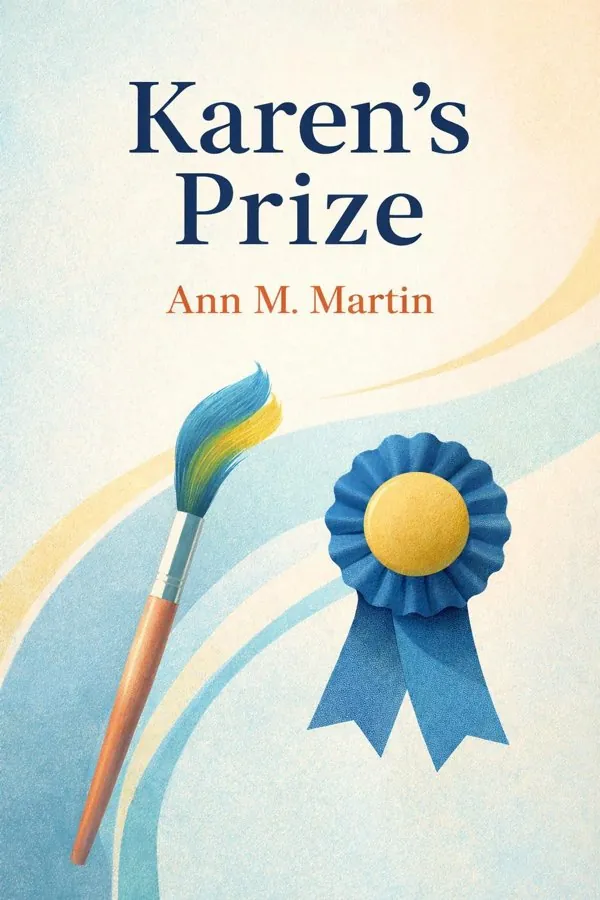
Karen's Prize: Summary & Key Insights
 10 min8 chaptersAudio available
Key Takeaways from Karen's Prize
Creativity often begins not with talent, but with permission.
Self-doubt usually enters quietly, especially when other people are involved.
Winning is rarely as simple as children imagine it will be.
Contests do more than rank performance; they expose how people think about themselves and others.
Children are often told to be creative, but they are not always shown that creativity is personal.
What Is Karen's Prize About?
Karen's Prize by Ann M. Martin is a bestsellers book spanning 3 pages. Karen's Prize by Ann M. Martin is a warm, accessible children's story about what happens when a simple school art contest turns into a lesson in confidence, humility, and growing up. Karen is thrilled by the chance to create something special, but her excitement quickly becomes mixed with nerves, comparison, and the pressure to do well. As she paints, hopes, worries, and finally responds to the outcome, readers see how creativity can bring out both joy and insecurity. What makes the book matter is its understanding of small childhood moments that feel enormous when you are living them. A contest at school is never just a contest; it becomes a test of identity, friendship, fairness, and self-worth. Martin, best known for The Baby-Sitters Club and the Baby-Sitters Little Sister series, has a rare gift for translating children's emotional worlds with honesty and tenderness. In Karen's Prize, she shows that winning can feel complicated, that trying your best matters, and that real success often comes from learning how to be proud without losing kindness.
This FizzRead summary covers all 8 key chapters of Karen's Prize in approximately 10 minutes, distilling the most important ideas, arguments, and takeaways from Ann M. Martin's work. Also available as an audio summary and Key Quotes Podcast.
Karen's Prize
Karen's Prize by Ann M. Martin is a warm, accessible children's story about what happens when a simple school art contest turns into a lesson in confidence, humility, and growing up. Karen is thrilled by the chance to create something special, but her excitement quickly becomes mixed with nerves, comparison, and the pressure to do well. As she paints, hopes, worries, and finally responds to the outcome, readers see how creativity can bring out both joy and insecurity. What makes the book matter is its understanding of small childhood moments that feel enormous when you are living them. A contest at school is never just a contest; it becomes a test of identity, friendship, fairness, and self-worth. Martin, best known for The Baby-Sitters Club and the Baby-Sitters Little Sister series, has a rare gift for translating children's emotional worlds with honesty and tenderness. In Karen's Prize, she shows that winning can feel complicated, that trying your best matters, and that real success often comes from learning how to be proud without losing kindness.
Who Should Read Karen's Prize?
This book is perfect for anyone interested in bestsellers and looking to gain actionable insights in a short read. Whether you're a student, professional, or lifelong learner, the key ideas from Karen's Prize by Ann M. Martin will help you think differently.
- ✓Readers who enjoy bestsellers and want practical takeaways
- ✓Professionals looking to apply new ideas to their work and life
- ✓Anyone who wants the core insights of Karen's Prize in just 10 minutes
Want the full summary?
Get instant access to this book summary and 100K+ more with Fizz Moment.
Get Free SummaryAvailable on App Store • Free to download
Key Chapters
Creativity often begins not with talent, but with permission. In Karen's Prize, everything starts when Karen hears about a school art contest, and that announcement lights up her imagination. Suddenly, ordinary school life feels more vivid. A blank sheet of paper becomes a possibility. A box of crayons or paints becomes a set of choices. What Ann M. Martin captures beautifully is the emotional force of that moment: before the contest is judged, before anyone compares results, there is pure excitement. Karen dreams, plans, and imagines what she might create, and in doing so she experiences one of childhood's most valuable lessons: making something can be thrilling in itself.
This idea matters because many children, and adults too, assume creativity belongs to the naturally gifted. The story quietly argues the opposite. Inspiration comes alive when someone is invited to participate. A teacher who announces a contest, a parent who displays a drawing on the fridge, or a friend who says, "That's a great idea," can open the door to self-expression. Karen's enthusiasm shows how confidence often begins before skill does.
In practical terms, this applies far beyond art. A writing assignment, science fair, or music recital can all trigger the same burst of possibility. The important thing is to start before overthinking takes over. Karen's first response is not perfectionism; it is eagerness. That eagerness is precious because it fuels effort and experimentation.
The deeper insight is that inspiration should be protected. Comparison, fear, and self-criticism often arrive later. Martin reminds readers that the earliest stage of any creative act is playful, curious, and hopeful. That mindset deserves attention because it helps children develop resilience and joy in learning.
Actionable takeaway: when a new opportunity appears, focus first on curiosity instead of outcome. Ask, "What do I want to make?" before asking, "Will it be the best?"
Self-doubt usually enters quietly, especially when other people are involved. After Karen's initial excitement about the art contest, she begins noticing what her classmates are doing. Their paintings seem brighter, neater, or more impressive. What felt fun now starts to feel risky. Ann M. Martin shows how quickly confidence can shrink when we compare our work to someone else's. Karen's emotional journey is familiar: first there is enthusiasm, then there is uncertainty, and then comes the question many children ask themselves—"What if mine isn't good enough?"
This is one of the book's most important lessons because doubt is not a sign that someone should quit. It is often a sign that they care. Karen's worries do not mean she lacks creativity; they mean she is invested in what she is making. Martin treats this feeling with empathy rather than judgment. She does not mock Karen's insecurity or solve it instantly. Instead, the story allows readers to see that doubt is part of trying.
In everyday life, children experience this during school projects, sports, performances, and even friendships. A child may love singing until hearing a stronger voice nearby. A student may enjoy writing until someone else's story gets more praise. Adults are no different. We compare careers, homes, achievements, and appearance. Karen's experience gives younger readers a simple but powerful framework for handling these feelings.
The practical application is to separate effort from comparison. A painting does not lose its value because another painting is different. A project can still be meaningful even if someone else appears more polished. Karen learns, in her own childlike way, that finishing honestly matters more than performing perfectly.
Martin's message is subtle but strong: courage is not the absence of doubt. Courage is continuing while doubt sits beside you.
Actionable takeaway: when comparison makes you feel smaller, redirect attention to your own process by asking, "What part of my work am I proud I completed?"
Winning is rarely as simple as children imagine it will be. In Karen's Prize, the contest result matters, but the real point is what Karen learns from receiving recognition. A prize seems like the final answer to an emotional struggle: if you win, you must be talented; if you lose, you must not be. Ann M. Martin gently dismantles that idea. Karen's prize brings excitement, pride, and validation, but it also raises questions about how to respond, how to stay kind, and how to understand success without becoming arrogant.
This is why the title itself is meaningful. The prize is not only the ribbon, certificate, or public acknowledgment. The deeper prize is growth. Karen discovers that being recognized feels wonderful, but it does not make her more important than other children. Nor does it erase the effort everyone else put in. Martin uses this small school event to teach a mature lesson: achievement is best understood in the context of community.
That perspective is useful in school and in adult life. Promotions, awards, grades, and praise can easily distort how people see themselves and others. Some begin to feel superior. Others feel invisible. Karen's story offers a healthier model. Recognition can be appreciated without becoming the sole measure of worth. If a child wins a spelling bee, the real opportunity is learning how to celebrate gratefully. If a child loses, the lesson is learning that the lack of a prize does not cancel the value of trying.
The concept also encourages adults to praise wisely. Instead of saying only, "You won!" they can ask, "How did it feel to work hard on this?" or "What did you learn while making it?" This keeps attention on growth rather than status.
Martin's lasting insight is that prizes are temporary, but character stays. How Karen handles success becomes more important than the success itself.
Actionable takeaway: if you receive praise or recognition, enjoy it fully—but also name one thing you learned and one person whose effort you respect.
Contests do more than rank performance; they expose how people think about themselves and others. In Karen's Prize, the school art contest creates a small but revealing social world. Once there is a winner to be chosen, emotions sharpen. Hope becomes mixed with jealousy, admiration, anticipation, and fear. Ann M. Martin understands that competition is not automatically harmful, but it is always revealing. It shows whether a person can strive without becoming unkind and whether disappointment can be handled without bitterness.
Karen's experience demonstrates that competition can be a classroom for emotional maturity. She wants to do well, and that desire is natural. The problem comes only if wanting to win begins to outweigh honesty, generosity, or perspective. Martin avoids making competition the villain. Instead, she shows it as a pressure test. Under pressure, children discover what values they have absorbed. Do they root for others? Do they sulk when things do not go their way? Do they assume winning makes them better than everyone else?
This idea applies to nearly every stage of life. Grades, auditions, team selections, and job interviews all involve comparison. The challenge is not eliminating competition but learning to move through it with integrity. Parents and teachers can help by framing contests as opportunities to practice composure, not just to collect trophies. Children can be taught to say, "I wanted to win, but I can still be happy for someone else," or "I am disappointed, but I can improve next time."
What makes Karen's story valuable is that it presents these lessons at a child's scale, where the emotional stakes feel manageable but real. Readers get to rehearse emotional skills through her. That is one reason stories like this endure: they let children recognize themselves safely.
Actionable takeaway: before entering any competition, define success in two ways—doing your best work and treating others well—so winning is never your only standard.
Children are often told to be creative, but they are not always shown that creativity is personal. In Karen's Prize, art is not just a school assignment to complete neatly. It is a way for Karen to put something of herself into the world. That matters because self-expression is one of the first ways children begin building identity. A drawing, painting, story, or craft says, "This is how I see things." Ann M. Martin gives Karen space to experience that truth, even as the contest introduces judgment from others.
The key tension is powerful: art begins as expression, then becomes something evaluated. This mirrors a lifelong challenge. Writers face reviews, employees face performance metrics, and creators of all kinds face public opinion. Karen's story reminds readers that the original purpose of making something should not disappear simply because others will look at it. If a child paints only to impress, the joy drains away. If she paints to express, the work retains meaning no matter the result.
This idea has practical relevance for parents, teachers, and children. Adults can ask open-ended questions such as, "What were you trying to show?" instead of only, "What is it?" or "Did it win?" Those questions communicate that art is not merely decorative or competitive. For children, the lesson is that their perspective matters. They do not need to copy someone else's style to make something worthwhile.
Martin's approach also validates imperfect creativity. A heartfelt piece of art can be messy, surprising, and unconventional. In a world that often rewards polished outcomes, Karen's journey encourages readers to value sincerity. That is especially important for young children, who can quickly shut down if they believe there is only one right way to create.
At its best, art gives shape to feeling. Karen's effort becomes meaningful because it reflects her enthusiasm, choices, and courage.
Actionable takeaway: when creating something, identify one personal detail, feeling, or idea you want the work to express, and let that guide your choices more than other people's expectations.
A prize can feel special for a day, but friendship shapes everyday life. One of the quiet strengths of Karen's Prize is how it places social relationships alongside achievement. Karen is not creating in isolation. She is surrounded by classmates, teachers, and the emotional atmosphere of school. That means the contest affects not only how she sees her artwork, but also how she relates to the people around her. Ann M. Martin understands that for children, peer relationships are often as important as the event itself.
The story suggests that success can strain friendships if it is handled poorly. A winner who boasts may create distance. A disappointed friend may become resentful. Even innocent excitement can be misread if empathy is absent. Karen's experience helps readers see that achievement and kindness must go together. It is possible to feel proud and still be considerate. It is possible to celebrate and still notice someone else's feelings.
This lesson has everyday applications. When one student gets the lead in a play, another earns the highest grade, or one teammate scores the winning goal, the social aftermath matters. The healthiest communities are not the ones without winners, but the ones where winning does not damage belonging. Children can be taught to congratulate others sincerely, to avoid showing off, and to remember that one event should not define a friendship.
For adults, the takeaway is to help children process both sides of these moments. If your child wins, talk about gratitude and sensitivity. If your child loses, talk about disappointment without turning the winner into a villain. Martin's story provides a simple model of emotional intelligence rooted in ordinary school life.
The deeper truth is that relationships outlast competitions. A ribbon gets tucked away. A class prize is soon forgotten. But the memory of who was kind, who was gracious, and who made others feel small can last much longer.
Actionable takeaway: when something goes well for you, share your happiness in a way that includes others—say thank you, acknowledge their effort, and avoid turning success into a performance.
Children do not interpret success and failure alone; they learn how to interpret them from the adults around them. In Karen's Prize, the adults in Karen's world—especially teachers and caregivers—form the emotional frame around the contest. Their reactions help determine whether the experience becomes a healthy confidence-builder or a source of pressure. Ann M. Martin's storytelling recognizes something important: small adult comments can carry enormous weight in a child's mind.
If adults overemphasize the prize, children may conclude that outcomes matter more than effort. If adults dismiss the contest entirely, children may feel unseen. The most helpful response lies in between. Karen's story invites readers to notice the role of guidance, encouragement, and proportion. A caring adult can validate excitement without making the result feel like a verdict on worth.
This matters in practice because many childhood experiences are emotionally shaped after the event. Imagine a child saying, "I didn't win." One adult might respond, "That's okay, maybe next time," which can feel flat. Another might say, "I'm proud of how carefully you worked and how brave you were to enter," which reinforces agency and effort. Likewise, if a child wins, an adult can move beyond simple praise: "You should feel proud. What did you enjoy most about making it?"
Martin's insight here is subtle but significant. Children build their internal voice partly from repeated external voices. Adults who connect achievement with character, learning, and joy help children develop resilience. Adults who tie achievement only to approval may accidentally create anxiety.
This key idea extends beyond art contests. Report cards, recitals, games, and classroom participation all carry hidden lessons about self-worth. Karen's story shows how important it is for adults to hold those moments wisely.
Actionable takeaway: when responding to a child's result, mention three things in this order—effort, feeling, and learning—before talking about the award or ranking.
Confidence is rarely formed in grand, dramatic breakthroughs. More often, it is built through ordinary moments that are taken seriously. Karen's Prize shows how a modest school event can become a meaningful milestone in a child's self-understanding. To an adult, an art contest may seem small. To Karen, it is big enough to trigger hope, fear, effort, and pride. Ann M. Martin excels at honoring that scale. She reminds readers that childhood confidence develops through repeated experiences of trying, feeling, and reflecting.
This matters because many people think confidence comes from constant success. In reality, it often comes from surviving uncertainty. Karen becomes stronger not simply because of recognition, but because she goes through the full process—she gets excited, she doubts herself, she completes the work, she faces judgment, and she learns from the outcome. Each stage contributes to a sturdier sense of self.
In practical life, this is how children grow. A child reads aloud in class despite nervousness. Another joins a team without knowing if she will play well. Another submits a drawing, poem, or invention and waits to see what happens. These experiences are cumulative. Over time, children learn, "I can do hard things," not because every result is perfect, but because they have evidence that they can show up.
For adults, the lesson is not to minimize children's stakes. Instead, provide perspective while still respecting their feelings. Saying, "It's just a contest," may dismiss the emotional reality. Saying, "I know this feels important, and I'm proud of you for participating," both comforts and strengthens.
Martin's larger contribution is showing that confidence is not noise. It is not bragging, certainty, or being fearless. It is the quiet belief that trying is safe enough to be worth it.
Actionable takeaway: build confidence by celebrating completed effort. After any challenge, pause and name one thing you were brave enough to attempt, regardless of the final result.
All Chapters in Karen's Prize
About the Author
Ann M. Martin is an American author best known for creating The Baby-Sitters Club, a landmark children's series that has captivated generations of readers. Born on August 12, 1955, in Princeton, New Jersey, she developed an early love of reading and writing and later worked in publishing before becoming a full-time author. Martin has written numerous books for children and young adults, including the Baby-Sitters Little Sister series featuring Karen Brewer. Her work is widely praised for its warmth, clarity, and emotional intelligence, especially in portraying friendship, family life, school experiences, and the challenges of growing up. Across her career, she has earned a lasting reputation for understanding how children think and feel, making her stories both comforting and memorable.
Get This Summary in Your Preferred Format
Read or listen to the Karen's Prize summary by Ann M. Martin anytime, anywhere. FizzRead offers multiple formats so you can learn on your terms — all free.
Available formats: App · Audio · PDF · EPUB — All included free with FizzRead
Download Karen's Prize PDF and EPUB Summary
Key Quotes from Karen's Prize
“Creativity often begins not with talent, but with permission.”
“Self-doubt usually enters quietly, especially when other people are involved.”
“Winning is rarely as simple as children imagine it will be.”
“Contests do more than rank performance; they expose how people think about themselves and others.”
“Children are often told to be creative, but they are not always shown that creativity is personal.”
Frequently Asked Questions about Karen's Prize
Karen's Prize by Ann M. Martin is a bestsellers book that explores key ideas across 8 chapters. Karen's Prize by Ann M. Martin is a warm, accessible children's story about what happens when a simple school art contest turns into a lesson in confidence, humility, and growing up. Karen is thrilled by the chance to create something special, but her excitement quickly becomes mixed with nerves, comparison, and the pressure to do well. As she paints, hopes, worries, and finally responds to the outcome, readers see how creativity can bring out both joy and insecurity. What makes the book matter is its understanding of small childhood moments that feel enormous when you are living them. A contest at school is never just a contest; it becomes a test of identity, friendship, fairness, and self-worth. Martin, best known for The Baby-Sitters Club and the Baby-Sitters Little Sister series, has a rare gift for translating children's emotional worlds with honesty and tenderness. In Karen's Prize, she shows that winning can feel complicated, that trying your best matters, and that real success often comes from learning how to be proud without losing kindness.
More by Ann M. Martin



You Might Also Like
The Godfather
Mario Puzo
10 min
The Handmaid's Tale
Margaret Atwood
10 min
The Hunger Games
Suzanne Collins
10 min
The Nightingale
Kristin Hannah
10 min
The Seven Husbands of Evelyn Hugo
Taylor Jenkins Reid
10 min
Backwater Justice
Fern Michaels
10 minBrowse by Category
Ready to read Karen's Prize?
Get the full summary and 100K+ more books with Fizz Moment.