
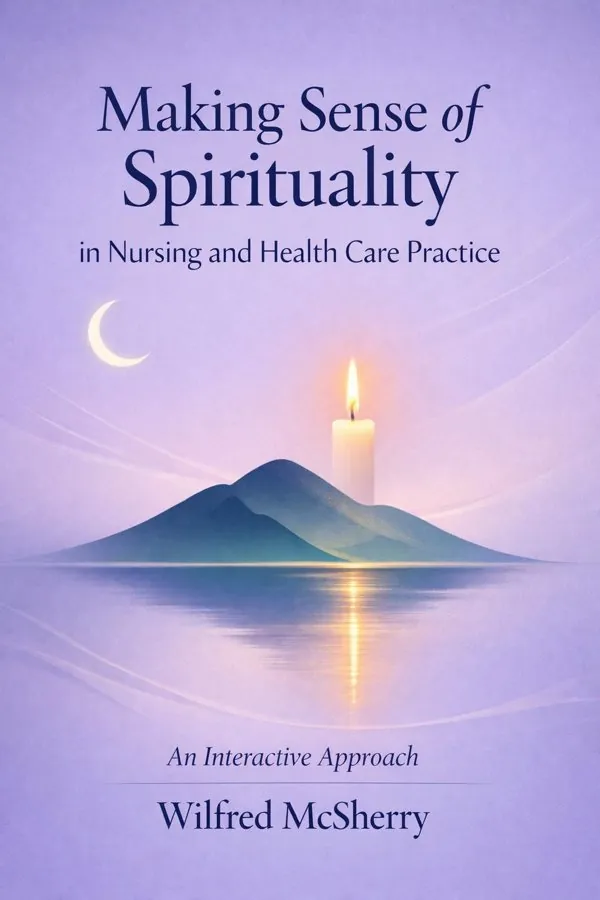
Making Sense of Spirituality in Nursing and Health Care Practice: An Interactive Approach: Summary & Key Insights
 10 min9 chaptersAudio available
Key Takeaways from Making Sense of Spirituality in Nursing and Health Care Practice: An Interactive Approach
One of the book’s most important insights is that spirituality becomes difficult only when we define it too narrowly.
Modern healthcare often treats spiritual care as a new or optional addition, yet McSherry shows that it has always been part of healing.
Healthcare commonly speaks the language of holistic care, but McSherry asks a challenging question: can care truly be holistic if spirituality is ignored?
A powerful theme in the book is that professionals cannot support others’ spiritual needs without examining their own beliefs, assumptions, and values.
Many clinicians worry that spiritual assessment requires special tools, scripted questions, or expert-level knowledge.
What Is Making Sense of Spirituality in Nursing and Health Care Practice: An Interactive Approach About?
Making Sense of Spirituality in Nursing and Health Care Practice: An Interactive Approach by Wilfred McSherry is a health_med book spanning 14 pages. Spirituality is one of the most frequently mentioned yet least confidently addressed dimensions of healthcare. In clinical settings, professionals often recognize that patients need more than technical treatment, but many struggle to name, assess, and respond to deeper concerns about meaning, hope, identity, suffering, connection, and peace. In Making Sense of Spirituality in Nursing and Health Care Practice, Wilfred McSherry tackles this uncertainty directly. He offers a practical, reflective, and highly accessible guide to understanding spirituality as an essential part of holistic care rather than an optional extra or purely religious topic. Drawing on nursing traditions, professional debates, case material, and interactive exercises, McSherry helps readers explore both their patients’ spiritual needs and their own assumptions, values, and professional boundaries. His authority comes from years of research and leadership in spirituality and healthcare, especially in translating complex ideas into usable practice. The result is a book that does not simply define spirituality; it shows why spiritual care matters, how it can be delivered ethically and sensitively, and how healthcare professionals can grow more confident in one of the most human dimensions of care.
This FizzRead summary covers all 9 key chapters of Making Sense of Spirituality in Nursing and Health Care Practice: An Interactive Approach in approximately 10 minutes, distilling the most important ideas, arguments, and takeaways from Wilfred McSherry's work. Also available as an audio summary and Key Quotes Podcast.
Making Sense of Spirituality in Nursing and Health Care Practice: An Interactive Approach
Spirituality is one of the most frequently mentioned yet least confidently addressed dimensions of healthcare. In clinical settings, professionals often recognize that patients need more than technical treatment, but many struggle to name, assess, and respond to deeper concerns about meaning, hope, identity, suffering, connection, and peace. In Making Sense of Spirituality in Nursing and Health Care Practice, Wilfred McSherry tackles this uncertainty directly. He offers a practical, reflective, and highly accessible guide to understanding spirituality as an essential part of holistic care rather than an optional extra or purely religious topic. Drawing on nursing traditions, professional debates, case material, and interactive exercises, McSherry helps readers explore both their patients’ spiritual needs and their own assumptions, values, and professional boundaries. His authority comes from years of research and leadership in spirituality and healthcare, especially in translating complex ideas into usable practice. The result is a book that does not simply define spirituality; it shows why spiritual care matters, how it can be delivered ethically and sensitively, and how healthcare professionals can grow more confident in one of the most human dimensions of care.
Who Should Read Making Sense of Spirituality in Nursing and Health Care Practice: An Interactive Approach?
This book is perfect for anyone interested in health_med and looking to gain actionable insights in a short read. Whether you're a student, professional, or lifelong learner, the key ideas from Making Sense of Spirituality in Nursing and Health Care Practice: An Interactive Approach by Wilfred McSherry will help you think differently.
- ✓Readers who enjoy health_med and want practical takeaways
- ✓Professionals looking to apply new ideas to their work and life
- ✓Anyone who wants the core insights of Making Sense of Spirituality in Nursing and Health Care Practice: An Interactive Approach in just 10 minutes
Want the full summary?
Get instant access to this book summary and 100K+ more with Fizz Moment.
Get Free SummaryAvailable on App Store • Free to download
Key Chapters
One of the book’s most important insights is that spirituality becomes difficult only when we define it too narrowly. Many healthcare professionals hear the word “spirituality” and immediately think of religion, prayer, or chaplaincy. McSherry argues that this assumption creates unnecessary discomfort and can prevent meaningful care. Spirituality certainly may include religious faith, but it also reaches far beyond formal belief systems. It concerns the ways people search for meaning, sustain hope, relate to others, understand suffering, preserve dignity, and make sense of life-changing events.
This broader definition matters in practice because patients do not experience illness only as a biological malfunction. A diagnosis can disrupt a person’s identity, family role, future plans, and understanding of self. Someone recovering from surgery may ask, “Why did this happen to me?” A person with a terminal condition may worry less about pain than about unfinished relationships. A parent caring for a sick child may cling to small rituals, memories, or personal values that provide strength. All of these are spiritual concerns, whether or not religion is involved.
McSherry’s approach helps nurses move from fear of “getting spirituality wrong” to recognizing it as a natural part of patient-centered care. Rather than becoming amateur theologians, clinicians are invited to notice what gives a person meaning, comfort, belonging, or resilience. That may include faith practices, but it may also include nature, family, music, storytelling, personal beliefs, or a need to be heard.
Actionable takeaway: When speaking with patients, listen for words about meaning, hope, fear, purpose, connection, and identity; these often reveal spiritual needs even when religion is never mentioned.
Modern healthcare often treats spiritual care as a new or optional addition, yet McSherry shows that it has always been part of healing. Historically, care of the body and care of the spirit were closely linked across cultures, religious traditions, and early nursing practice. Long before healthcare became highly specialized, healers recognized that illness affected the whole person. Nursing itself emerged from traditions that valued compassion, presence, moral commitment, and attention to the inner life of those who suffered.
This historical perspective matters because it corrects a common misunderstanding: that spiritual care is somehow unprofessional or incompatible with evidence-based practice. In reality, the split between physical treatment and spiritual support is relatively recent, shaped by institutional, scientific, and organizational developments. As healthcare systems became more technical and efficiency-driven, the measurable dimensions of care often took priority over the relational and existential ones. What was lost was not sentimentality, but an older understanding of human wholeness.
McSherry does not argue for returning to a premodern or purely religious model of care. Instead, he uses history to remind practitioners that spiritual care is consistent with nursing’s core identity. The profession has long emphasized attending to vulnerability, preserving dignity, and being present at moments of fear, transition, birth, illness, and death. These are not peripheral concerns; they are central to healthcare.
In practice, this means clinicians can view spiritual care not as an added task, but as part of the profession’s inheritance. A nurse who pauses to listen to a patient’s fears before treatment, helps someone connect with family, or respects a meaningful ritual is continuing a long-standing tradition of holistic healing.
Actionable takeaway: Reframe spiritual care as part of nursing’s historical mission to treat the whole person, not as an extra service to provide only when time allows.
Healthcare commonly speaks the language of holistic care, but McSherry asks a challenging question: can care truly be holistic if spirituality is ignored? His answer is no. Physical, psychological, social, and spiritual dimensions are deeply interconnected, especially during illness. Pain may be worsened by fear. Anxiety may be intensified by loss of meaning. Social isolation can deepen despair. A person’s spiritual beliefs or sources of hope can affect how they cope with treatment, make decisions, and face uncertainty.
The book therefore pushes readers to move beyond checklist thinking. Holistic care is not simply a model with four neat boxes; it is a way of seeing the patient as a whole human being whose symptoms, emotions, relationships, values, and beliefs interact continuously. For example, a patient refusing treatment may not be “noncompliant” in a simple sense; they may be wrestling with identity, faith, shame, or concerns about burdening family members. A person recovering slowly may need more than medication adjustment; they may need reassurance, meaning, and a sense of control.
McSherry’s interactive style helps practitioners connect theory to everyday care. He encourages observation, reflection, and curiosity. What matters to this person now? What have they lost? What helps them endure? What relationships or beliefs are sustaining them? Such questions help clinicians avoid reducing patients to diagnoses.
Importantly, spiritual awareness also supports better teamwork and care planning. If a patient’s hope is tied to seeing a grandchild, returning home, or maintaining a cherished ritual, that information can shape goals and interventions. Spiritual care is therefore not separate from clinical work; it informs it.
Actionable takeaway: In every assessment, ask yourself what this illness means to the patient personally, not just what it means medically.
A powerful theme in the book is that professionals cannot support others’ spiritual needs without examining their own beliefs, assumptions, and values. McSherry does not suggest that nurses must have fixed spiritual answers. Instead, he argues that self-awareness is essential because personal worldview affects how clinicians interpret distress, difference, hope, and suffering. Without reflection, practitioners may avoid spiritual conversations, impose their own values, or misread patients’ expressions of need.
This is especially important in emotionally charged situations. A clinician who is uncomfortable with death may change the subject when a patient raises questions about mortality. Someone strongly attached to a particular religious or secular outlook may unconsciously judge another person’s beliefs. A nurse under stress may focus only on tasks and miss subtle cues that a patient feels abandoned, afraid, or spiritually fractured.
McSherry’s reflective exercises are designed to build professional maturity. He invites readers to consider their own sources of meaning, their reactions to vulnerability, and their understanding of care. Questions like “What sustains me?” or “How do I respond when patients believe differently from me?” are not private diversions; they are practical tools for better practice. Self-awareness helps clinicians remain present without becoming intrusive, respectful without becoming detached, and supportive without trying to control the conversation.
In day-to-day healthcare, this might mean noticing your own reaction when a patient asks for prayer, rejects it, expresses anger at God, or speaks about death calmly. Reflection allows you to respond thoughtfully rather than defensively. It also protects against burnout by helping staff understand their own emotional and spiritual resources.
Actionable takeaway: Build a regular reflective habit by asking after difficult encounters what personal beliefs or emotions were activated and how they influenced your care.
Many clinicians worry that spiritual assessment requires special tools, scripted questions, or expert-level knowledge. McSherry offers a more grounded perspective: meaningful assessment begins with attentive listening. Spiritual need is often revealed indirectly through language about fear, loss, guilt, hope, purpose, loneliness, forgiveness, or the future. Patients rarely announce, “I have a spiritual need.” More often, they speak in stories, worries, silence, or repeated concerns that point to something deeper than symptoms.
The book helps readers distinguish between formal assessment and relational sensitivity. Structured tools can be useful, especially in institutional settings, but no form can replace human presence. A patient who asks, “Do you think I’ll ever be myself again?” may be expressing an identity crisis. Someone who says, “I don’t want to be a burden,” may be voicing concerns about worth and belonging. A family member insisting on a certain ritual may be seeking continuity and control in the midst of chaos. These are opportunities for spiritual assessment if the professional is alert enough to notice them.
McSherry also emphasizes that assessment is not interrogation. The goal is not to collect intimate data for its own sake, but to understand what matters to the person and what kind of support may help. Sometimes the right response is a gentle follow-up question. Sometimes it is referral to chaplaincy, counseling, family support, or community resources. Sometimes it is simply staying present.
In practical terms, spiritual assessment can be woven into routine care: asking what helps the patient cope, what matters most right now, whether there are beliefs or practices staff should know about, and who or what gives support.
Actionable takeaway: Replace the question “How do I assess spirituality?” with “What is this person telling me about meaning, hope, fear, and support?”
One of McSherry’s clearest messages is that spiritual care is often delivered less through impressive words than through attentive presence. In healthcare environments dominated by time pressure and technical tasks, it is easy to underestimate the healing value of simply being with someone. Yet patients often remember not the most sophisticated intervention, but the professional who listened, stayed calm, respected silence, and treated them as a person rather than a problem.
Communication in spiritual care requires sensitivity, not performance. McSherry highlights skills such as open-ended questioning, active listening, noticing emotional cues, tolerating silence, and responding without rushing to reassure or fix. This matters because spiritual distress cannot always be solved. A person facing terminal illness, grief, disability, or irreversible loss may not need neat answers. They may need witness, companionship, honesty, and dignity.
For example, when a patient asks, “Why is this happening?” the least helpful response may be a quick explanation or platitude. A more therapeutic response might be, “That sounds very hard. Would you like to say more about what this has been like for you?” Likewise, when families are overwhelmed, calm presence and clear communication can reduce isolation and restore trust.
McSherry also connects presence to professional authenticity. Patients often detect when a clinician is merely performing empathy. Genuine spiritual care involves attention, humility, and willingness to enter another person’s experience without taking over. Even brief encounters can be meaningful when they convey respect and human recognition.
Actionable takeaway: In your next patient interaction, deliberately slow down for one minute, listen without interrupting, and notice how much spiritual information emerges through tone, silence, and emotion.
Because spirituality touches deeply personal beliefs and values, it must be handled with care. McSherry is careful to show that spiritual care is not a license for professionals to share personal beliefs indiscriminately, steer patients toward particular worldviews, or blur therapeutic boundaries. Ethical spiritual care is patient-led, respectful, and professionally grounded. Its purpose is to support the person’s needs, not meet the caregiver’s emotional, moral, or religious agenda.
This distinction is crucial in diverse healthcare environments. A nurse may share a patient’s faith, but that does not mean assumptions should be made. Another clinician may hold no religious beliefs at all, yet still provide excellent spiritual care by listening well and facilitating appropriate support. The ethical question is not whether the clinician is spiritual, but whether the care offered honors autonomy, dignity, vulnerability, and consent.
McSherry encourages practitioners to recognize the limits of their role. It may be appropriate to ask whether a patient would like contact with a chaplain, faith leader, family member, or cultural representative. It may be appropriate to support simple practices such as privacy for prayer or accommodation of meaningful rituals. It is not appropriate to preach, pressure, dismiss beliefs, or avoid care because of disagreement. Similarly, professionals must be alert to situations where their own need to comfort, rescue, or influence the patient could become intrusive.
Ethical practice also includes documentation, referral, and accountability. Spiritual issues can affect treatment choices, end-of-life preferences, and family dynamics, so they deserve thoughtful communication within the care team when relevant.
Actionable takeaway: Before engaging a spiritual issue, ask yourself, “Am I responding to the patient’s need, or to my own beliefs, discomfort, or desire to help?”
No single model of spirituality can fit every patient, and McSherry repeatedly stresses the importance of cultural, religious, and personal diversity. In contemporary healthcare, practitioners encounter people whose beliefs about illness, suffering, healing, family, death, and ritual may differ greatly from their own. Spiritual care therefore requires humility rather than certainty. The clinician’s task is not to master every tradition, but to approach each person with openness, curiosity, and respect.
This has practical implications across the care pathway. Dietary needs, modesty concerns, prayer times, sacred objects, family decision-making patterns, and end-of-life practices may all carry spiritual significance. Misunderstanding them can create distress, mistrust, or conflict. By contrast, small acts of accommodation can communicate deep respect. Asking, “Are there any beliefs or practices we should be aware of while caring for you?” can open valuable conversations.
McSherry also highlights interdisciplinary collaboration as a core part of good spiritual care. Nurses are not expected to do everything alone. Chaplains, physicians, social workers, counselors, psychologists, community faith leaders, and family members may each contribute to meeting spiritual needs. Collaboration becomes especially important in complex situations involving grief, trauma, ethical dilemmas, or end-of-life decisions. A spiritually sensitive healthcare culture depends on systems, not just individual goodwill.
The book further points to education, research, and organizational policy. Staff need training to build confidence, institutions need frameworks that legitimize spiritual care, and research is needed to strengthen evidence and improve practice. Spiritual care flourishes when it is embedded in team culture rather than left to chance.
Actionable takeaway: Treat every spiritual conversation as an invitation to learn, and involve the wider care team whenever a patient’s needs go beyond your role or expertise.
What makes this book especially practical is its interactive method. McSherry does not present spirituality as a concept to memorize; he presents it as a capacity to develop through reflection, case discussion, and repeated application. Case studies, scenarios, and exercises allow readers to test their assumptions and consider how spiritual care unfolds in real clinical contexts. This is important because confidence in this area rarely comes from theory alone. It grows from practice, reflection, feedback, and thoughtful engagement with ambiguity.
The cases in the book reveal how easily spiritual issues can be overlooked. A patient’s anger may mask fear. Repeated requests from a family may reflect cultural or spiritual meaning rather than difficult behavior. A staff member’s frustration may expose unexamined assumptions. By working through such situations, readers learn that spiritual care is not a separate event but part of everyday nursing judgment.
McSherry also points toward the future of practice. If spirituality is to be taken seriously, it must be supported by education, institutional leadership, policy development, and evidence-informed care. Training programs should help students and practitioners build language, confidence, and ethical awareness. Organizations should create environments where time, referral pathways, and interdisciplinary support make spiritual care possible. Research should continue examining patient outcomes, staff experience, and effective models of care.
Ultimately, the book’s future-oriented message is simple: spiritual care is a continuing journey, not a completed competency. Professionals will keep encountering new questions, diverse needs, and complex situations. The goal is not perfection, but thoughtful, compassionate responsiveness.
Actionable takeaway: Use reflection after clinical encounters to identify one missed spiritual cue, one effective response, and one practical change you can make in future care.
All Chapters in Making Sense of Spirituality in Nursing and Health Care Practice: An Interactive Approach
About the Author
Wilfred McSherry is a professor of nursing and a widely recognized voice in the study of spirituality and healthcare. His work has focused on helping nurses and other professionals understand spiritual care as a practical, ethical, and essential part of holistic practice. Through research, teaching, and professional leadership, he has explored how questions of meaning, belief, hope, dignity, and human connection shape patient experience across healthcare settings. McSherry is especially known for making a complex and sometimes uncomfortable subject more accessible to practitioners, students, and educators. Rather than treating spirituality as abstract or narrowly religious, he emphasizes reflection, communication, and person-centered care. His writing has contributed significantly to ongoing discussions about how healthcare systems can support the whole person, not just the disease.
Get This Summary in Your Preferred Format
Read or listen to the Making Sense of Spirituality in Nursing and Health Care Practice: An Interactive Approach summary by Wilfred McSherry anytime, anywhere. FizzRead offers multiple formats so you can learn on your terms — all free.
Available formats: App · Audio · PDF · EPUB — All included free with FizzRead
Download Making Sense of Spirituality in Nursing and Health Care Practice: An Interactive Approach PDF and EPUB Summary
Key Quotes from Making Sense of Spirituality in Nursing and Health Care Practice: An Interactive Approach
“One of the book’s most important insights is that spirituality becomes difficult only when we define it too narrowly.”
“Modern healthcare often treats spiritual care as a new or optional addition, yet McSherry shows that it has always been part of healing.”
“Healthcare commonly speaks the language of holistic care, but McSherry asks a challenging question: can care truly be holistic if spirituality is ignored?”
“A powerful theme in the book is that professionals cannot support others’ spiritual needs without examining their own beliefs, assumptions, and values.”
“Many clinicians worry that spiritual assessment requires special tools, scripted questions, or expert-level knowledge.”
Frequently Asked Questions about Making Sense of Spirituality in Nursing and Health Care Practice: An Interactive Approach
Making Sense of Spirituality in Nursing and Health Care Practice: An Interactive Approach by Wilfred McSherry is a health_med book that explores key ideas across 9 chapters. Spirituality is one of the most frequently mentioned yet least confidently addressed dimensions of healthcare. In clinical settings, professionals often recognize that patients need more than technical treatment, but many struggle to name, assess, and respond to deeper concerns about meaning, hope, identity, suffering, connection, and peace. In Making Sense of Spirituality in Nursing and Health Care Practice, Wilfred McSherry tackles this uncertainty directly. He offers a practical, reflective, and highly accessible guide to understanding spirituality as an essential part of holistic care rather than an optional extra or purely religious topic. Drawing on nursing traditions, professional debates, case material, and interactive exercises, McSherry helps readers explore both their patients’ spiritual needs and their own assumptions, values, and professional boundaries. His authority comes from years of research and leadership in spirituality and healthcare, especially in translating complex ideas into usable practice. The result is a book that does not simply define spirituality; it shows why spiritual care matters, how it can be delivered ethically and sensitively, and how healthcare professionals can grow more confident in one of the most human dimensions of care.
You Might Also Like

On Immunity
Eula Biss
10 min
The Three-Body Problem
Liu Cixin
10 min
Community Health Volunteer Toolkit: Training and Practical Activities
World Health Organization
10 min
Healing Back Pain: The Mind-Body Connection
John E. Sarno
10 min
Health Literacy for All: Practical Guides to Communicate Health Information (Compilations)
World Health Organization
10 min
The Complete Guide to Sports Supplements: An Evidence-Based Review
Anita Bean
10 minBrowse by Category
Ready to read Making Sense of Spirituality in Nursing and Health Care Practice: An Interactive Approach?
Get the full summary and 100K+ more books with Fizz Moment.