
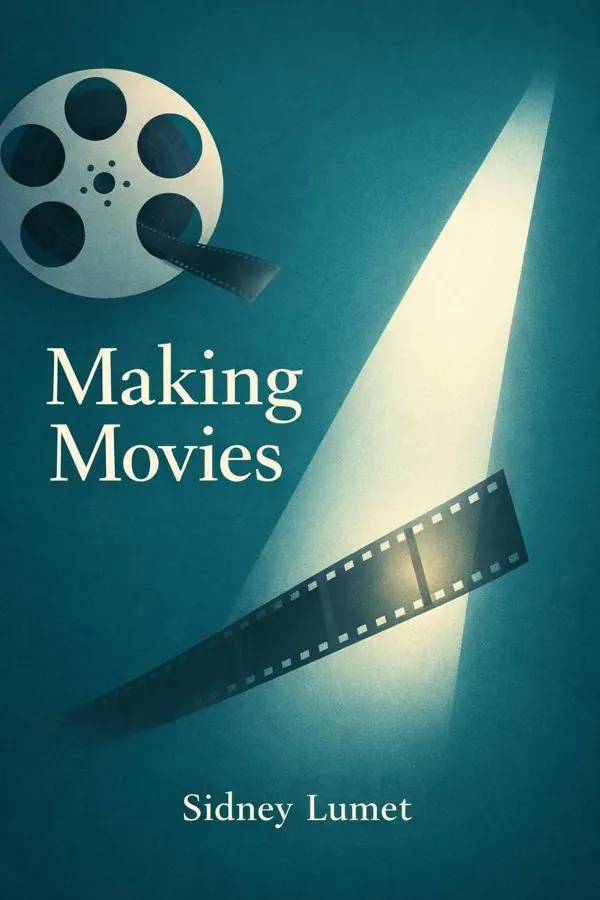
Making Movies: Summary & Key Insights
by Sidney Lumet
 10 min9 chaptersAudio available
Key Takeaways from Making Movies
A film’s fate is often sealed long before the first camera is set up.
The most powerful visual style is not the one that looks impressive, but the one that expresses what the story is saying.
A director does not manufacture performances; a director creates the conditions in which truthful performances can happen.
A camera does more than record action; it directs attention, creates emotion, and shapes the viewer’s relationship to the story.
What audiences call a film’s “look” is never the result of one decision or one department.
What Is Making Movies About?
Making Movies by Sidney Lumet is a music_film book spanning 11 pages. Making Movies is Sidney Lumet’s candid masterclass on how films are actually made—not in theory, but in the messy, pressured, exhilarating reality of production. Rather than romanticizing cinema, Lumet walks readers through the full process of filmmaking: choosing a script, shaping a visual style, rehearsing actors, collaborating with cinematographers and editors, handling the practical chaos of shooting, and navigating the commercial demands of studios and audiences. The result is both a technical guide and a philosophical reflection on artistic responsibility. What makes the book so valuable is Lumet’s rare combination of clarity, humility, and authority. As the director of landmark films such as 12 Angry Men, Dog Day Afternoon, Serpico, and Network, he spent decades learning how to turn written stories into powerful screen experiences. He explains that great filmmaking is never the result of a single genius imposing a vision. It comes from disciplined choices, trust among collaborators, and a relentless commitment to what the story needs. For aspiring filmmakers, film students, and anyone curious about how cinema works behind the scenes, Making Movies remains one of the most practical and illuminating books ever written about the craft.
This FizzRead summary covers all 9 key chapters of Making Movies in approximately 10 minutes, distilling the most important ideas, arguments, and takeaways from Sidney Lumet's work. Also available as an audio summary and Key Quotes Podcast.
Making Movies
Making Movies is Sidney Lumet’s candid masterclass on how films are actually made—not in theory, but in the messy, pressured, exhilarating reality of production. Rather than romanticizing cinema, Lumet walks readers through the full process of filmmaking: choosing a script, shaping a visual style, rehearsing actors, collaborating with cinematographers and editors, handling the practical chaos of shooting, and navigating the commercial demands of studios and audiences. The result is both a technical guide and a philosophical reflection on artistic responsibility.
What makes the book so valuable is Lumet’s rare combination of clarity, humility, and authority. As the director of landmark films such as 12 Angry Men, Dog Day Afternoon, Serpico, and Network, he spent decades learning how to turn written stories into powerful screen experiences. He explains that great filmmaking is never the result of a single genius imposing a vision. It comes from disciplined choices, trust among collaborators, and a relentless commitment to what the story needs. For aspiring filmmakers, film students, and anyone curious about how cinema works behind the scenes, Making Movies remains one of the most practical and illuminating books ever written about the craft.
Who Should Read Making Movies?
This book is perfect for anyone interested in music_film and looking to gain actionable insights in a short read. Whether you're a student, professional, or lifelong learner, the key ideas from Making Movies by Sidney Lumet will help you think differently.
- ✓Readers who enjoy music_film and want practical takeaways
- ✓Professionals looking to apply new ideas to their work and life
- ✓Anyone who wants the core insights of Making Movies in just 10 minutes
Want the full summary?
Get instant access to this book summary and 100K+ more with Fizz Moment.
Get Free SummaryAvailable on App Store • Free to download
Key Chapters
A film’s fate is often sealed long before the first camera is set up. Lumet insists that the script is the foundation of everything: tone, pace, visual style, acting choices, production scale, and even the audience’s emotional journey. A screenplay is not merely a blueprint for dialogue and plot. It contains the film’s rhythm, moral tension, and hidden structure. If the script is confused, indulgent, or dishonest, no amount of technical brilliance can fully rescue it.
For Lumet, reading a script means asking hard questions. What is the story really about beneath the events? Whose journey matters most? What must the audience feel scene by scene? These answers influence every later decision. A tense chamber drama like 12 Angry Men demands a different cinematic approach than the chaotic public energy of Dog Day Afternoon. The script tells the director whether the movie should feel claustrophobic, fluid, cold, funny, aggressive, or intimate.
This idea applies beyond filmmaking. In any complex project, the original design determines the quality of execution. If the concept is weak, teams end up compensating instead of creating. In practical terms, Lumet’s approach means spending serious time in development: rewriting, clarifying motivations, trimming unnecessary scenes, and identifying what each scene contributes.
A useful exercise is to summarize a script in one sentence, then summarize each scene in one line of dramatic purpose. If a scene cannot justify its existence, it probably does not belong. Lumet teaches that great directing begins not with control on set, but with honesty at the page. Actionable takeaway: before worrying about style or production, identify the script’s core dramatic truth and make every later decision serve it.
The most powerful visual style is not the one that looks impressive, but the one that expresses what the story is saying. Lumet rejects decorative filmmaking for its own sake. He argues that style is not a layer added after the fact; it is the specific formal language that reveals meaning. Camera movement, lens choice, lighting, blocking, pacing, and color should emerge from the emotional and thematic content of the story.
That is why two films by the same director can feel completely different. A director should not impose a signature at the expense of the material. Instead, the director must discover what kind of visual and dramatic world the script needs. A paranoid, unstable story may require fractured compositions and uneasy movement. A moral drama may benefit from restraint, letting tension build through performance and staging rather than visual flourish.
Lumet’s thinking is especially useful in an era where many creators imitate fashionable aesthetics without understanding their function. Slow motion, handheld realism, saturated color, or elaborate long takes can all be effective, but only if they deepen the audience’s experience of the story. Otherwise they become empty gestures.
A practical application is to create a style brief before production begins. Write down the emotional qualities of the film—say, “compressed, suspicious, urban, restless”—and then translate those into technical choices. Maybe that means tighter lenses, lower-key lighting, crowded frames, and fewer wide establishing shots. This discipline keeps the entire team aligned.
Lumet’s larger lesson is that artistic choices carry meaning whether you intend them to or not. A movie always communicates through form. Actionable takeaway: define your film’s emotional and thematic needs first, then build a visual style that grows naturally from them rather than from habit or trend.
A director does not manufacture performances; a director creates the conditions in which truthful performances can happen. Lumet is especially insightful about actors because he understood that acting is both intensely vulnerable and highly technical. Actors need clarity, safety, and precision. They need to know what the scene is doing, what their character wants, and how far they can experiment without losing the film’s coherence.
Lumet valued rehearsal because it helped actors move beyond self-consciousness. Rehearsal was not about locking every line reading into place. It was about discovering relationships, beats, objectives, and tensions before the machinery of production made everything harder. Once on set, time pressure, lighting setups, and schedule demands can easily crush spontaneity. Good rehearsal gives everyone a shared foundation.
He also stresses that actors should not be overloaded with abstract theory when they need playable direction. Telling someone to “be sadder” or “make it more powerful” is often useless. Giving a concrete objective—persuade him, hide your fear, win her back, maintain control—gives the actor something active to do. That creates behavior, not just emotion.
This principle applies to leadership generally. People perform best when expectations are clear and the environment supports risk-taking. The leader’s job is not to dominate every move, but to focus energy on the right problem.
A practical method is to discuss each scene in terms of action verbs and turning points. What does each character want? When does the power shift? What changes by the end? Those questions help actors anchor their choices in the scene’s dramatic structure.
Lumet reminds us that performance is the heart of cinema because audiences respond first to human truth. Actionable takeaway: invest early in rehearsal, communicate in concrete objectives, and treat trust as the essential tool for drawing strong performances.
A camera does more than record action; it directs attention, creates emotion, and shapes the viewer’s relationship to the story. Lumet treats camera placement as one of the most important narrative decisions in filmmaking. Where the camera is placed determines what the audience sees, what it misses, how intimate it feels, and how powerfully a moment lands.
A close-up can trap us inside a character’s private crisis. A wide shot can expose loneliness, social pressure, or absurdity. A static frame can create tension by refusing release, while a moving camera can energize or destabilize a scene. These choices are not neutral. They form the grammar through which cinema speaks.
Lumet was careful not to fetishize camera movement. Just because the camera can move does not mean it should. A moving shot should have dramatic purpose. For instance, a gradual push-in during a confrontation can intensify pressure as truth surfaces. By contrast, random movement may distract from the performance and flatten the scene’s emotional structure.
One practical application is to plan coverage based on dramatic function rather than habit. Instead of automatically shooting a master, over-the-shoulders, and close-ups, ask what the scene needs. Is it about distance? Power? Confusion? Seduction? Revelation? Let those questions determine angles and shot progression.
For creators in any medium, Lumet’s deeper point is that presentation shapes meaning. How you frame information influences how people interpret it. In cinema, framing is literal, and that makes the responsibility even greater.
A useful exercise is to storyboard or shot-list a scene while writing down the emotional reason for each setup. If you cannot explain why a shot exists, reconsider it. Actionable takeaway: treat every camera choice as a storytelling decision, and design shots to guide emotion and attention with intention.
What audiences call a film’s “look” is never the result of one decision or one department. It emerges from the coordinated work of the director, cinematographer, production designer, costume designer, makeup team, and lab or postproduction process. Lumet emphasizes that visual coherence comes from collaboration. The mood of a movie is built through hundreds of aligned choices, from wall colors and fabric textures to contrast ratios and practical light sources.
This means the director must do more than have taste. The director must communicate clearly across disciplines so that each visual element supports the same dramatic world. A courtroom drama, for example, may need a restrained palette and sober compositions to foreground moral tension. A satire may benefit from visual excess that reflects corruption or madness. The look is not just pretty surface. It helps define what kind of reality the audience is entering.
Lumet’s process often involved detailed conversations early in prep so departments could solve problems before production. That saves time and protects artistic consistency. If costumes clash with the set, or lighting contradicts the intended tone, the film loses subtle but crucial unity.
This lesson matters for any collaborative creative project. Strong work happens when teams share a common interpretation of purpose. Without that, even talented contributors pull in different directions.
A practical way to apply this is to build a visual reference package that includes not only images but reasons: “these colors suggest emotional repression,” “these textures imply institutional decay,” “this light quality feels exposed and unforgiving.” Such language helps the whole team make smarter decisions.
Lumet shows that cinematic beauty is not accidental. It is the outcome of disciplined alignment. Actionable takeaway: define the film’s visual world early, share that vision across departments, and make sure every design choice reinforces the same emotional reality.
A film set may look glamorous from the outside, but Lumet presents production as a daily test of discipline, preparation, and problem-solving. Shooting a film means balancing artistic ambition against relentless constraints: time, money, fatigue, weather, technical issues, location limits, and human unpredictability. The director must keep the story alive while managing all of this without panic.
Lumet’s gift was not simply inspiration. It was organization. He believed that serious preparation creates freedom. If scenes are rehearsed, shot plans are considered, and departments are coordinated, the director can respond creatively when the unexpected happens. Without preparation, surprises become disasters. With preparation, they can become opportunities.
He also understood that morale affects quality. A chaotic set wastes energy and erodes confidence. A focused set allows actors and crew to do their best work. This is why punctuality, clarity, and calm leadership matter. They are not bureaucratic habits; they are artistic tools. When a crew trusts that the director knows what matters, everyone works with greater confidence.
This principle extends well beyond filmmaking. In any high-stakes project, stress reveals whether systems are strong enough to support creativity. Professionals do not rely on last-minute heroics. They build structures that let people perform under pressure.
A practical production habit is to identify the non-negotiables for each shooting day: the emotional purpose of the scenes, the must-have shots, and the likely risk points. If time runs short, you can adapt intelligently rather than randomly. This protects the film’s core intentions.
Lumet strips away the myth that art happens only through inspiration. Often, art survives through discipline. Actionable takeaway: prepare rigorously, lead calmly, and treat schedule, morale, and logistics as essential parts of creative success rather than distractions from it.
Movies are often rewritten three times: on the page, on the set, and in the editing room. Lumet makes clear that editing is not merely the technical assembly of footage. It is where the final dramatic shape of the film is discovered. Timing, emphasis, point of view, and emotional progression all become newly visible once scenes are placed in sequence.
A scene that felt electric during shooting may prove too long in context. A reaction shot may become more important than the line that prompted it. A cut made two seconds earlier can sharpen tension; one held longer can deepen discomfort or grief. Editing teaches humility because it reveals what the film actually is, not what the director imagined it would be.
Lumet valued editors as storytellers, not mechanics. Their job is to protect rhythm and narrative clarity while preserving the emotional truth of performances. In many cases, the strongest choice is subtraction. If a scene explains too much, repeats a beat, or dilutes momentum, it may need trimming or removal. The audience does not experience the labor it took to shoot the material; it only experiences the result.
This insight applies to writing, presentations, and strategy work as well. Drafting creates possibilities, but revision creates form. The willingness to cut what you like for the sake of the whole is a mark of maturity.
A practical editing question is: what is the scene really about, and when does the audience understand it? Once that point is reached, extra footage may weaken impact. Another useful test is to watch a sequence with sound off to study pure visual rhythm and storytelling.
Lumet’s lesson is that precision creates power. Actionable takeaway: approach editing as a fresh act of storytelling, and be ruthless about removing anything that weakens pace, clarity, or emotional force.
What we hear in a film often influences us as deeply as what we see, yet audiences notice sound most when it fails. Lumet treats sound and music as central storytelling tools, not decorative afterthoughts. Dialogue clarity, ambient texture, silence, effects, and score all shape mood, realism, tension, and interpretation. Sound is the emotional atmosphere of a movie.
A busy street, a distant siren, fluorescent room tone, the absence of expected noise—each can alter how a scene feels before a character even speaks. Music can intensify emotion, but Lumet warns against using it lazily to tell the audience what to feel. If overused, music becomes emotional coercion. The best score supports the film’s inner life without flattening ambiguity or competing with performance.
He also highlights the importance of the final mix, where image and sound are balanced into a coherent experience. A scene can be transformed by adjusting what is foregrounded. A whispered line, a sudden sonic drop, or a subtle environmental layer can all sharpen the audience’s emotional focus.
For modern creators, this is a powerful reminder that meaning lives in sensory design. Podcasts, videos, presentations, and digital media all benefit from attention to pacing, silence, emphasis, and texture.
A practical application is to review scenes with eyes closed. Ask what the audience learns from sound alone. Does the audio create place, tension, and emotional movement? If not, the scene may be relying too heavily on visuals or exposition. Similarly, test whether music is revealing something hidden or merely amplifying the obvious.
Lumet’s broader point is that great filmmaking works on conscious and subconscious levels at once. Sound is one of the medium’s most subtle forms of control. Actionable takeaway: design sound and music as part of the story from the beginning, and use them to deepen, not dictate, the audience’s emotional experience.
Filmmaking is both art and industry, and Lumet never pretends otherwise. A director works within systems of financing, distribution, marketing, and audience expectation. Studios can support a movie, constrain it, or reshape it. Audiences can embrace a film for reasons the makers never predicted. This tension between artistic intention and commercial reality is part of the job, not an unfortunate side issue.
Yet Lumet goes further by linking professional choices to ethics. Every film reflects judgments about people, institutions, power, violence, and truth. Even when a movie seems purely entertaining, it carries assumptions and values. For Lumet, the filmmaker has a responsibility to think seriously about what the work is saying and how it represents the world. This is especially urgent when dealing with political subjects, social conflict, or moral ambiguity.
He does not argue for preachiness. Instead, he argues for awareness. A director must know why a story matters and what consequences follow from the way it is told. Commerce may shape what gets made, but conscience should shape how it is made.
This insight remains timely. In any creative field, professionals face pressure to simplify, sensationalize, or chase trends. Lumet’s example shows that integrity does not require naivety. It requires clarity about what you will and will not compromise.
A practical habit is to ask three questions before and during production: What is this film saying about human beings? What sympathies is it encouraging? Where might the work become manipulative, false, or exploitative? These questions can prevent serious artistic drift.
Lumet’s enduring message is that craft and conscience belong together. Actionable takeaway: understand the business realities of your work, but define your ethical boundaries early and let them guide the choices that shape the final film.
All Chapters in Making Movies
About the Author
Sidney Lumet (1924–2011) was an acclaimed American film director, producer, and screenwriter whose career spanned more than five decades. He began as a child actor in New York, later worked in theater and live television, and became one of the most respected directors in American cinema. Lumet was known for films that combined emotional intensity, strong performances, and sharp moral inquiry, including 12 Angry Men, Long Day’s Journey Into Night, Serpico, Dog Day Afternoon, Network, and The Verdict. His work often examined institutions, power, justice, and corruption with remarkable realism. Admired for his efficiency on set and his skill with actors, Lumet earned multiple Academy Award nominations and received an honorary Oscar for his contributions to filmmaking. Making Movies reflects the clarity, discipline, and integrity that defined his career.
Get This Summary in Your Preferred Format
Read or listen to the Making Movies summary by Sidney Lumet anytime, anywhere. FizzRead offers multiple formats so you can learn on your terms — all free.
Available formats: App · Audio · PDF · EPUB — All included free with FizzRead
Download Making Movies PDF and EPUB Summary
Key Quotes from Making Movies
“A film’s fate is often sealed long before the first camera is set up.”
“The most powerful visual style is not the one that looks impressive, but the one that expresses what the story is saying.”
“A director does not manufacture performances; a director creates the conditions in which truthful performances can happen.”
“A camera does more than record action; it directs attention, creates emotion, and shapes the viewer’s relationship to the story.”
“What audiences call a film’s “look” is never the result of one decision or one department.”
Frequently Asked Questions about Making Movies
Making Movies by Sidney Lumet is a music_film book that explores key ideas across 9 chapters. Making Movies is Sidney Lumet’s candid masterclass on how films are actually made—not in theory, but in the messy, pressured, exhilarating reality of production. Rather than romanticizing cinema, Lumet walks readers through the full process of filmmaking: choosing a script, shaping a visual style, rehearsing actors, collaborating with cinematographers and editors, handling the practical chaos of shooting, and navigating the commercial demands of studios and audiences. The result is both a technical guide and a philosophical reflection on artistic responsibility. What makes the book so valuable is Lumet’s rare combination of clarity, humility, and authority. As the director of landmark films such as 12 Angry Men, Dog Day Afternoon, Serpico, and Network, he spent decades learning how to turn written stories into powerful screen experiences. He explains that great filmmaking is never the result of a single genius imposing a vision. It comes from disciplined choices, trust among collaborators, and a relentless commitment to what the story needs. For aspiring filmmakers, film students, and anyone curious about how cinema works behind the scenes, Making Movies remains one of the most practical and illuminating books ever written about the craft.
You Might Also Like
Beethoven: A Documentary Study
H. C. Robbins Landon
10 min
Cinema Speculation
Quentin Tarantino
10 min
Deep Listening: A Composer's Sound Practice
Pauline Oliveros
10 min
Dylan Goes Electric!: Newport, Seeger, Dylan, and the Night That Split the Sixties
Elijah Wald
10 min
Future Frames
Maria Walsh
10 min
Hamilton: The Revolution: Being the Complete Libretto of the Broadway Musical, with a True Account of Its Creation, and Concise Remarks on Hip-Hop, the Power of Stories, and the New America
Lin-Manuel Miranda, Jeremy McCarter
10 minBrowse by Category
Ready to read Making Movies?
Get the full summary and 100K+ more books with Fizz Moment.