
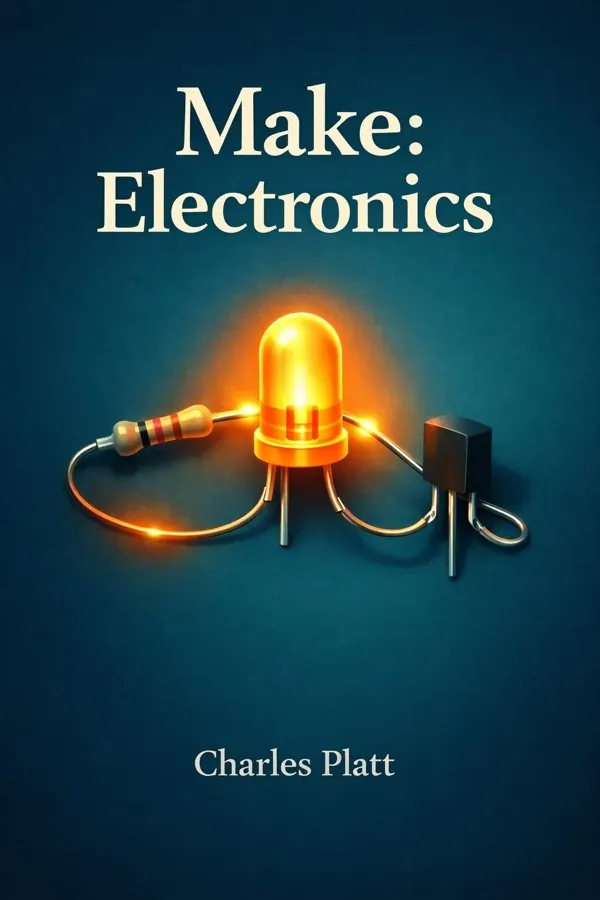
Make: Electronics: Learning Through Discovery: Summary & Key Insights
 10 min10 chaptersAudio available
What Is Make: Electronics: Learning Through Discovery About?
Make: Electronics: Learning Through Discovery by Charles Platt is a popular_sci book spanning 10 pages. Make: Electronics es un libro introductorio que enseña los fundamentos de la electrónica a través de proyectos prácticos y experimentos. Charles Platt guía al lector paso a paso en la construcción de circuitos reales, explicando los principios detrás de resistencias, condensadores, transistores y otros componentes esenciales. El enfoque práctico y accesible del libro lo convierte en una referencia ideal para principiantes que desean aprender haciendo.
This FizzRead summary covers all 10 key chapters of Make: Electronics: Learning Through Discovery in approximately 10 minutes, distilling the most important ideas, arguments, and takeaways from Charles Platt's work. Also available as an audio summary and Key Quotes Podcast.
Make: Electronics: Learning Through Discovery
Make: Electronics es un libro introductorio que enseña los fundamentos de la electrónica a través de proyectos prácticos y experimentos. Charles Platt guía al lector paso a paso en la construcción de circuitos reales, explicando los principios detrás de resistencias, condensadores, transistores y otros componentes esenciales. El enfoque práctico y accesible del libro lo convierte en una referencia ideal para principiantes que desean aprender haciendo.
Who Should Read Make: Electronics: Learning Through Discovery?
This book is perfect for anyone interested in popular_sci and looking to gain actionable insights in a short read. Whether you're a student, professional, or lifelong learner, the key ideas from Make: Electronics: Learning Through Discovery by Charles Platt will help you think differently.
- ✓Readers who enjoy popular_sci and want practical takeaways
- ✓Professionals looking to apply new ideas to their work and life
- ✓Anyone who wants the core insights of Make: Electronics: Learning Through Discovery in just 10 minutes
Want the full summary?
Get instant access to this book summary and 100K+ more with Fizz Moment.
Get Free SummaryAvailable on App Store • Free to download
Key Chapters
Overview of Basic Electrical Concepts: Voltage, Current, Resistance, and the Role of the Multimeter
Everything about electronics begins with understanding three invisible quantities: voltage, current, and resistance. These are the fundamental forces that determine what happens when electricity moves. Voltage is like pressure—it’s the potential that drives electrons through a circuit. Current is the actual flow of electrons, while resistance acts as the obstacle that slows or controls that flow. To see this interplay, we use the most versatile tool in electronics—the multimeter. It’s your window into the hidden world of an electric circuit.
I designed this part to give you a tactile sense of these ideas. You’ll measure voltages across different components, see how resistance changes the brightness of a light, discover how current flows differently depending on circuit arrangement. The act of measuring transforms numbers into sensations—you *see* the result of changing a resistor’s value and *feel* the relationship between voltage and current. By using a multimeter early on, you begin treating electrical behavior like tangible material—something you can poke, prod, and understand.
The key revelation here is simple but powerful: every circuit is a conversation between voltage, current, and resistance. Once you grasp how they interplay, the rest of electronics becomes a language you can read and speak fluently. You’re no longer guessing; you’re interpreting real behavior.
The next step is hands-on play with resistors and LEDs—two of the most intuitive components for beginners. I designed these experiments to make invisible currents visible and to show the importance of polarity. LEDs are perfect because they only allow current to flow in one direction. When they light up, you witness the successful transfer of energy; when they stay dark, you instantly see that something’s wrong. This feedback loop teaches more than any theoretical explanation could.
By connecting LEDs to resistors and power sources, you learn the first practical rule of electronics—never feed a component more current than it can handle. The resistor protects the LED, and by varying the resistance you observe how brightness changes. You start to think in terms of balance: too much current burns out the LED, too little makes it dim. This is the essence of understanding how components cooperate.
Each experiment builds sensory experience—how the color and glow correspond to the voltage applied, how orientation matters, how even the simplest circuit tells you about direction and control. You’ll begin to memorize polarities instinctively, feeling which leg of the LED connects where. In that moment, theory stops being abstract; it becomes muscle memory.
+ 8 more chapters — available in the FizzRead app
All Chapters in Make: Electronics: Learning Through Discovery
About the Author
Charles Platt es un escritor, diseñador y educador británico-estadounidense conocido por sus libros sobre electrónica práctica y tecnología. Ha sido editor colaborador de la revista Make y autor de varios títulos de la serie Make: Electronics. Antes de dedicarse a la enseñanza de la electrónica, trabajó como novelista de ciencia ficción y editor en publicaciones tecnológicas.
Get This Summary in Your Preferred Format
Read or listen to the Make: Electronics: Learning Through Discovery summary by Charles Platt anytime, anywhere. FizzRead offers multiple formats so you can learn on your terms — all free.
Available formats: App · Audio · PDF · EPUB — All included free with FizzRead
Download Make: Electronics: Learning Through Discovery PDF and EPUB Summary
Key Quotes from Make: Electronics: Learning Through Discovery
“Everything about electronics begins with understanding three invisible quantities: voltage, current, and resistance.”
“The next step is hands-on play with resistors and LEDs—two of the most intuitive components for beginners.”
Frequently Asked Questions about Make: Electronics: Learning Through Discovery
Make: Electronics: Learning Through Discovery by Charles Platt is a popular_sci book that explores key ideas across 10 chapters. Make: Electronics es un libro introductorio que enseña los fundamentos de la electrónica a través de proyectos prácticos y experimentos. Charles Platt guía al lector paso a paso en la construcción de circuitos reales, explicando los principios detrás de resistencias, condensadores, transistores y otros componentes esenciales. El enfoque práctico y accesible del libro lo convierte en una referencia ideal para principiantes que desean aprender haciendo.
You Might Also Like

Structures: Or Why Things Don"t Fall Down
J.E. Gordon
10 min
The Road to Wigan Pier
George Orwell
10 min
Bonk: The Curious Coupling of Science and Sex
Mary Roach
10 min
First Bite: How We Learn to Eat
Bee Wilson
10 min
In Pursuit Of The Unknown: 17 Equations That Changed The World
Ian Stewart
10 min
Napoleon's Buttons: 17 Molecules That Changed History
Penny Le Couteur and Jay Burreson
10 minBrowse by Category
Ready to read Make: Electronics: Learning Through Discovery?
Get the full summary and 100K+ more books with Fizz Moment.