
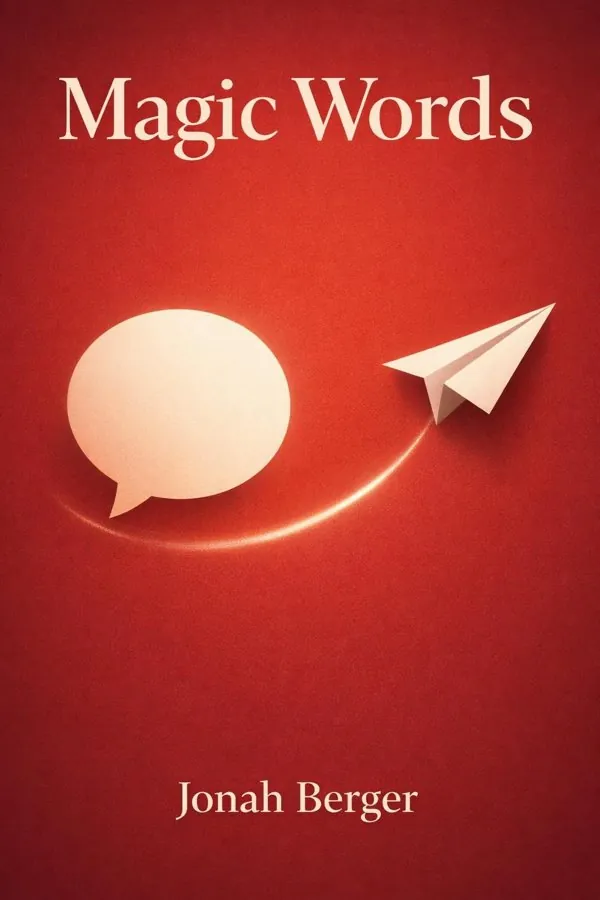
Magic Words: What to Say to Get Your Way: Summary & Key Insights
by Jonah Berger
 10 min10 chaptersAudio available
What Is Magic Words: What to Say to Get Your Way About?
Magic Words: What to Say to Get Your Way by Jonah Berger is a communication book spanning 10 pages. In 'Magic Words: What to Say to Get Your Way', Jonah Berger, a marketing professor at the Wharton School, explores the science of language and persuasion. Drawing on extensive research, Berger identifies six types of words that can transform how people influence, motivate, and connect with others. The book provides practical insights into how subtle shifts in phrasing can make communication more effective in business, relationships, and everyday life.
This FizzRead summary covers all 10 key chapters of Magic Words: What to Say to Get Your Way in approximately 10 minutes, distilling the most important ideas, arguments, and takeaways from Jonah Berger's work. Also available as an audio summary and Key Quotes Podcast.
Magic Words: What to Say to Get Your Way
In 'Magic Words: What to Say to Get Your Way', Jonah Berger, a marketing professor at the Wharton School, explores the science of language and persuasion. Drawing on extensive research, Berger identifies six types of words that can transform how people influence, motivate, and connect with others. The book provides practical insights into how subtle shifts in phrasing can make communication more effective in business, relationships, and everyday life.
Who Should Read Magic Words: What to Say to Get Your Way?
This book is perfect for anyone interested in communication and looking to gain actionable insights in a short read. Whether you're a student, professional, or lifelong learner, the key ideas from Magic Words: What to Say to Get Your Way by Jonah Berger will help you think differently.
- ✓Readers who enjoy communication and want practical takeaways
- ✓Professionals looking to apply new ideas to their work and life
- ✓Anyone who wants the core insights of Magic Words: What to Say to Get Your Way in just 10 minutes
Want the full summary?
Get instant access to this book summary and 100K+ more with Fizz Moment.
Get Free SummaryAvailable on App Store • Free to download
Key Chapters
Language doesn’t just describe reality—it constructs it. Every phrase we use invites listeners to see through a particular lens. Across domains from marketing to leadership, research shows that subtle shifts in language can produce outsized effects.
In my work and in studies from psychology and linguistics, we’ve seen how small linguistic tweaks change perception, motivation, and credibility. For instance, when lawyers frame an argument with concrete examples rather than abstract reasoning, jurors find them more credible. When salespeople speak confidently and use specific detail instead of generic descriptors, they close more deals. When leaders use inclusive words like "we" instead of "I," their teams feel greater belonging and purpose.
The magic lies not in tricks or charisma but in the cognitive biases embedded in language. We respond instinctively to certain structures and tones because they cue us to trust, to commit, or to feel connected. Language activates mental shortcuts—schemas, identities, emotional triggers—that can either propel or undermine your message.
Understanding this gives you agency. You begin to recognize why two equally good ideas can yield such different results depending on how they are framed. In this sense, harnessing the power of words is not about eloquence; it’s about precision. It’s about knowing which words open doors and which close them.
One of the simplest yet most potent discoveries in linguistic psychology concerns identity. The way we phrase actions can transform them into self-perceptions. When we say to a child, "help," we invite a temporary behavior. When we say, "be a helper," we invoke an identity. That small shift—from verb to noun—changes the stakes.
In experiments, children asked to "be helpers" showed greater persistence and returned to assist even after setbacks. Adults respond similarly. Calling someone "a voter" rather than asking them to "vote" increases the likelihood they’ll show up at the polls. Why? Because identity is enduring. When people see a behavior as reflecting who they are, not just what they do, motivation deepens.
In leadership, teaching, or marketing, using identity language strengthens commitment by tying actions to self-concept. This doesn’t mean flattery or labeling for manipulation. It means recognizing that people crave alignment between their actions and their sense of self. Speak to that inner identity and you elevate your influence.
When I train leaders, I encourage them to ask not, "How can I get people to act differently?" but, "How can I help them see themselves differently?" Once someone says, "I am the kind of person who…," change becomes self-driven rather than externally imposed. Language creates the bridge.
+ 8 more chapters — available in the FizzRead app
All Chapters in Magic Words: What to Say to Get Your Way
About the Author
Jonah Berger is a professor of marketing at the Wharton School of the University of Pennsylvania and a world-renowned expert on social influence, word of mouth, and consumer behavior. He is the author of several bestselling books, including 'Contagious' and 'Invisible Influence'. His research has been featured in major media outlets such as The New York Times, The Wall Street Journal, and Harvard Business Review.
Get This Summary in Your Preferred Format
Read or listen to the Magic Words: What to Say to Get Your Way summary by Jonah Berger anytime, anywhere. FizzRead offers multiple formats so you can learn on your terms — all free.
Available formats: App · Audio · PDF · EPUB — All included free with FizzRead
Download Magic Words: What to Say to Get Your Way PDF and EPUB Summary
Key Quotes from Magic Words: What to Say to Get Your Way
“Language doesn’t just describe reality—it constructs it.”
“One of the simplest yet most potent discoveries in linguistic psychology concerns identity.”
Frequently Asked Questions about Magic Words: What to Say to Get Your Way
Magic Words: What to Say to Get Your Way by Jonah Berger is a communication book that explores key ideas across 10 chapters. In 'Magic Words: What to Say to Get Your Way', Jonah Berger, a marketing professor at the Wharton School, explores the science of language and persuasion. Drawing on extensive research, Berger identifies six types of words that can transform how people influence, motivate, and connect with others. The book provides practical insights into how subtle shifts in phrasing can make communication more effective in business, relationships, and everyday life.
More by Jonah Berger

You Might Also Like
Magic Words: The Science and Secrets Behind Seven Words That Motivate, Engage, and Influence
Tim David
10 min
Talking Across The Divide: How to Communicate with People You Disagree with and Maybe Even Change the World
Justin Lee
10 min
The Exceptional Presenter: A Proven Formula to Open Up! and Own the Room
Timothy J. Koegel
10 min
4 Essential Keys to Effective Communication in Love, Life, Work--Anywhere!: Including the 12-Day Communication Challenge!
Bento C. Leal III
10 min
Active Listening Techniques: 30 Practical Tools to Hone Your Communication Skills
Nisha Gupta
10 min
Bargaining for Advantage: Negotiation Strategies for Reasonable People
G. Richard Shell
10 minBrowse by Category
Ready to read Magic Words: What to Say to Get Your Way?
Get the full summary and 100K+ more books with Fizz Moment.