
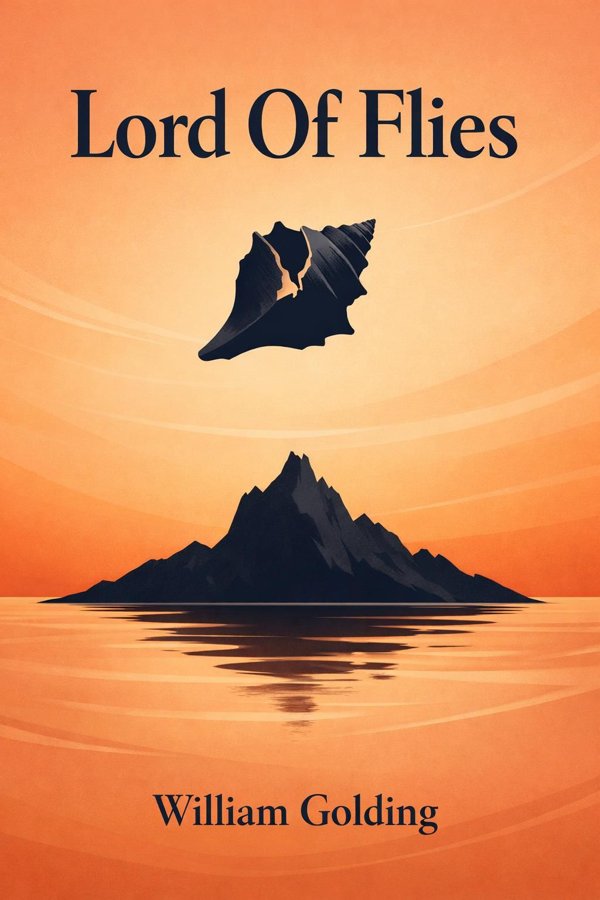
Lord of the Flies: Summary & Key Insights
 10 min4 chaptersAudio available
What Is Lord of the Flies About?
Lord of the Flies by William Golding is a fiction book published in 1954 spanning 4 pages. A group of British boys stranded on an uninhabited island descend into savagery as they attempt to govern themselves. The novel explores the dark side of human nature and the breakdown of civilization when societal structures are removed.
This FizzRead summary covers all 4 key chapters of Lord of the Flies in approximately 10 minutes, distilling the most important ideas, arguments, and takeaways from William Golding's work. Also available as an audio summary and Key Quotes Podcast.
Lord Of The Flies
A group of British boys stranded on an uninhabited island descend into savagery as they attempt to govern themselves. The novel explores the dark side of human nature and the breakdown of civilization when societal structures are removed.
Who Should Read Lord of the Flies?
This book is perfect for anyone interested in fiction and looking to gain actionable insights in a short read. Whether you're a student, professional, or lifelong learner, the key ideas from Lord of the Flies by William Golding will help you think differently.
- ✓Readers who enjoy fiction and want practical takeaways
- ✓Professionals looking to apply new ideas to their work and life
- ✓Anyone who wants the core insights of Lord of the Flies in just 10 minutes
Want the full summary?
Get instant access to this book summary and 100K+ more with Fizz Moment.
Get Free SummaryAvailable on App Store • Free to download
Key Chapters
The novel begins with catastrophe—a plane crash that delivers a group of schoolboys onto a deserted island. At first, it feels like an adventure, an accidental paradise removed from adult constraint. I chose children because they still echo the innocence we all falsely attribute to human nature. Quickly, they recognize that survival requires leadership and structure, so Ralph emerges as a natural choice, the embodiment of rational authority and democratic principle. He grasps the first truth of civilization: order is not instinctive, it must be built.
The conch shell they find becomes their symbol of democracy, their tool to summon voice through collective rules. It’s a fragile instrument, just like any social contract—it means something only as long as they agree it does. Piggy, intellectually gifted but physically limited, reinforces Ralph’s vision with reasoned thinking. His insistence on shelters, names, lists, and sanitation stands as a reflection of humanity’s cognitive victory over chaos. Meanwhile, the signal fire—Ralph’s top priority—embodies hope, the belief in rescue, and the light of human endeavor. When the fire flickers or dies, civilization wanes.
In writing these chapters, I wanted readers to feel the initial optimism amid uncertainty, to sense the naive confidence that humans often bring to untested freedom. Ralph’s leadership mirrors collective progress—democracy, cooperation, and trust. Yet, you can already see the cracks forming beneath the surface. Some boys enjoy freedom too much; discipline feels unnatural in paradise. The fire, their connection to the outside world, is neglected. Slowly, order decays not because of overt rebellion but through apathy. Civilization does not collapse violently at first—it erodes in silence, one abandoned fire at a time.
Darkness does not always march openly; sometimes it sneaks into the mind. I wanted to show that fear is the seed of disorder. For the boys, the island might have been Eden, yet their imagination conjures monsters. The "beast" they believe lurks among them begins as rumor, then grows into shared terror. This fear becomes a religion of its own, an invisible god feeding their insecurity and binding them through irrational dread.
Jack, whose initial duty is the choir’s leadership, transforms through his obsession with hunting. It is not merely hunger that drives him—it’s the intoxicating sense of blood and dominance. As he paints his face and gathers followers, Jack discovers the primal pleasure of anonymity, the freedom to act without self-awareness. The mask gives him power. In contrast to Ralph’s rational flame, Jack’s fire burns for conquest. The hunt, once necessity, becomes ritual. He compels the boys with chants, promises, and spectacles. When I wrote these scenes, I was drawing on centuries of tribal instinct—the way crowds can substitute morality for thrill.
The beast, of course, never exists except within them. Fear externalized becomes weaponized; it justifies cruelty and consolidates Jack’s command. Ralph struggles to remind them of rescue, Piggy pleads for reason, but fear floods reason’s gates. This is how humanity often falls: terror makes us blind to truth. Political powers rise the same way—by manipulating fear, not facts. By the time Simon begins to grasp what the beast truly is, the boys are too deep in their own shadows to listen. Belief has replaced sight.
+ 2 more chapters — available in the FizzRead app
All Chapters in Lord of the Flies
About the Author
William Golding (1911–1993) was an English novelist, playwright, and poet. He is best known for his allegorical novel 'Lord of the Flies', which earned him the Nobel Prize in Literature in 1983. His works often examine moral dilemmas and the inherent evil within humanity.
Get This Summary in Your Preferred Format
Read or listen to the Lord of the Flies summary by William Golding anytime, anywhere. FizzRead offers multiple formats so you can learn on your terms — all free.
Available formats: App · Audio · PDF · EPUB — All included free with FizzRead
Download Lord of the Flies PDF and EPUB Summary
Key Quotes from Lord of the Flies
“The novel begins with catastrophe—a plane crash that delivers a group of schoolboys onto a deserted island.”
“Darkness does not always march openly; sometimes it sneaks into the mind.”
Frequently Asked Questions about Lord of the Flies
Lord of the Flies by William Golding is a fiction book that explores key ideas across 4 chapters. A group of British boys stranded on an uninhabited island descend into savagery as they attempt to govern themselves. The novel explores the dark side of human nature and the breakdown of civilization when societal structures are removed.
You Might Also Like
Browse by Category
Ready to read Lord of the Flies?
Get the full summary and 100K+ more books with Fizz Moment.