
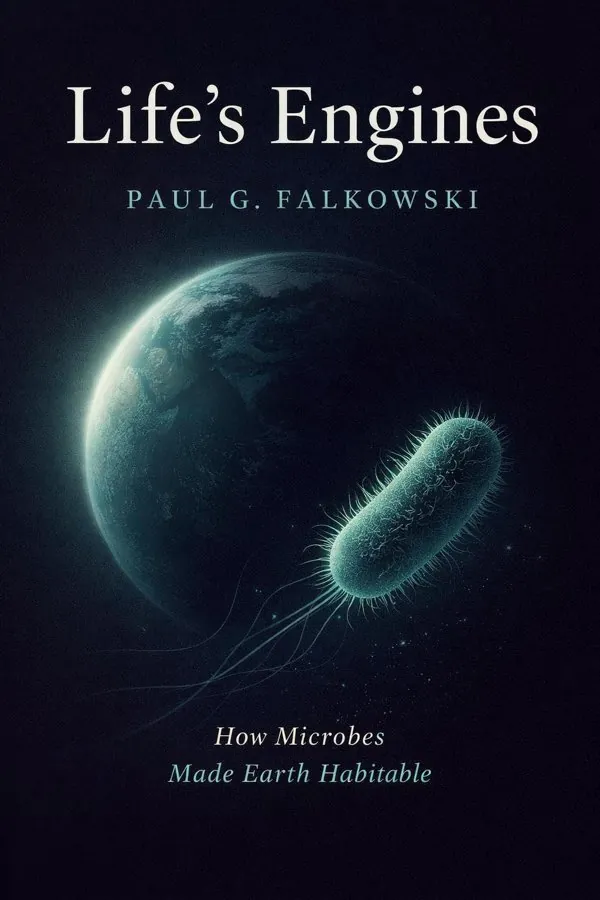
Life’s Engines: How Microbes Made Earth Habitable: Summary & Key Insights
 10 min10 chaptersAudio available
What Is Life’s Engines: How Microbes Made Earth Habitable About?
Life’s Engines: How Microbes Made Earth Habitable by Paul G. Falkowski is a life_science book spanning 10 pages. This book explores how microorganisms shaped the planet’s atmosphere, oceans, and ecosystems, making Earth habitable for complex life. Falkowski explains the biochemical and evolutionary processes that link microbes to the planet’s geochemical cycles, offering a deep look into the origins and sustainability of life on Earth.
This FizzRead summary covers all 10 key chapters of Life’s Engines: How Microbes Made Earth Habitable in approximately 10 minutes, distilling the most important ideas, arguments, and takeaways from Paul G. Falkowski's work. Also available as an audio summary and Key Quotes Podcast.
Life’s Engines: How Microbes Made Earth Habitable
This book explores how microorganisms shaped the planet’s atmosphere, oceans, and ecosystems, making Earth habitable for complex life. Falkowski explains the biochemical and evolutionary processes that link microbes to the planet’s geochemical cycles, offering a deep look into the origins and sustainability of life on Earth.
Who Should Read Life’s Engines: How Microbes Made Earth Habitable?
This book is perfect for anyone interested in life_science and looking to gain actionable insights in a short read. Whether you're a student, professional, or lifelong learner, the key ideas from Life’s Engines: How Microbes Made Earth Habitable by Paul G. Falkowski will help you think differently.
- ✓Readers who enjoy life_science and want practical takeaways
- ✓Professionals looking to apply new ideas to their work and life
- ✓Anyone who wants the core insights of Life’s Engines: How Microbes Made Earth Habitable in just 10 minutes
Want the full summary?
Get instant access to this book summary and 100K+ more with Fizz Moment.
Get Free SummaryAvailable on App Store • Free to download
Key Chapters
Let me begin by introducing you to the vast, unseen world of microbes. They are everywhere—not merely in soil or water, but within your body, in clouds drifting above the Earth, and even in the darkest hydrothermal vents of the ocean floor. Microbes dominate the biosphere by number, biomass, and biochemical influence. Though invisible to the naked eye, they represent Earth's oldest and most successful form of life.
When I first studied microbial life, what astonished me most was their diversity. From the bacteria and archaea that thrive in boiling sulfur pools to those living amid Antarctic ice, microbes display an extraordinary range of metabolic and genetic adaptations. They evolved long before animals or plants emerged, shaping the chemical contours of oceans and atmosphere. In a mere teaspoon of seawater, you’ll find millions of microbial cells forming dynamic communities, constantly exchanging genetic material and managing the elemental cycles that sustain Earth’s equilibrium.
Our planet’s history is effectively a microbial saga. By tracing back through the fossil record and molecular evidence, we can see that microbial mats and stromatolites once painted shallow seas, driving the oxygenation of the oceans. These ancient systems were complex in their own right—communities that created micro-environments, evolved mutual dependencies, and, by virtue of their metabolism, transformed geology.
To understand microbes is to understand the architecture of life itself. They are not primitive relics but fundamental living engines. Every complex organism is, in essence, a coalition of microbial inventions—enzymes, membranes, metabolic pathways—all derived from an ancient microbial toolkit honed over billions of years. This microbial world forms the backbone of ecology, evolution, and even climate regulation, reminding us that life’s continuity depends on these invisible agents working in concert across scales and centuries.
In trying to understand where life began, we are drawn to questions about chemistry, energy, and environment. My approach in *Life’s Engines* is to examine the intersection of geochemistry and molecular evolution. Life did not emerge from random chance—it emerged from a planet primed with energy gradients and molecular building blocks that allowed self-sustaining chemical networks to form.
Imagine early Earth: a world freshly cooled, covered by volcanic landscapes and shallow seas teeming with organic compounds. In such settings, molecules began reacting, assembling into complex structures capable of capturing energy. The key breakthrough, I argue, was the emergence of metabolism—the ability to harness energy from the environment through chemical transformation. Once this process started, natural selection took hold, preserving and refining those early biochemical engines.
We do not yet know the exact moment life sparked into being, but we can trace its biochemical fingerprints. The earliest known microbial fossils, nearly 3.5 billion years old, already show evidence of metabolic activity. Such complexity suggests life’s origin was less a sudden miracle than a gradual emergence from geochemical potential. Energy flow created order—cells emerged as compartments to stabilize those reactions.
From my perspective, understanding the origin of life is not simply about tracing ancestral molecules; it’s about appreciating how deeply metabolism connects to the planet’s chemistry. Life arose not in isolation but as a feedback process shaped by Earth’s environment. The first microbes were miniature chemists interacting with minerals, gases, and light—setting into motion the planetary-scale cycles that sustain us today. The spark of life, in that sense, was the spark of planetary transformation.
+ 8 more chapters — available in the FizzRead app
All Chapters in Life’s Engines: How Microbes Made Earth Habitable
About the Author
Paul G. Falkowski is an American biological oceanographer and professor at Rutgers University. His research focuses on biogeochemical cycles, photosynthesis, and the evolution of life on Earth. He is a member of the National Academy of Sciences and has authored numerous influential works in marine and earth sciences.
Get This Summary in Your Preferred Format
Read or listen to the Life’s Engines: How Microbes Made Earth Habitable summary by Paul G. Falkowski anytime, anywhere. FizzRead offers multiple formats so you can learn on your terms — all free.
Available formats: App · Audio · PDF · EPUB — All included free with FizzRead
Download Life’s Engines: How Microbes Made Earth Habitable PDF and EPUB Summary
Key Quotes from Life’s Engines: How Microbes Made Earth Habitable
“Let me begin by introducing you to the vast, unseen world of microbes.”
“In trying to understand where life began, we are drawn to questions about chemistry, energy, and environment.”
Frequently Asked Questions about Life’s Engines: How Microbes Made Earth Habitable
Life’s Engines: How Microbes Made Earth Habitable by Paul G. Falkowski is a life_science book that explores key ideas across 10 chapters. This book explores how microorganisms shaped the planet’s atmosphere, oceans, and ecosystems, making Earth habitable for complex life. Falkowski explains the biochemical and evolutionary processes that link microbes to the planet’s geochemical cycles, offering a deep look into the origins and sustainability of life on Earth.
You Might Also Like
The Selfish Gene
Richard Dawkins
10 min
Awakenings
Oliver Sacks
10 min
Parasite Rex: Inside the Bizarre World of Nature's Most Dangerous Creatures
Carl Zimmer
10 min
The Atlas of Life on Earth
Various
10 min
The Book of Humans: The Story of How We Became Us
Adam Rutherford
10 min
The Horse
Wendy Williams
10 minBrowse by Category
Ready to read Life’s Engines: How Microbes Made Earth Habitable?
Get the full summary and 100K+ more books with Fizz Moment.