
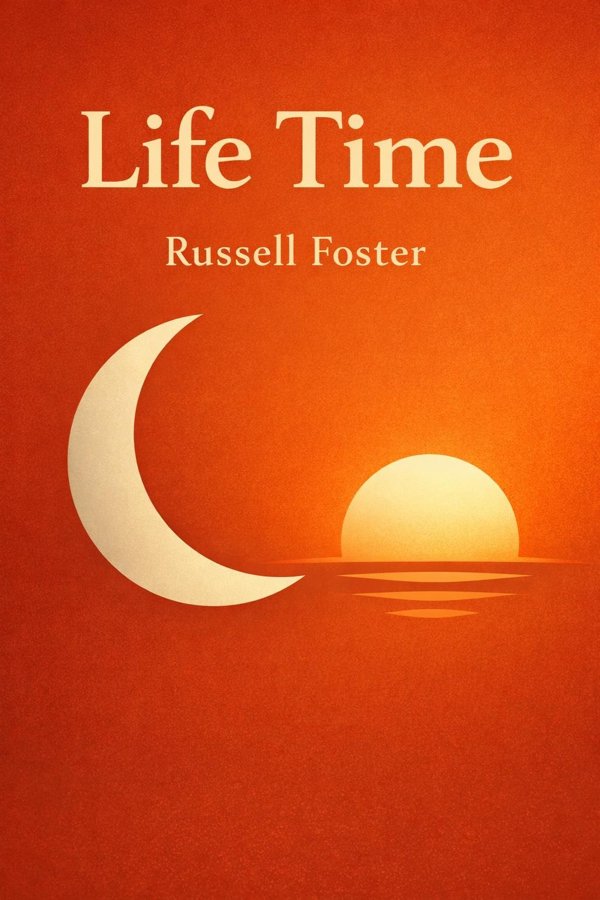
Life Time: Your Body Clock and Its Essential Roles in Good Health and Sleep: Summary & Key Insights
 10 min7 chaptersAudio available
What Is Life Time: Your Body Clock and Its Essential Roles in Good Health and Sleep About?
Life Time: Your Body Clock and Its Essential Roles in Good Health and Sleep by Russell Foster is a popular_sci book spanning 7 pages. In Life Time, Professor Russell Foster explores the science of circadian rhythms and how our internal body clocks influence sleep, health, and cognitive performance. Drawing on decades of research, Foster explains how aligning our daily routines with biological time can improve wellbeing, productivity, and longevity. The book dismantles myths about sleep and offers practical guidance for living in harmony with our natural rhythms.
This FizzRead summary covers all 7 key chapters of Life Time: Your Body Clock and Its Essential Roles in Good Health and Sleep in approximately 10 minutes, distilling the most important ideas, arguments, and takeaways from Russell Foster's work. Also available as an audio summary and Key Quotes Podcast.
Life Time: Your Body Clock and Its Essential Roles in Good Health and Sleep
In Life Time, Professor Russell Foster explores the science of circadian rhythms and how our internal body clocks influence sleep, health, and cognitive performance. Drawing on decades of research, Foster explains how aligning our daily routines with biological time can improve wellbeing, productivity, and longevity. The book dismantles myths about sleep and offers practical guidance for living in harmony with our natural rhythms.
Who Should Read Life Time: Your Body Clock and Its Essential Roles in Good Health and Sleep?
This book is perfect for anyone interested in popular_sci and looking to gain actionable insights in a short read. Whether you're a student, professional, or lifelong learner, the key ideas from Life Time: Your Body Clock and Its Essential Roles in Good Health and Sleep by Russell Foster will help you think differently.
- ✓Readers who enjoy popular_sci and want practical takeaways
- ✓Professionals looking to apply new ideas to their work and life
- ✓Anyone who wants the core insights of Life Time: Your Body Clock and Its Essential Roles in Good Health and Sleep in just 10 minutes
Want the full summary?
Get instant access to this book summary and 100K+ more with Fizz Moment.
Get Free SummaryAvailable on App Store • Free to download
Key Chapters
The story of how we came to understand biological time begins with a set of curious observations. Long before we had modern laboratories, scientists noted that certain plants opened their leaves at the same time every day, even when kept in darkness. This hinted at an inner metronome. That realization launched the field of chronobiology—the study of how living things keep time.
In tracing this history, I walk you from the earliest botanists like Jean-Jacques d’Ortous de Mairan, who noticed daily leaf movements in the 18th century, through the 20th-century discoveries of circadian rhythms in animals and humans. The very term “circadian,” meaning “about a day,” crystallized our recognition that biological systems are not passive to the environment; they anticipate it. From fruit flies to humans, every organism carries molecular machinery that marks each passing cycle of light and dark.
By the mid-1900s, researchers found that if you sealed people inside bunkers without clocks or sunlight, they would still exhibit sleep–wake cycles of roughly 24.2 hours. We are fundamentally rhythmic creatures. What was missing, then, was an understanding of how this internal time is set and maintained. That thread would lead us to the brain’s master clock and to a new way of interpreting human health.
When I first peered through a microscope at the hypothalamus, I could scarcely imagine that within a cluster of about 50,000 neurons lay the conductor of the body’s temporal symphony. This region—the suprachiasmatic nucleus, or SCN—sits just above the optic chiasm and receives direct input from the eyes. From dawn to dusk, it synchronizes the activity of billions of cellular clocks scattered throughout the body.
At the cellular level, these clocks are made of genes and proteins that work in elegant feedback loops. Clock genes such as PER, CRY, BMAL1, and CLOCK rhythmically turn on and off, driving oscillations that control when hormones are secreted, when metabolism peaks, and even when DNA repair occurs. Each tissue—liver, heart, muscle—has its own version of this machinery. What keeps them all in harmony is the SCN’s coordination through neural and hormonal signals.
But this system is not rigid. It adapts every morning when the first photons strike specialized light-sensitive cells in your retina. That light resets the SCN, anchoring your biological clock to the Earth’s 24-hour rotation. Without this cue, rhythms begin to drift, a situation vividly known to anyone suffering jet lag or working night shifts. The SCN, connected to our perception of light, is nature’s way of ensuring that our internal clocks never fall too far out of sync with the day.
+ 5 more chapters — available in the FizzRead app
All Chapters in Life Time: Your Body Clock and Its Essential Roles in Good Health and Sleep
About the Author
Russell Foster is a British neuroscientist and Professor of Circadian Neuroscience at the University of Oxford. He is known for his pioneering research on sleep and biological rhythms, and he has published extensively on how light and time affect human health.
Get This Summary in Your Preferred Format
Read or listen to the Life Time: Your Body Clock and Its Essential Roles in Good Health and Sleep summary by Russell Foster anytime, anywhere. FizzRead offers multiple formats so you can learn on your terms — all free.
Available formats: App · Audio · PDF · EPUB — All included free with FizzRead
Download Life Time: Your Body Clock and Its Essential Roles in Good Health and Sleep PDF and EPUB Summary
Key Quotes from Life Time: Your Body Clock and Its Essential Roles in Good Health and Sleep
“The story of how we came to understand biological time begins with a set of curious observations.”
“When I first peered through a microscope at the hypothalamus, I could scarcely imagine that within a cluster of about 50,000 neurons lay the conductor of the body’s temporal symphony.”
Frequently Asked Questions about Life Time: Your Body Clock and Its Essential Roles in Good Health and Sleep
Life Time: Your Body Clock and Its Essential Roles in Good Health and Sleep by Russell Foster is a popular_sci book that explores key ideas across 7 chapters. In Life Time, Professor Russell Foster explores the science of circadian rhythms and how our internal body clocks influence sleep, health, and cognitive performance. Drawing on decades of research, Foster explains how aligning our daily routines with biological time can improve wellbeing, productivity, and longevity. The book dismantles myths about sleep and offers practical guidance for living in harmony with our natural rhythms.
You Might Also Like

Structures: Or Why Things Don"t Fall Down
J.E. Gordon
10 min
The Road to Wigan Pier
George Orwell
10 min
Bonk: The Curious Coupling of Science and Sex
Mary Roach
10 min
First Bite: How We Learn to Eat
Bee Wilson
10 min
In Pursuit Of The Unknown: 17 Equations That Changed The World
Ian Stewart
10 min
Napoleon's Buttons: 17 Molecules That Changed History
Penny Le Couteur and Jay Burreson
10 minBrowse by Category
Ready to read Life Time: Your Body Clock and Its Essential Roles in Good Health and Sleep?
Get the full summary and 100K+ more books with Fizz Moment.