
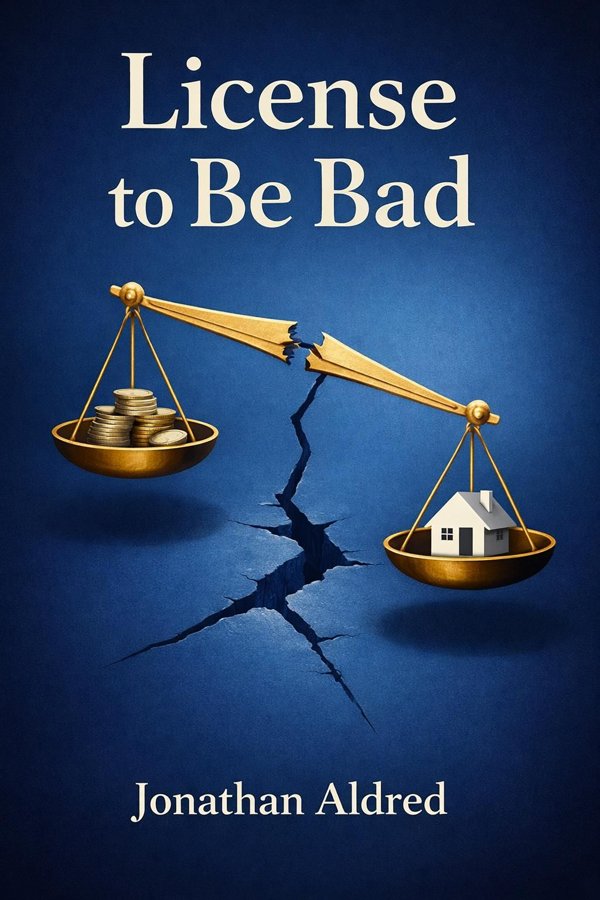
License to Be Bad: How Economics Corrupted Us: Summary & Key Insights
 10 min6 chaptersAudio available
What Is License to Be Bad: How Economics Corrupted Us About?
License to Be Bad: How Economics Corrupted Us by Jonathan Aldred is a economics book spanning 6 pages. In this provocative work, economist Jonathan Aldred explores how modern economic thinking has reshaped our moral landscape. He argues that the rise of free-market ideology has encouraged selfishness, eroded trust, and justified inequality under the guise of rational choice. Drawing on history, philosophy, and behavioral science, Aldred reveals how economic ideas have infiltrated everyday life, from education and healthcare to personal relationships, and calls for a rethinking of what it means to live ethically in a market-driven world.
This FizzRead summary covers all 6 key chapters of License to Be Bad: How Economics Corrupted Us in approximately 10 minutes, distilling the most important ideas, arguments, and takeaways from Jonathan Aldred's work. Also available as an audio summary and Key Quotes Podcast.
License to Be Bad: How Economics Corrupted Us
In this provocative work, economist Jonathan Aldred explores how modern economic thinking has reshaped our moral landscape. He argues that the rise of free-market ideology has encouraged selfishness, eroded trust, and justified inequality under the guise of rational choice. Drawing on history, philosophy, and behavioral science, Aldred reveals how economic ideas have infiltrated everyday life, from education and healthcare to personal relationships, and calls for a rethinking of what it means to live ethically in a market-driven world.
Who Should Read License to Be Bad: How Economics Corrupted Us?
This book is perfect for anyone interested in economics and looking to gain actionable insights in a short read. Whether you're a student, professional, or lifelong learner, the key ideas from License to Be Bad: How Economics Corrupted Us by Jonathan Aldred will help you think differently.
- ✓Readers who enjoy economics and want practical takeaways
- ✓Professionals looking to apply new ideas to their work and life
- ✓Anyone who wants the core insights of License to Be Bad: How Economics Corrupted Us in just 10 minutes
Want the full summary?
Get instant access to this book summary and 100K+ more with Fizz Moment.
Get Free SummaryAvailable on App Store • Free to download
Key Chapters
To understand how economics drifted from moral philosophy into a detached science, we must start with its origins. In the eighteenth century, thinkers like Adam Smith and David Hume did not see economics and ethics as separate spheres. For Smith, self-interest was not a celebration of selfishness but an acknowledgment of human motivation within a moral framework. His *Theory of Moral Sentiments* came before *The Wealth of Nations*, and the two were meant to complement one another. Markets, in Smith’s view, functioned best when participants were guided by sympathy and justice.
But as economics matured into a distinct discipline, its practitioners increasingly sought the precision of physics and the prestige of mathematics. The moral language that once guided political economy—words like virtue, duty, and benevolence—gave way to terms like utility, equilibrium, and optimization. Humans became simplified into ‘agents,’ morality into ‘preferences.’ The field's success in predicting and quantifying economic behavior came at a cost: the abandonment of moral nuance.
This shift might have seemed innocent. After all, who could object to making our theories clearer and our models more rigorous? Yet beneath that technical refinement lay a profound change in how we viewed human beings. Economics became less about how we ought to live together and more about how individuals could maximize their outcomes. The seeds of moral distortion were already sown.
By the mid-twentieth century, economics had reimagined human behavior through the lens of rational choice. Homo economicus was born: a being who calculates, optimizes, and pursues self-interest with machine-like consistency. Rational choice theory offered mathematical elegance and predictive clarity—but at the expense of humanity itself.
In this new model, moral sentiments were errors, altruism a strategic choice, generosity a market signal. People weren’t guided by ethics; they were driven by incentives. Economists began to treat moral beliefs as preferences, no different from tastes in food or music. The language of virtue gave way to the language of utility.
The power of rational choice thinking lay not merely in its academic influence but in its psychological allure. It gave us permission to see selfishness as natural, even admirable. It told us that helping others only made sense if it served our interests. This was not just a description of behavior—it was a prescription for how society should be organized.
The ripple effects were vast. From corporate boardrooms to public policy, the logic of rational self-interest became the new moral compass. Inequality could be justified so long as it was ‘efficient.’ Greed was recast as a form of enlightened rationality. The invisible hand, once tempered by moral restraint, became a license to pursue profit without guilt.
+ 4 more chapters — available in the FizzRead app
All Chapters in License to Be Bad: How Economics Corrupted Us
About the Author
Jonathan Aldred is a British economist and Fellow of Emmanuel College, University of Cambridge. His research focuses on ethics and economics, environmental economics, and the philosophical foundations of economic theory. He is known for his accessible writing that bridges moral philosophy and economic thought.
Get This Summary in Your Preferred Format
Read or listen to the License to Be Bad: How Economics Corrupted Us summary by Jonathan Aldred anytime, anywhere. FizzRead offers multiple formats so you can learn on your terms — all free.
Available formats: App · Audio · PDF · EPUB — All included free with FizzRead
Download License to Be Bad: How Economics Corrupted Us PDF and EPUB Summary
Key Quotes from License to Be Bad: How Economics Corrupted Us
“To understand how economics drifted from moral philosophy into a detached science, we must start with its origins.”
“By the mid-twentieth century, economics had reimagined human behavior through the lens of rational choice.”
Frequently Asked Questions about License to Be Bad: How Economics Corrupted Us
License to Be Bad: How Economics Corrupted Us by Jonathan Aldred is a economics book that explores key ideas across 6 chapters. In this provocative work, economist Jonathan Aldred explores how modern economic thinking has reshaped our moral landscape. He argues that the rise of free-market ideology has encouraged selfishness, eroded trust, and justified inequality under the guise of rational choice. Drawing on history, philosophy, and behavioral science, Aldred reveals how economic ideas have infiltrated everyday life, from education and healthcare to personal relationships, and calls for a rethinking of what it means to live ethically in a market-driven world.
More by Jonathan Aldred
You Might Also Like
Business Adventures
John Brooks
10 min
Nudge
Richard H. Thaler, Cass R. Sunstein
10 min
The Hitchhiker"s Guide to the Galaxy
Douglas Adams
10 minThe Muqaddimah
Ibn Khaldun
10 minThe Outsiders
William N. Thorndike
10 min
A Little History of Economics
Niall Kishtainy
10 minBrowse by Category
Ready to read License to Be Bad: How Economics Corrupted Us?
Get the full summary and 100K+ more books with Fizz Moment.