
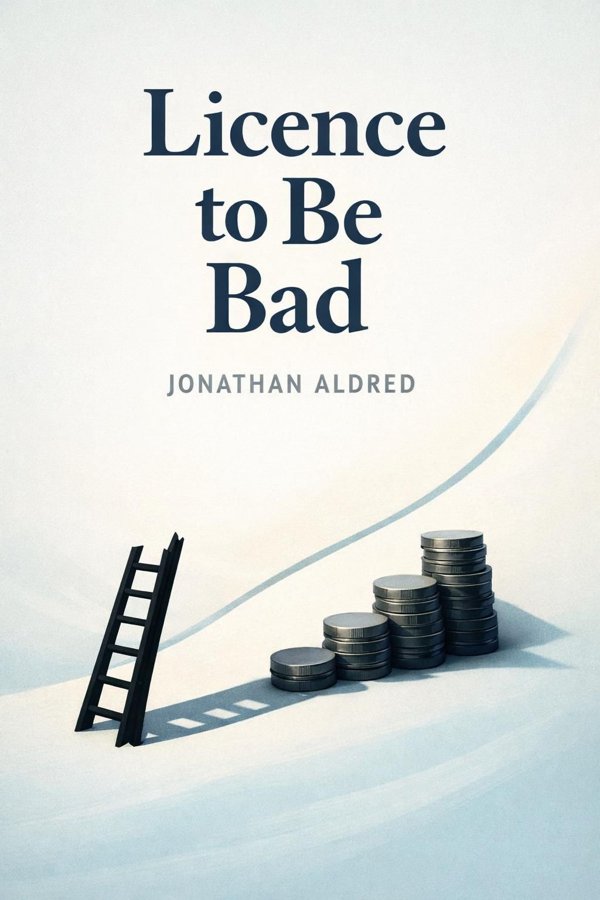
Licence to Be Bad: How Economics Corrupted Us: Summary & Key Insights
 10 min9 chaptersAudio available
What Is Licence to Be Bad: How Economics Corrupted Us About?
Licence to Be Bad: How Economics Corrupted Us by Jonathan Aldred is a economics book spanning 9 pages. Licence to Be Bad explores how modern economic theories have reshaped our moral and social landscape. Jonathan Aldred traces the influence of ideas such as free-riding, game theory, and rational choice, showing how they have justified selfishness and undermined collective responsibility. The book argues that economics has not only described human behavior but also changed it, granting moral permission for greed and self-interest to flourish.
This FizzRead summary covers all 9 key chapters of Licence to Be Bad: How Economics Corrupted Us in approximately 10 minutes, distilling the most important ideas, arguments, and takeaways from Jonathan Aldred's work. Also available as an audio summary and Key Quotes Podcast.
Licence to Be Bad: How Economics Corrupted Us
Licence to Be Bad explores how modern economic theories have reshaped our moral and social landscape. Jonathan Aldred traces the influence of ideas such as free-riding, game theory, and rational choice, showing how they have justified selfishness and undermined collective responsibility. The book argues that economics has not only described human behavior but also changed it, granting moral permission for greed and self-interest to flourish.
Who Should Read Licence to Be Bad: How Economics Corrupted Us?
This book is perfect for anyone interested in economics and looking to gain actionable insights in a short read. Whether you're a student, professional, or lifelong learner, the key ideas from Licence to Be Bad: How Economics Corrupted Us by Jonathan Aldred will help you think differently.
- ✓Readers who enjoy economics and want practical takeaways
- ✓Professionals looking to apply new ideas to their work and life
- ✓Anyone who wants the core insights of Licence to Be Bad: How Economics Corrupted Us in just 10 minutes
Want the full summary?
Get instant access to this book summary and 100K+ more with Fizz Moment.
Get Free SummaryAvailable on App Store • Free to download
Key Chapters
The transformation begins with rational choice theory—the proud cornerstone of modern economics. The idea appears simple enough: people act rationally to maximize their satisfaction, choosing whatever option serves their self-interest best. The seduction lies in its elegance and mathematical clarity. Once human beings are treated as calculating agents—homo economicus—the messy unpredictability of moral motivation can be tidily set aside.
In policy circles and business schools alike, this abstraction took hold as a universal lens on behavior. Rationality was redefined as self-interested calculation, and by a subtle inversion, anything that did not serve narrow self-interest came to be viewed as irrational. Generosity, loyalty, even honesty, were reinterpreted as strategic in disguise—long-term plays in a game of self-advancement.
I saw how this framework smoothly colonized public reasoning. Governments began designing policies premised on the assumption that citizens would cheat or free-ride unless constrained by incentives. The social contract, once grounded in shared moral duty, morphed into a network of self-seeking actors compelled by surveillance, penalties, and rewards. What had once been the language of ethics gave way to the language of mechanism.
The deeper consequence was a moral reprogramming: by constantly telling people that rational behavior means selfish behavior, economists helped make that story real. Rational choice theory did not simply describe human nature—it reconstructed it.
If rational choice provides the grammar, game theory supplies the syntax of modern cynicism. Developed in the mid-twentieth century, game theory brought the drama of competition to life using models of players, payoffs, and strategies. Its influence extended far beyond economics, shaping military strategy, business negotiation, and even romantic relationships.
The logic of game theory assumes that each player acts to maximize personal gain, anticipating that others do the same. Cooperation appears fragile, trust naive. The famous Prisoner’s Dilemma encapsulates this fatalism: even when cooperation would yield the best outcome for both, rational players betray each other out of fear that the other will do the same. It is a bleak parable of mistrust masquerading as realism.
When this logic entered public policy, it normalized a harsh form of strategic thinking. Diplomacy, labor negotiations, and environmental cooperation came to be framed as contests of manipulation and deterrence. Even moral choices were recast as strategy. People were encouraged to ask not what is right, but what advantage they gain by seeming right.
Yet, when societies expect distrust, they produce it. The self-fulfilling prophecy of game theory corrodes the very conditions of cooperation it analyzes. The tragic irony is that by insisting we are competitors by nature, economists have helped make us so.
+ 7 more chapters — available in the FizzRead app
All Chapters in Licence to Be Bad: How Economics Corrupted Us
About the Author
Jonathan Aldred is a British economist and Fellow of Emmanuel College, University of Cambridge. His research focuses on ethics and economics, particularly the moral assumptions underlying economic theory and policy.
Get This Summary in Your Preferred Format
Read or listen to the Licence to Be Bad: How Economics Corrupted Us summary by Jonathan Aldred anytime, anywhere. FizzRead offers multiple formats so you can learn on your terms — all free.
Available formats: App · Audio · PDF · EPUB — All included free with FizzRead
Download Licence to Be Bad: How Economics Corrupted Us PDF and EPUB Summary
Key Quotes from Licence to Be Bad: How Economics Corrupted Us
“The transformation begins with rational choice theory—the proud cornerstone of modern economics.”
“If rational choice provides the grammar, game theory supplies the syntax of modern cynicism.”
Frequently Asked Questions about Licence to Be Bad: How Economics Corrupted Us
Licence to Be Bad: How Economics Corrupted Us by Jonathan Aldred is a economics book that explores key ideas across 9 chapters. Licence to Be Bad explores how modern economic theories have reshaped our moral and social landscape. Jonathan Aldred traces the influence of ideas such as free-riding, game theory, and rational choice, showing how they have justified selfishness and undermined collective responsibility. The book argues that economics has not only described human behavior but also changed it, granting moral permission for greed and self-interest to flourish.
More by Jonathan Aldred
You Might Also Like
Business Adventures
John Brooks
10 min
Nudge
Richard H. Thaler, Cass R. Sunstein
10 min
The Hitchhiker"s Guide to the Galaxy
Douglas Adams
10 minThe Muqaddimah
Ibn Khaldun
10 minThe Outsiders
William N. Thorndike
10 min
A Little History of Economics
Niall Kishtainy
10 minBrowse by Category
Ready to read Licence to Be Bad: How Economics Corrupted Us?
Get the full summary and 100K+ more books with Fizz Moment.