
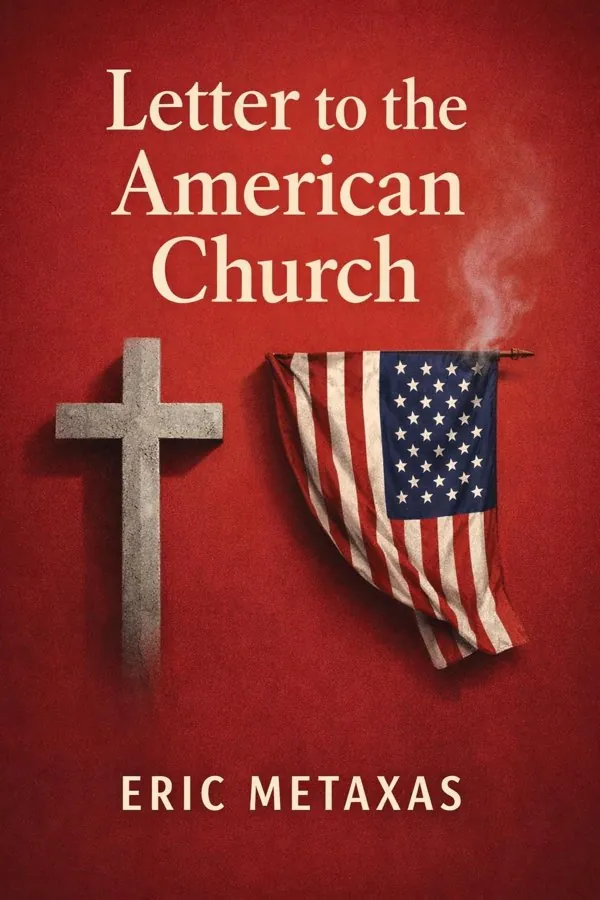
Letter to the American Church: Summary & Key Insights
by Eric Metaxas
 10 min12 chaptersAudio available
What Is Letter to the American Church About?
Letter to the American Church by Eric Metaxas is a politics book spanning 12 pages. In this impassioned work, Eric Metaxas warns that the American church faces a moral crisis similar to that of the German church during the rise of Nazism. He argues that silence in the face of cultural and political evil is complicity, urging Christians to speak truth boldly and act courageously in defense of faith and freedom.
This FizzRead summary covers all 12 key chapters of Letter to the American Church in approximately 10 minutes, distilling the most important ideas, arguments, and takeaways from Eric Metaxas's work. Also available as an audio summary and Key Quotes Podcast.
Letter to the American Church
In this impassioned work, Eric Metaxas warns that the American church faces a moral crisis similar to that of the German church during the rise of Nazism. He argues that silence in the face of cultural and political evil is complicity, urging Christians to speak truth boldly and act courageously in defense of faith and freedom.
Who Should Read Letter to the American Church?
This book is perfect for anyone interested in politics and looking to gain actionable insights in a short read. Whether you're a student, professional, or lifelong learner, the key ideas from Letter to the American Church by Eric Metaxas will help you think differently.
- ✓Readers who enjoy politics and want practical takeaways
- ✓Professionals looking to apply new ideas to their work and life
- ✓Anyone who wants the core insights of Letter to the American Church in just 10 minutes
Want the full summary?
Get instant access to this book summary and 100K+ more with Fizz Moment.
Get Free SummaryAvailable on App Store • Free to download
Key Chapters
When I draw the parallel between today’s American church and the German church of the Hitler era, I do so with trembling reverence and serious intent. The comparison is not rhetorical, nor is it exaggerated. In the decades after World War I, German Christians faced enormous social upheaval—economic uncertainty, national humiliation, and the allure of order promised by a strong political leader. Amid these pressures, many church leaders convinced themselves they should avoid political entanglement, preferring to focus on spiritual matters. In doing so, they created a vacuum where evil could thrive. Hitler exploited that silence, and the church that should have been moral conscience became largely complicit or indifferent.
Dietrich Bonhoeffer, one of few German pastors who refused such moral retreat, understood that faith required action. He saw how theology detached from reality became an accomplice to injustice. His life became a testimony that genuine discipleship demands costly obedience—a lesson the American church seems in danger of forgetting. Our own society is not plagued by a dictator in the same form, but we face growing ideological absolutism that demands conformity at the expense of truth. As many churches strive for cultural acceptance, they risk repeating the fatal mistake of privileging peace over righteousness.
History, therefore, is not merely a backdrop but a warning. When Christians cease to speak truth publicly, evil gains legitimacy. The silence of the German church did not merely fail to oppose Hitler—it actively permitted his ascent by normalizing cowardice masked as “prudence.” We must recognize ourselves in their story not to condemn them, but to understand that moral blindness is always closer than we think. The past should not be treated as safely concluded, but as mirror and mentor for today. I recount these events because the cost of silence remains the same: the erosion of freedom, the degradation of truth, and the disappearance of moral witness.
Evil does not always present itself in grotesque shapes. Often it advances quietly, wrapped in the language of progress, compassion, and neutrality. Many Christians fail to resist it because they do not recognize its subtlety. Theological tradition teaches that evil thrives not only through the actions of the wicked, but even more effectively through the inaction of the good. When believers believe they can remain silent, they unknowingly become part of the machinery that sustains wrongdoing.
In reflecting on Bonhoeffer’s thought, I emphasize that silence is not morally neutral—it is active cooperation with evil. Bonhoeffer saw this clearly when his fellow pastors rationalized their passivity. They argued that fighting Hitler was political and thus unspiritual, that the church existed for saving souls not for opposing governments. Yet Bonhoeffer knew that faith, to be real, demands obedience even when that obedience makes one politically uncomfortable. He declared that the church must not only bandage the victims under the wheel, but also jam a spoke in the wheel itself. His words remain a piercing indictment of our present timidity.
Today, many believers tell themselves that cultural controversies are distractions from the gospel. But denying engagement is not spiritual purity—it is abdication of responsibility. Moral darkness spreads wherever light withdraws. The advance of evil in any form—whether ideological coercion, moral relativism, or suppression of religious freedom—depends on the cooperation of the silent majority. Each time we choose comfort over conviction, we echo the tragic failures of history. To understand evil rightly, then, is to recognize it not as an external force but as the sum of our own collective evasions. True faith requires the courage to name sin when culture says we must tolerate it.
+ 10 more chapters — available in the FizzRead app
All Chapters in Letter to the American Church
About the Author
Eric Metaxas is an American author, speaker, and radio host known for his biographies of religious and historical figures such as Dietrich Bonhoeffer and William Wilberforce. His works often explore the intersection of faith, culture, and moral courage.
Get This Summary in Your Preferred Format
Read or listen to the Letter to the American Church summary by Eric Metaxas anytime, anywhere. FizzRead offers multiple formats so you can learn on your terms — all free.
Available formats: App · Audio · PDF · EPUB — All included free with FizzRead
Download Letter to the American Church PDF and EPUB Summary
Key Quotes from Letter to the American Church
“When I draw the parallel between today’s American church and the German church of the Hitler era, I do so with trembling reverence and serious intent.”
“Evil does not always present itself in grotesque shapes.”
Frequently Asked Questions about Letter to the American Church
Letter to the American Church by Eric Metaxas is a politics book that explores key ideas across 12 chapters. In this impassioned work, Eric Metaxas warns that the American church faces a moral crisis similar to that of the German church during the rise of Nazism. He argues that silence in the face of cultural and political evil is complicity, urging Christians to speak truth boldly and act courageously in defense of faith and freedom.
You Might Also Like
Antifa: The Anti-Fascist Handbook
Mark Bray
10 min
Attack from Within: How Disinformation Is Sabotaging America
Barbara McQuade
10 min
Coercion, Capital, and European States, AD 990–1992
Charles Tilly
10 min
Digital Democracy: Concepts, Methodologies, Tools, and Applications
Various Authors
10 min
Fascism
Stanley G. Payne
10 min
Fire And Fury: Inside The Trump White House
Michael Wolff
10 minBrowse by Category
Ready to read Letter to the American Church?
Get the full summary and 100K+ more books with Fizz Moment.