
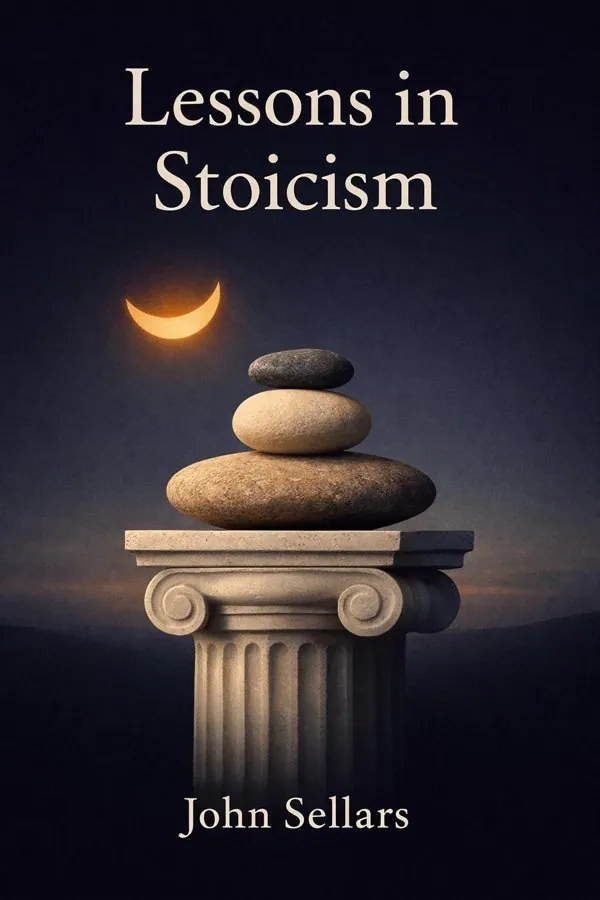
Lessons in Stoicism: Summary & Key Insights
by John Sellars
 10 min8 chaptersAudio available
What Is Lessons in Stoicism About?
Lessons in Stoicism by John Sellars is a western_phil book spanning 8 pages. A concise introduction to Stoic philosophy, exploring how ancient Stoic ideas can guide modern life. The book distills key teachings from figures such as Seneca, Epictetus, and Marcus Aurelius, offering practical reflections on resilience, virtue, and emotional balance.
This FizzRead summary covers all 8 key chapters of Lessons in Stoicism in approximately 10 minutes, distilling the most important ideas, arguments, and takeaways from John Sellars's work. Also available as an audio summary and Key Quotes Podcast.
Lessons in Stoicism
A concise introduction to Stoic philosophy, exploring how ancient Stoic ideas can guide modern life. The book distills key teachings from figures such as Seneca, Epictetus, and Marcus Aurelius, offering practical reflections on resilience, virtue, and emotional balance.
Who Should Read Lessons in Stoicism?
This book is perfect for anyone interested in western_phil and looking to gain actionable insights in a short read. Whether you're a student, professional, or lifelong learner, the key ideas from Lessons in Stoicism by John Sellars will help you think differently.
- ✓Readers who enjoy western_phil and want practical takeaways
- ✓Professionals looking to apply new ideas to their work and life
- ✓Anyone who wants the core insights of Lessons in Stoicism in just 10 minutes
Want the full summary?
Get instant access to this book summary and 100K+ more with Fizz Moment.
Get Free SummaryAvailable on App Store • Free to download
Key Chapters
At the heart of Stoicism lies a cosmology anchored in reason. The Stoics believed that the universe is an interwoven, living whole governed by Logos, a rational principle pervading all things. This divine reason is not a distant god but the very structure of reality, ordering the cosmos with coherence and purpose. To live according to nature therefore means living in harmony with reason—recognizing that we ourselves are fragments of that rational order. Our minds, the Stoics taught, are sparks of the cosmic fire.
When we see ourselves as participants within this larger system, many of our anxieties start to dissolve. We begin to understand that events follow a chain of causes beyond any individual will. This insight doesn’t make us passive; rather, it helps us find our proper role. The Stoic sage doesn’t rail against the tide, nor does he float aimlessly upon it. He learns to steer his vessel with skill, using reason as his compass.
This worldview transforms what might seem fatalistic into an ethics of active cooperation with the world’s order. The Stoic believes that the rational mind has the duty to align itself with the whole—working for the common good, acting justly, and pursuing wisdom as an expression of universal reason. Once this perspective is internalized, our grievances against fortune appear misplaced. For the Stoics, nature does not conspire against us. It simply unfolds according to its own eternal logic. Our task is to understand and consent to that logic, to live lucidly within it.
Few insights in philosophy are as liberating as Epictetus’s distinction between what is up to us and what is not. We cannot choose the weather, our genetic inheritance, or the passing thoughts of others. But we can choose our judgments, our intentions, and the actions that flow from them. Everything else, the Stoics tell us, belongs to the realm of what is not in our control.
Acceptance, then, is not surrender but strength—the strength of clarity. By confining our concern to what lies within our power, we recover an inner sovereignty no circumstance can annul. Epictetus reminds us that freedom does not depend on possessions or prestige, but on self-command. Once you see how much of life’s turbulence stems from misdirected concern, the path to tranquility becomes visible. Every event can be met with the question: Is this mine or not? If it isn’t, then it deserves no tyranny over your peace.
This principle, however stark, is not cruel. It offers compassion—toward ourselves and others—for it reveals how often our suffering arises from false expectations. To live as a Stoic is to adjust one’s desires to reality, not reality to one’s desires. In this way, control and acceptance become one motion of the mind: lucid awareness of what depends on us and graceful acquiescence to what does not.
+ 6 more chapters — available in the FizzRead app
All Chapters in Lessons in Stoicism
About the Author
John Sellars is a British philosopher and Senior Lecturer in Philosophy at Royal Holloway, University of London. He specializes in ancient philosophy, particularly Stoicism, and has written several books on the subject, including 'Stoicism' and 'Hellenistic Philosophy'.
Get This Summary in Your Preferred Format
Read or listen to the Lessons in Stoicism summary by John Sellars anytime, anywhere. FizzRead offers multiple formats so you can learn on your terms — all free.
Available formats: App · Audio · PDF · EPUB — All included free with FizzRead
Download Lessons in Stoicism PDF and EPUB Summary
Key Quotes from Lessons in Stoicism
“At the heart of Stoicism lies a cosmology anchored in reason.”
“Few insights in philosophy are as liberating as Epictetus’s distinction between what is up to us and what is not.”
Frequently Asked Questions about Lessons in Stoicism
Lessons in Stoicism by John Sellars is a western_phil book that explores key ideas across 8 chapters. A concise introduction to Stoic philosophy, exploring how ancient Stoic ideas can guide modern life. The book distills key teachings from figures such as Seneca, Epictetus, and Marcus Aurelius, offering practical reflections on resilience, virtue, and emotional balance.
You Might Also Like
A Little History of Philosophy
Nigel Warburton
10 min
Areopagitica
John Milton
10 min
How To Think Like A Philosopher: Essential Principles For Clear Thinking
Peter Cave
10 min
Language, Truth and Logic
A. J. Ayer
10 min
The Age of Reason
Thomas Paine
10 min
The Essays
Michel De Montaigne
10 minBrowse by Category
Ready to read Lessons in Stoicism?
Get the full summary and 100K+ more books with Fizz Moment.