
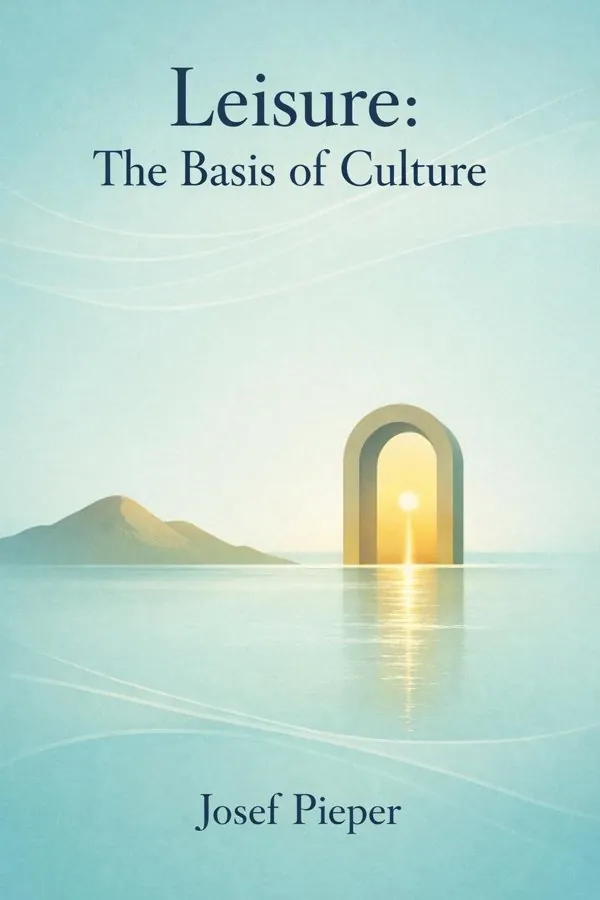
Leisure: The Basis of Culture: Summary & Key Insights
by Josef Pieper
 10 min9 chaptersAudio available
What Is Leisure: The Basis of Culture About?
Leisure: The Basis of Culture by Josef Pieper is a western_phil book spanning 9 pages. In this philosophical classic, Josef Pieper argues that true culture is rooted in leisure—a state of inner calm and openness to being. He distinguishes between work and leisure, showing that leisure forms the foundation for contemplation, art, and religion. The book defends spiritual freedom against the totalitarian absorption of human life by work and utility.
This FizzRead summary covers all 9 key chapters of Leisure: The Basis of Culture in approximately 10 minutes, distilling the most important ideas, arguments, and takeaways from Josef Pieper's work. Also available as an audio summary and Key Quotes Podcast.
Leisure: The Basis of Culture
In this philosophical classic, Josef Pieper argues that true culture is rooted in leisure—a state of inner calm and openness to being. He distinguishes between work and leisure, showing that leisure forms the foundation for contemplation, art, and religion. The book defends spiritual freedom against the totalitarian absorption of human life by work and utility.
Who Should Read Leisure: The Basis of Culture?
This book is perfect for anyone interested in western_phil and looking to gain actionable insights in a short read. Whether you're a student, professional, or lifelong learner, the key ideas from Leisure: The Basis of Culture by Josef Pieper will help you think differently.
- ✓Readers who enjoy western_phil and want practical takeaways
- ✓Professionals looking to apply new ideas to their work and life
- ✓Anyone who wants the core insights of Leisure: The Basis of Culture in just 10 minutes
Want the full summary?
Get instant access to this book summary and 100K+ more with Fizz Moment.
Get Free SummaryAvailable on App Store • Free to download
Key Chapters
Leisure, I argued, is often misunderstood. In everyday speech, we treat it as the opposite of labor—a gap between tasks, an interval of rest earned through effort. But that is not its true essence. Leisure is not mere idleness, nor simple recreation. It is a condition of the soul, a mode of being in which one ceases to be preoccupied with utility and becomes receptive to reality. Work focuses on what must be done; leisure, on what simply is.
This distinction is ancient. In Greek thought, the word 'scholé'—from which our word 'school' derives—meant leisure, and it signified not time off but the state in which one could contemplate truth. Aristotle held that contemplation (theōria) is the highest form of activity precisely because it is not for anything else; it is done for its own sake. Leisure, then, is not laziness but divine openness, an inner stillness that allows reality to disclose itself.
In modern society, we have lost sight of this. When everything is measured by performance, leisure becomes suspicious, even shameful. We define ourselves by our work, by our achievements, by constant 'doing.' But man is not created to be forever active; he is created also to receive. The deepest experiences—love, beauty, worship—cannot be demanded or manufactured. They come as gifts, in moments when we permit ourselves to be still.
So, leisure is the condition for contemplation, and contemplation is the root of culture. When we are leisurely, we affirm that the world is good, that being itself deserves celebration. In this affirmation lies the origin of every art, every philosophy, and every prayer. Without leisure, culture becomes utilitarian; with leisure, it breathes again.
Modern civilization is proud of its work ethic. We speak of efficiency, productivity, and the dignity of labor, often seeing idleness as a moral failing. I do not deny that work has dignity—it is necessary, and through it man participates in creation. But there is a danger in absolutizing it. When work becomes our total horizon, we begin to confuse means with ends.
Historically, this transformation did not happen overnight. The ancient and medieval worlds distinguished between the vita activa—the active life—and the vita contemplativa—the contemplative life. Work had purpose, but contemplation was regarded as higher, for through it one approached truth itself. The modern age inverted that hierarchy. Industrialization, utilitarian philosophy, and political ideologies enthroned work as the supreme value. Man became a 'worker,' judged by output rather than by virtue.
This 'work society' believes that everything must have a function, that even leisure must serve recovery in order to prepare one for more work. Education is for jobs; art is for social utility; religion is moral discipline. In such a climate, the contemplative life is marginalized as impractical.
Yet when I look deeper, I see that without a dimension of leisure, even work itself loses meaning. Labor derives purpose from a vision of what is good; without contemplation, we no longer know what that is. We become efficient but directionless, capable of producing endlessly, but not of answering why. To restore the balance between work and contemplation is to recover the soul of action itself—to work meaningfully because we have first encountered meaning.
+ 7 more chapters — available in the FizzRead app
All Chapters in Leisure: The Basis of Culture
About the Author
Josef Pieper (1904–1997) was a German Catholic philosopher known for his works on virtue ethics and the relationship between philosophy and theology. He taught at the University of Münster and is regarded as one of the most important representatives of 20th-century Christian philosophy.
Get This Summary in Your Preferred Format
Read or listen to the Leisure: The Basis of Culture summary by Josef Pieper anytime, anywhere. FizzRead offers multiple formats so you can learn on your terms — all free.
Available formats: App · Audio · PDF · EPUB — All included free with FizzRead
Download Leisure: The Basis of Culture PDF and EPUB Summary
Key Quotes from Leisure: The Basis of Culture
“Leisure, I argued, is often misunderstood.”
“Modern civilization is proud of its work ethic.”
Frequently Asked Questions about Leisure: The Basis of Culture
Leisure: The Basis of Culture by Josef Pieper is a western_phil book that explores key ideas across 9 chapters. In this philosophical classic, Josef Pieper argues that true culture is rooted in leisure—a state of inner calm and openness to being. He distinguishes between work and leisure, showing that leisure forms the foundation for contemplation, art, and religion. The book defends spiritual freedom against the totalitarian absorption of human life by work and utility.
You Might Also Like
A Little History of Philosophy
Nigel Warburton
10 min
Areopagitica
John Milton
10 min
How To Think Like A Philosopher: Essential Principles For Clear Thinking
Peter Cave
10 min
Language, Truth and Logic
A. J. Ayer
10 min
The Age of Reason
Thomas Paine
10 min
The Essays
Michel De Montaigne
10 minBrowse by Category
Ready to read Leisure: The Basis of Culture?
Get the full summary and 100K+ more books with Fizz Moment.