
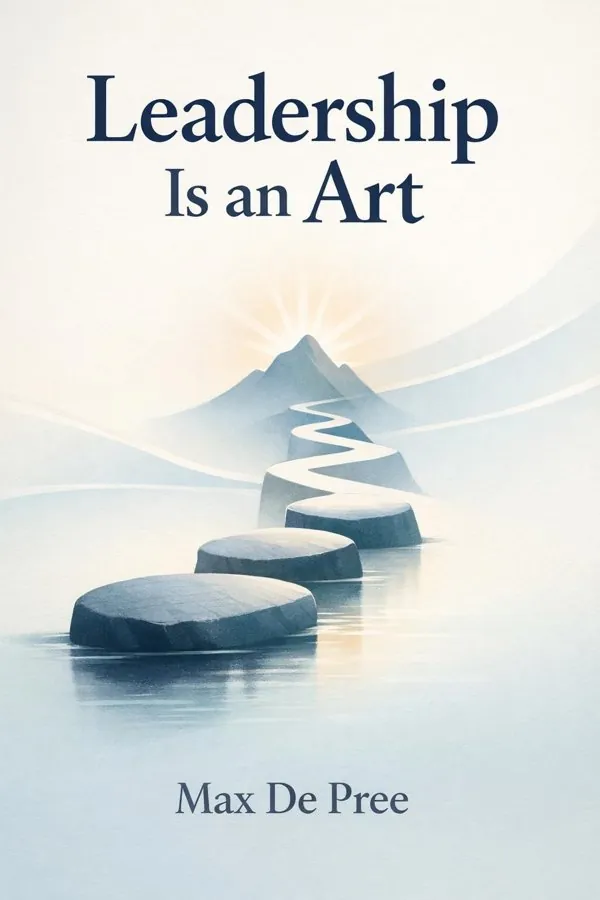
Leadership Is an Art: Summary & Key Insights
by Max De Pree
 10 min12 chaptersAudio available
What Is Leadership Is an Art About?
Leadership Is an Art by Max De Pree is a leadership book spanning 12 pages. In this influential work, Max De Pree, former CEO of Herman Miller, explores the human side of leadership. He argues that leadership is not about control or authority but about serving others, fostering trust, and enabling people to reach their potential. Drawing from his experience, De Pree presents leadership as a moral art rooted in relationships, integrity, and community.
This FizzRead summary covers all 12 key chapters of Leadership Is an Art in approximately 10 minutes, distilling the most important ideas, arguments, and takeaways from Max De Pree's work. Also available as an audio summary and Key Quotes Podcast.
Leadership Is an Art
In this influential work, Max De Pree, former CEO of Herman Miller, explores the human side of leadership. He argues that leadership is not about control or authority but about serving others, fostering trust, and enabling people to reach their potential. Drawing from his experience, De Pree presents leadership as a moral art rooted in relationships, integrity, and community.
Who Should Read Leadership Is an Art?
This book is perfect for anyone interested in leadership and looking to gain actionable insights in a short read. Whether you're a student, professional, or lifelong learner, the key ideas from Leadership Is an Art by Max De Pree will help you think differently.
- ✓Readers who enjoy leadership and want practical takeaways
- ✓Professionals looking to apply new ideas to their work and life
- ✓Anyone who wants the core insights of Leadership Is an Art in just 10 minutes
Want the full summary?
Get instant access to this book summary and 100K+ more with Fizz Moment.
Get Free SummaryAvailable on App Store • Free to download
Key Chapters
Early in my career, I came to understand that leadership is not a position one holds—it is a grace one practices. I call it servant leadership. The essence of this idea is stewardship: to be entrusted with the lives, hopes, and gifts of others, and to treat that trust with reverence. A leader is not the owner of vision or talent but its caretaker. Stewardship begins with acknowledging our accountability, not just to shareholders or customers, but to the human beings who make up the organization. They are not hired hands; they are partners in purpose.
Stewardship demands humility. The true leader asks, ‘Whose servant am I?’ before asking, ‘Who serves me?’ It means establishing a culture where respect replaces entitlement, where leaders nurture rather than dominate. In practical terms, I learned to ask employees not only what they did but what they dreamed, what they cared about. Because the more a person’s inner values align with what they do, the more the work becomes a calling and less an obligation.
Servant leadership also means responsibility—responsibility for creating environments where people can thrive, where they can fail without fear, and where success is shared generously. When leadership becomes stewardship, organizations begin to act as communities that serve a common good rather than systems that consume energy for private gain.
Leadership has its truest expression in community. The foundation of any enduring organization is the people who believe in what it stands for and who choose to belong. To me, community is not merely a collection of individuals working under a roof—it is a covenant, a shared promise that binds us together in purpose and trust.
At Herman Miller, we discovered that creating community meant designing human-centered relationships. It meant giving space for people to be heard, to participate, and to feel that their voice mattered. It meant fostering a culture of inclusion and belonging, where people could bring not only their skills but their whole selves to work. Community thrives in mutual respect; it decays in isolation or secrecy.
The leader’s role is to nurture this sense of community every day—not through formal speeches, but through acts of attention and listening. When a leader knows the names, stories, and hopes of their people, leadership ceases to be about authority and becomes about empathy. A real community values not only results but relationships; it celebrates milestones together and works through conflict with grace. For me, the mark of great leadership was not how many projects we completed, but how connected we felt in doing them together.
+ 10 more chapters — available in the FizzRead app
All Chapters in Leadership Is an Art
About the Author
Max De Pree (1924–2017) was an American businessman and author best known for his tenure as CEO of Herman Miller, Inc. Under his leadership, the company became a model of participative management and corporate culture. De Pree wrote several books on leadership and organizational values, emphasizing service, trust, and human dignity.
Get This Summary in Your Preferred Format
Read or listen to the Leadership Is an Art summary by Max De Pree anytime, anywhere. FizzRead offers multiple formats so you can learn on your terms — all free.
Available formats: App · Audio · PDF · EPUB — All included free with FizzRead
Download Leadership Is an Art PDF and EPUB Summary
Key Quotes from Leadership Is an Art
“Early in my career, I came to understand that leadership is not a position one holds—it is a grace one practices.”
“Leadership has its truest expression in community.”
Frequently Asked Questions about Leadership Is an Art
Leadership Is an Art by Max De Pree is a leadership book that explores key ideas across 12 chapters. In this influential work, Max De Pree, former CEO of Herman Miller, explores the human side of leadership. He argues that leadership is not about control or authority but about serving others, fostering trust, and enabling people to reach their potential. Drawing from his experience, De Pree presents leadership as a moral art rooted in relationships, integrity, and community.
You Might Also Like

Extreme Ownership
Jocko Willink
10 min
Dare to Lead
Brene Brown
10 min
Leaders Eat Last
Simon Sinek
10 min
The 21 Irrefutable Laws of Leadership
John Maxwell
10 min
Start With Why
Simon Sinek
10 min
How to Lead When You're Not in Charge
Clay Scroggins
10 minBrowse by Category
Ready to read Leadership Is an Art?
Get the full summary and 100K+ more books with Fizz Moment.