
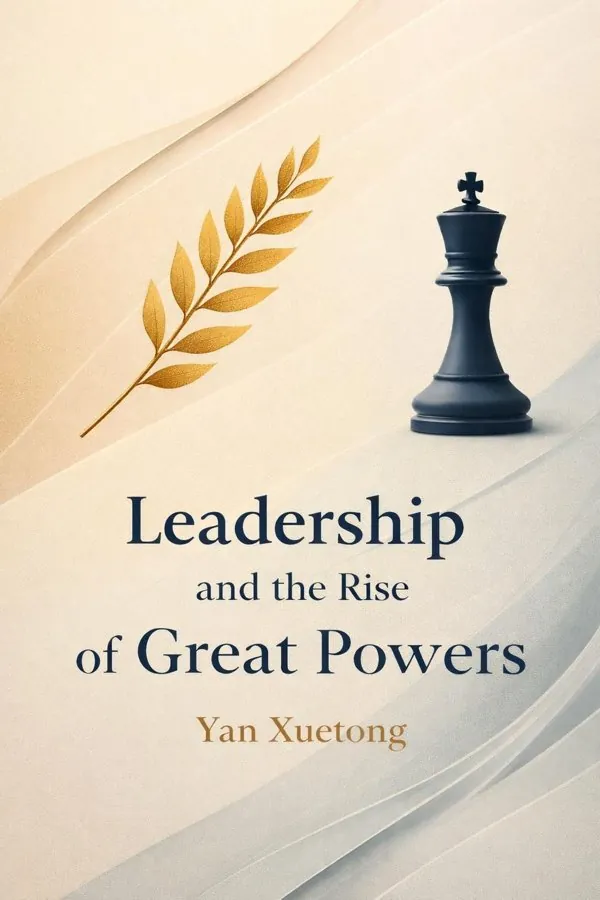
Leadership and the Rise of Great Powers: Summary & Key Insights
by Yan Xuetong
 10 min10 chaptersAudio available
What Is Leadership and the Rise of Great Powers About?
Leadership and the Rise of Great Powers by Yan Xuetong is a politics book spanning 10 pages. Leadership and the Rise of Great Powers presents Yan Xuetong’s theory of moral realism, arguing that the moral character and political leadership of a state’s rulers are decisive factors in determining its rise or decline in the international system. Drawing on historical and contemporary examples, Yan contends that moral authority and strategic wisdom are as crucial as material power in shaping global influence.
This FizzRead summary covers all 10 key chapters of Leadership and the Rise of Great Powers in approximately 10 minutes, distilling the most important ideas, arguments, and takeaways from Yan Xuetong's work. Also available as an audio summary and Key Quotes Podcast.
Leadership and the Rise of Great Powers
Leadership and the Rise of Great Powers presents Yan Xuetong’s theory of moral realism, arguing that the moral character and political leadership of a state’s rulers are decisive factors in determining its rise or decline in the international system. Drawing on historical and contemporary examples, Yan contends that moral authority and strategic wisdom are as crucial as material power in shaping global influence.
Who Should Read Leadership and the Rise of Great Powers?
This book is perfect for anyone interested in politics and looking to gain actionable insights in a short read. Whether you're a student, professional, or lifelong learner, the key ideas from Leadership and the Rise of Great Powers by Yan Xuetong will help you think differently.
- ✓Readers who enjoy politics and want practical takeaways
- ✓Professionals looking to apply new ideas to their work and life
- ✓Anyone who wants the core insights of Leadership and the Rise of Great Powers in just 10 minutes
Want the full summary?
Get instant access to this book summary and 100K+ more with Fizz Moment.
Get Free SummaryAvailable on App Store • Free to download
Key Chapters
Moral realism emerges from dissatisfaction with the simplifications of classical realism and liberalism. Realism tells us that states act in pursuit of power, and morality is irrelevant in a world of strategic competition. Liberalism, on the other hand, envisions international harmony through cooperation and common values. But both theories fail to capture the dynamic interaction between ethical leadership and practical politics.
As I explain, moral realism retains realism’s core insight: that power and interests are real and decisive. Yet, it adds a crucial dimension—the moral quality of leadership directly affects a country’s capability to use its power effectively. In moral realism, morality is not an abstract virtue but an instrument of strategy. A nation with morally credible leadership can transform material advantages into sustained legitimacy at home and abroad.
To grasp this, consider history as a series of moral contests as much as military ones. When leaders act with justice, honesty, and benevolence, they gain the loyalty of citizens and the respect of partners. When they act with deceit and arrogance, their alliances erode even if their weapons are abundant. The Cold War underscored this principle: the United States’ self-presentation as a moral guardian against tyranny won it ideological allies, while the Soviet Union’s moral failures alienated many of its own satellites.
In moral realism, leadership ethics are part of strategic capability. A morally respected leader enjoys what I call “moral capital”—credibility that enhances deterrence, persuasion, and cooperation. This is not utopian; it recognizes that trust is material in international politics. When trust declines, costs rise. As a result, morality, in the realist sense, becomes a measurable asset of state power.
Thus, moral realism provides a bridge between value and interest. To rise as a great power today, a state must not only accumulate resources but also cultivate leadership that converts influence into legitimacy. Without moral order, there can be no enduring international order.
A state’s strength is never absolute—its stability depends on legitimacy, which derives from both material success and moral governance. In my research, I found that the moral quality of leadership directly influences national cohesion and international trust. When leaders exercise authority with moral consistency, they generate voluntary compliance at home and reliable alliances abroad.
Legitimacy is not inherited; it is earned through moral conduct. Leaders who serve their citizens justly forge an aligned social contract—people accept sacrifices in the name of a virtuous cause. But when rulers exploit their position for self-interest, legitimacy decays. That decay is political vulnerability: revolts, fractures, isolation. Hence, every great power’s rise has been made possible not only by its resources but also by leaders who transformed resources into morally guided policies.
In modern contexts, moral leadership safeguards stability by preventing corruption and abuse of authority. It strengthens institutional credibility and assures foreign partners that commitments will be honored. This invisible structure of trust differentiates moral powers from coercive ones. The difference between a legitimate hegemon and a mere empire lies precisely in this moral dimension—others follow willingly rather than through fear.
Leadership morality thus serves as a stabilizing force in an inherently chaotic world system. It is the element that transforms power into endurance. A regime that neglects moral legitimacy may succeed temporarily, but it cannot consolidate influence without the confidence of its own people or partners. Morality brings predictability; predictability brings stability; and stability sustains rise.
+ 8 more chapters — available in the FizzRead app
All Chapters in Leadership and the Rise of Great Powers
About the Author
Yan Xuetong is a leading Chinese scholar of international relations and the dean of the Institute of International Relations at Tsinghua University. His research focuses on international relations theory, Chinese foreign policy, and political philosophy. He is known for developing the theory of moral realism, which integrates ethical considerations into realist international relations theory.
Get This Summary in Your Preferred Format
Read or listen to the Leadership and the Rise of Great Powers summary by Yan Xuetong anytime, anywhere. FizzRead offers multiple formats so you can learn on your terms — all free.
Available formats: App · Audio · PDF · EPUB — All included free with FizzRead
Download Leadership and the Rise of Great Powers PDF and EPUB Summary
Key Quotes from Leadership and the Rise of Great Powers
“Moral realism emerges from dissatisfaction with the simplifications of classical realism and liberalism.”
“A state’s strength is never absolute—its stability depends on legitimacy, which derives from both material success and moral governance.”
Frequently Asked Questions about Leadership and the Rise of Great Powers
Leadership and the Rise of Great Powers by Yan Xuetong is a politics book that explores key ideas across 10 chapters. Leadership and the Rise of Great Powers presents Yan Xuetong’s theory of moral realism, arguing that the moral character and political leadership of a state’s rulers are decisive factors in determining its rise or decline in the international system. Drawing on historical and contemporary examples, Yan contends that moral authority and strategic wisdom are as crucial as material power in shaping global influence.
You Might Also Like
Antifa: The Anti-Fascist Handbook
Mark Bray
10 min
Attack from Within: How Disinformation Is Sabotaging America
Barbara McQuade
10 min
Coercion, Capital, and European States, AD 990–1992
Charles Tilly
10 min
Digital Democracy: Concepts, Methodologies, Tools, and Applications
Various Authors
10 min
Fascism
Stanley G. Payne
10 min
Fire And Fury: Inside The Trump White House
Michael Wolff
10 minBrowse by Category
Ready to read Leadership and the Rise of Great Powers?
Get the full summary and 100K+ more books with Fizz Moment.