
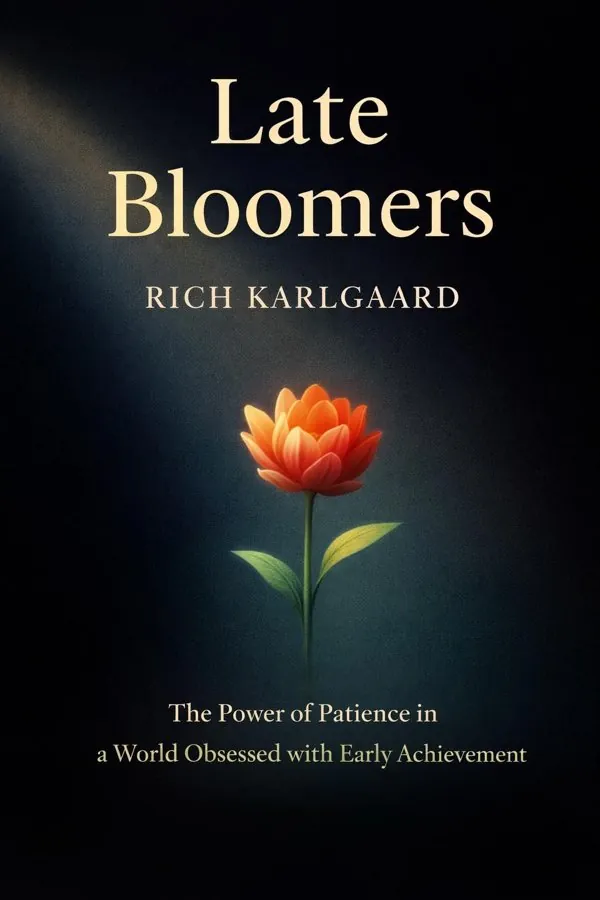
Late Bloomers: The Power of Patience in a World Obsessed with Early Achievement: Summary & Key Insights
 10 min9 chaptersAudio available
Key Takeaways from Late Bloomers: The Power of Patience in a World Obsessed with Early Achievement
One of the most misleading stories modern society tells is that if you have real talent, it should be obvious early.
The most hopeful idea in the book is that human development remains unfinished far longer than many people assume.
In a culture addicted to speed, patience can look like weakness.
Late bloomers are often judged by what they lack early, rather than valued for what they are quietly building.
When a society worships early achievement, it places enormous pressure on children and young adults to perform before they are fully formed.
What Is Late Bloomers: The Power of Patience in a World Obsessed with Early Achievement About?
Late Bloomers: The Power of Patience in a World Obsessed with Early Achievement by Rich Karlgaard is a mindset book spanning 9 pages. In Late Bloomers, Rich Karlgaard challenges one of modern culture’s most damaging assumptions: that real talent must show up early. From elite schools and standardized testing to startup culture and social media, we are surrounded by messages that glorify precocious success and quietly shame slower, less linear development. Karlgaard argues that this narrow view of achievement is not only psychologically harmful but also scientifically wrong. Drawing on neuroscience, psychology, education research, and stories from business, sports, and the arts, he shows that many people develop their strongest abilities later than expected—and that this delayed growth can become a profound advantage. The book matters because it speaks to students written off too soon, adults changing direction midlife, parents worried their children are “behind,” and leaders who underestimate unconventional talent. Karlgaard writes with authority as a longtime journalist, Forbes publisher, and observer of human performance and organizational culture. His central message is both reassuring and radical: success does not belong only to the early starters. In a world obsessed with speed, patience, maturity, and self-knowledge may be the real foundations of lasting achievement.
This FizzRead summary covers all 9 key chapters of Late Bloomers: The Power of Patience in a World Obsessed with Early Achievement in approximately 10 minutes, distilling the most important ideas, arguments, and takeaways from Rich Karlgaard's work. Also available as an audio summary and Key Quotes Podcast.
Late Bloomers: The Power of Patience in a World Obsessed with Early Achievement
In Late Bloomers, Rich Karlgaard challenges one of modern culture’s most damaging assumptions: that real talent must show up early. From elite schools and standardized testing to startup culture and social media, we are surrounded by messages that glorify precocious success and quietly shame slower, less linear development. Karlgaard argues that this narrow view of achievement is not only psychologically harmful but also scientifically wrong. Drawing on neuroscience, psychology, education research, and stories from business, sports, and the arts, he shows that many people develop their strongest abilities later than expected—and that this delayed growth can become a profound advantage.
The book matters because it speaks to students written off too soon, adults changing direction midlife, parents worried their children are “behind,” and leaders who underestimate unconventional talent. Karlgaard writes with authority as a longtime journalist, Forbes publisher, and observer of human performance and organizational culture. His central message is both reassuring and radical: success does not belong only to the early starters. In a world obsessed with speed, patience, maturity, and self-knowledge may be the real foundations of lasting achievement.
Who Should Read Late Bloomers: The Power of Patience in a World Obsessed with Early Achievement?
This book is perfect for anyone interested in mindset and looking to gain actionable insights in a short read. Whether you're a student, professional, or lifelong learner, the key ideas from Late Bloomers: The Power of Patience in a World Obsessed with Early Achievement by Rich Karlgaard will help you think differently.
- ✓Readers who enjoy mindset and want practical takeaways
- ✓Professionals looking to apply new ideas to their work and life
- ✓Anyone who wants the core insights of Late Bloomers: The Power of Patience in a World Obsessed with Early Achievement in just 10 minutes
Want the full summary?
Get instant access to this book summary and 100K+ more with Fizz Moment.
Get Free SummaryAvailable on App Store • Free to download
Key Chapters
One of the most misleading stories modern society tells is that if you have real talent, it should be obvious early. Rich Karlgaard argues that this belief has become so deeply embedded in education, work, and parenting that many people absorb it without question. We celebrate teenage prodigies, twenty-something founders, and young stars, then quietly assume that those who take longer are less capable. But this myth confuses early visibility with lasting ability.
Karlgaard shows how institutions reinforce this bias. Schools sort children through grades, tests, and rankings that suggest development should happen on a fixed schedule. Employers often favor polished résumés and fast-track trajectories. Media profiles spotlight exceptional youth while ignoring the countless people whose strengths emerge through struggle, experimentation, and maturity. As a result, many individuals internalize the idea that if they have not “made it” by a certain age, they have somehow missed their chance.
The problem is not merely cultural; it is personal. The early achievement myth creates anxiety, shame, and premature self-judgment. A student who develops confidence later may believe they are unintelligent. A professional who changes direction at thirty-five may feel like a failure next to peers who seem more established. Yet many forms of excellence—leadership, judgment, emotional intelligence, creativity, resilience—often deepen with time.
Karlgaard’s point is not that early achievers are overrated, but that delayed development is wrongly discounted. Life is not a race run on one universal clock. Different people mature cognitively, emotionally, and professionally at different rates. The actionable takeaway: stop using age-based milestones as the main measure of potential, and evaluate growth by direction, effort, and fit instead.
The most hopeful idea in the book is that human development remains unfinished far longer than many people assume. Karlgaard draws on neuroscience to show that the brain stays plastic well into adulthood. In particular, the prefrontal cortex—the region involved in judgment, planning, impulse control, and decision-making—continues maturing beyond adolescence. That means some of the traits most associated with effective adulthood do not fully arrive on a teenage or college timetable.
This scientific perspective undermines the simplistic notion that intelligence and capability are fixed early. While some abilities emerge young, many others strengthen through repeated experience, reflection, and adaptation. People can improve how they manage attention, relationships, stress, and complex problem-solving over time. Maturity is not a consolation prize; it is a developmental asset.
Karlgaard also points to research on noncognitive strengths such as grit, conscientiousness, perseverance, and emotional regulation. These qualities often matter as much as raw test performance in determining long-term outcomes. Someone who looks average at sixteen may become exceptional at forty because they have learned how to focus, recover, and persist.
In practical terms, this changes how we should think about education and career paths. A poor early score, delayed confidence, or slow start should not be treated as a final verdict. Adults can retrain, reskill, and reinvent because the underlying machinery of growth remains active. This is why career pivots, second acts, and late-emerging expertise are so common.
The actionable takeaway: replace the question “Was I great early?” with “What capacities can I still build?” and approach learning as an ongoing biological possibility, not a closed chapter.
In a culture addicted to speed, patience can look like weakness. Karlgaard argues the opposite: patience is often what allows late bloomers to build more durable forms of success. When progress is slower, people are forced to develop endurance, self-awareness, and the ability to work without immediate validation. These traits may not attract early applause, but they become powerful advantages over time.
Patience does not mean passivity. It means staying engaged long enough for important capacities to mature. A young person who is not yet ready to lead may still be accumulating judgment. An employee who takes longer to find the right role may be developing a clearer sense of strengths and values. A creative professional may produce uneven work for years before reaching a breakthrough that is deeper because it is rooted in lived experience.
Karlgaard connects patience with maturity. As people age, they often gain perspective, emotional steadiness, and an improved ability to integrate failure into growth. They become less reactive to comparison and more capable of strategic choices. This can lead to wiser risk-taking than the impulsive ambition often rewarded in youth-centered cultures.
A practical application is to create longer horizons for goals. Instead of asking whether you are ahead this year, ask whether you are becoming stronger over five years. Parents can avoid panicking over temporary developmental lags. Managers can assess employees by trajectory rather than early polish. Individuals can commit to practice even when rewards are delayed.
The actionable takeaway: choose one area of your life where you have been demanding instant results, and replace that pressure with a long-term development plan built around consistency, reflection, and measured progress.
When a society worships early achievement, it places enormous pressure on children and young adults to perform before they are fully formed. Karlgaard shows that this pressure can have serious costs. Instead of nurturing curiosity and development, it often produces anxiety, burnout, perfectionism, and a fear of failure. Young people learn to perform for approval rather than grow toward mastery.
This pressure begins early. Children are pushed into competitive academic tracks, résumé-building activities, and constant measurement. Parents worry about whether a child is “falling behind.” Schools emphasize narrow metrics that reward compliance and test-taking over originality and maturation. By the time students reach college or the workforce, many have become highly skilled at meeting expectations but deeply unsure of who they are or what they want.
The damage is not only emotional. Early pressure can crowd out exploration, which is often necessary for discovering strengths. A teenager rushed into a prestige pathway may never investigate fields better suited to their temperament. A young professional who fears appearing behind may stay in the wrong career for years. In trying to optimize for early success, people can end up sacrificing long-term fit and fulfillment.
Karlgaard does not argue against ambition. He argues against premature narrowing and constant comparison. High expectations become harmful when they ignore developmental timing and individuality. Healthy challenge should stretch people, not define their worth.
The actionable takeaway: if you are raising, teaching, or mentoring someone, reduce one unnecessary source of performance pressure and replace it with a conversation about exploration, growth, and the difference between current performance and future potential.
A central claim of Late Bloomers is that our timeline for success is far too narrow. Karlgaard challenges the idea that achievement should happen by a specific age, followed by steady upward momentum. Real lives are usually messier. People pause, pivot, regress, recover, and discover new capacities long after society expects them to have everything figured out.
This matters because rigid timelines create distorted judgments. Someone who becomes a doctor at thirty-eight, an artist at fifty, or a founder after a decade of ordinary jobs may be seen as late. But compared to what? These judgments depend on arbitrary cultural expectations, not on the actual quality or significance of a person’s work. A rushed life may look impressive from the outside while being poorly matched to the person living it.
Karlgaard encourages readers to replace socially imposed deadlines with developmental realism. Different fields also reward different timing. A gymnast may peak young, while a therapist, executive, teacher, or writer may grow stronger with accumulated experience. Wisdom-heavy roles often benefit from years of observation, emotional complexity, and pattern recognition.
In practice, redefining the timeline means normalizing detours and second acts. Career changes should be seen as adaptive, not embarrassing. Education does not have to happen all at once. Personal growth does not expire at thirty. Organizations can support this by valuing internal mobility, retraining, and experienced candidates rather than only youthful promise.
The actionable takeaway: review the deadlines you have imposed on your life, ask which ones are socially inherited rather than personally meaningful, and rewrite your timeline around readiness, values, and long-term contribution.
We often think of experience as merely the passage of time, but Karlgaard treats it as a developmental engine. Experience exposes people to complexity, contradiction, disappointment, and real-world feedback. Over time, this produces better judgment—the ability to read situations accurately, weigh trade-offs, and act with perspective. These strengths rarely appear all at once in youth; they accumulate through trial and reflection.
This is especially important in domains where success depends on human understanding. Leaders, teachers, physicians, designers, coaches, and parents all benefit from pattern recognition built through repeated encounters. A younger person may have technical brilliance, but an older practitioner often brings context, steadiness, and a more nuanced sense of what matters. Experience can also sharpen intuition, not as guesswork, but as stored knowledge refined by reality.
Karlgaard suggests that many late bloomers become powerful contributors because they are not simply older; they are more integrated. Their past failures, wrong turns, and varied roles become sources of wisdom. Someone who has worked across industries may see opportunities others miss. Someone who has endured setbacks may make sounder decisions under pressure.
A practical application is to stop discounting your past just because it does not fit a tidy narrative. A nonlinear career may actually be giving you a wider base of insight. For employers, it means recognizing that age and varied experience can be strategic assets, especially in roles requiring trust, discernment, and leadership.
The actionable takeaway: make a list of past experiences you once saw as detours and ask how each one has improved your judgment, empathy, or problem-solving in ways a faster path could not.
Potential is not only an individual trait; it is also shaped by environment. Karlgaard argues that many people fail to bloom not because they lack ability, but because they are placed in systems that misread or suppress how they develop. Schools, workplaces, and families often reward early polish, conformity, and speed while overlooking slower, more exploratory, or less conventional forms of growth.
A healthier environment recognizes that people need different amounts of time, support, and autonomy. In education, this might mean reducing overreliance on standardized measures and creating more room for project-based learning, mentoring, and second chances. In companies, it could mean hiring for potential rather than pedigree, offering retraining paths, and promoting on demonstrated judgment instead of self-promotion alone. In families, it means encouraging effort and self-discovery rather than constant comparison.
Karlgaard’s argument has an ethical dimension as well. When systems are built around narrow definitions of success, they waste human talent. A student labeled average may flourish under the right teacher. An employee overlooked for lacking confidence may thrive with better management. A person changing careers may contribute enormously if given room to learn.
Supportive environments do not eliminate standards; they broaden the pathways by which people can meet them. They create conditions where development is expected to vary. This benefits not only late bloomers but everyone, because it makes institutions more humane and more effective.
The actionable takeaway: whether you lead a team, teach a class, or support a family member, identify one structural habit—such as premature labeling, constant comparison, or rigid timelines—that may be stifling growth, and replace it with a practice that rewards progress and potential.
The book is ultimately not just a critique of culture but a guide for action. Karlgaard offers a mindset shift for people who feel behind: stop treating your current stage as a final identity. Late blooming requires accepting that development can be uneven while still taking responsibility for growth. Hope matters, but so do habits, environments, and choices.
One practical strategy is to focus on fit instead of status. Many people stay trapped because they pursue what looks impressive rather than what aligns with their temperament and strengths. Another strategy is to build gradually. Instead of waiting for a dramatic breakthrough, create momentum through small but consistent steps—taking a course, seeking mentorship, changing roles, or practicing a neglected skill. Reflection is also essential. Late bloomers often progress faster once they understand their own patterns, motivations, and obstacles.
Karlgaard also emphasizes identity. If you believe your story is already decided, you will act accordingly. If you see yourself as still becoming, you are more likely to experiment, recover from setbacks, and remain open to possibility. This requires resisting comparison, especially in a world where other people’s timelines are constantly displayed and celebrated.
A practical example is someone who feels stalled in an unfulfilling career. Rather than concluding they failed to choose correctly in youth, they can inventory strengths, test alternatives, learn incrementally, and transition with purpose. Growth may be slower than a dramatic reinvention, but it is more sustainable.
The actionable takeaway: choose one concrete next step that supports the person you are becoming—not the person you think you should have been by now—and commit to it for the next ninety days.
All Chapters in Late Bloomers: The Power of Patience in a World Obsessed with Early Achievement
About the Author
Rich Karlgaard is an American journalist, author, entrepreneur, and longtime publisher known for his work at Forbes, where he has written extensively about business, innovation, leadership, and the future of work. Over decades of observing companies, founders, and high performers, he developed a strong interest in how society identifies talent and how often it gets that process wrong. His writing blends economic insight with human development, making complex ideas accessible to a broad audience. Karlgaard is also a frequent speaker on corporate culture, technology, and performance. In Late Bloomers, he brings together research, reporting, and personal conviction to challenge the cultural obsession with precocious success and to argue for a more patient, realistic, and humane understanding of achievement.
Get This Summary in Your Preferred Format
Read or listen to the Late Bloomers: The Power of Patience in a World Obsessed with Early Achievement summary by Rich Karlgaard anytime, anywhere. FizzRead offers multiple formats so you can learn on your terms — all free.
Available formats: App · Audio · PDF · EPUB — All included free with FizzRead
Download Late Bloomers: The Power of Patience in a World Obsessed with Early Achievement PDF and EPUB Summary
Key Quotes from Late Bloomers: The Power of Patience in a World Obsessed with Early Achievement
“One of the most misleading stories modern society tells is that if you have real talent, it should be obvious early.”
“The most hopeful idea in the book is that human development remains unfinished far longer than many people assume.”
“In a culture addicted to speed, patience can look like weakness.”
“Late bloomers are often judged by what they lack early, rather than valued for what they are quietly building.”
“When a society worships early achievement, it places enormous pressure on children and young adults to perform before they are fully formed.”
Frequently Asked Questions about Late Bloomers: The Power of Patience in a World Obsessed with Early Achievement
Late Bloomers: The Power of Patience in a World Obsessed with Early Achievement by Rich Karlgaard is a mindset book that explores key ideas across 9 chapters. In Late Bloomers, Rich Karlgaard challenges one of modern culture’s most damaging assumptions: that real talent must show up early. From elite schools and standardized testing to startup culture and social media, we are surrounded by messages that glorify precocious success and quietly shame slower, less linear development. Karlgaard argues that this narrow view of achievement is not only psychologically harmful but also scientifically wrong. Drawing on neuroscience, psychology, education research, and stories from business, sports, and the arts, he shows that many people develop their strongest abilities later than expected—and that this delayed growth can become a profound advantage. The book matters because it speaks to students written off too soon, adults changing direction midlife, parents worried their children are “behind,” and leaders who underestimate unconventional talent. Karlgaard writes with authority as a longtime journalist, Forbes publisher, and observer of human performance and organizational culture. His central message is both reassuring and radical: success does not belong only to the early starters. In a world obsessed with speed, patience, maturity, and self-knowledge may be the real foundations of lasting achievement.
More by Rich Karlgaard

You Might Also Like

Browse by Category
Ready to read Late Bloomers: The Power of Patience in a World Obsessed with Early Achievement?
Get the full summary and 100K+ more books with Fizz Moment.