
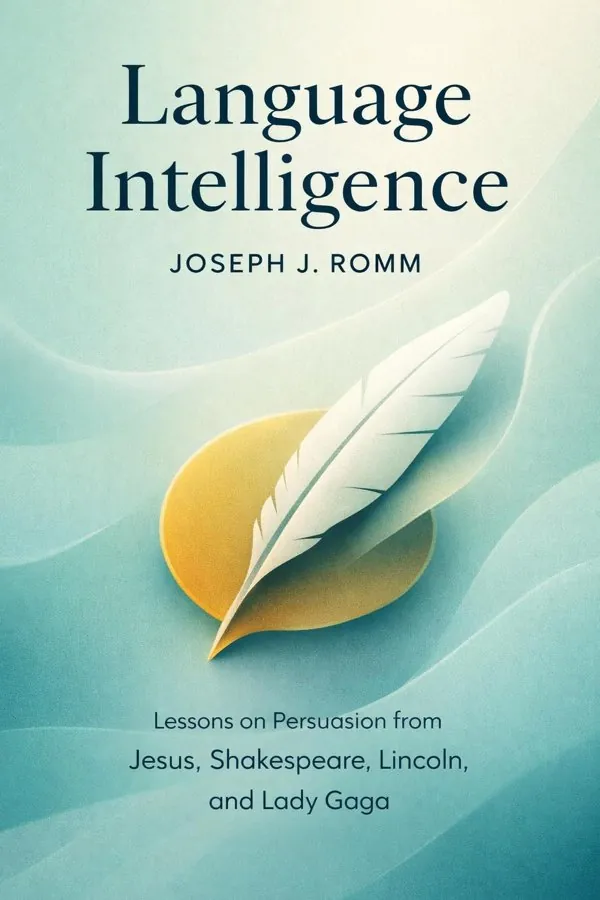
Language Intelligence: Lessons on Persuasion from Jesus, Shakespeare, Lincoln, and Lady Gaga: Summary & Key Insights
 10 min12 chaptersAudio available
What Is Language Intelligence: Lessons on Persuasion from Jesus, Shakespeare, Lincoln, and Lady Gaga About?
Language Intelligence: Lessons on Persuasion from Jesus, Shakespeare, Lincoln, and Lady Gaga by Joseph J. Romm is a communication book spanning 12 pages. Language Intelligence explores how the greatest communicators in history—from Jesus and Shakespeare to Lincoln and Lady Gaga—used rhetorical techniques to persuade and inspire. Joseph J. Romm, a scientist and expert in communication, analyzes the art of rhetoric and demonstrates how mastering language can enhance influence and understanding in modern discourse.
This FizzRead summary covers all 12 key chapters of Language Intelligence: Lessons on Persuasion from Jesus, Shakespeare, Lincoln, and Lady Gaga in approximately 10 minutes, distilling the most important ideas, arguments, and takeaways from Joseph J. Romm's work. Also available as an audio summary and Key Quotes Podcast.
Language Intelligence: Lessons on Persuasion from Jesus, Shakespeare, Lincoln, and Lady Gaga
Language Intelligence explores how the greatest communicators in history—from Jesus and Shakespeare to Lincoln and Lady Gaga—used rhetorical techniques to persuade and inspire. Joseph J. Romm, a scientist and expert in communication, analyzes the art of rhetoric and demonstrates how mastering language can enhance influence and understanding in modern discourse.
Who Should Read Language Intelligence: Lessons on Persuasion from Jesus, Shakespeare, Lincoln, and Lady Gaga?
This book is perfect for anyone interested in communication and looking to gain actionable insights in a short read. Whether you're a student, professional, or lifelong learner, the key ideas from Language Intelligence: Lessons on Persuasion from Jesus, Shakespeare, Lincoln, and Lady Gaga by Joseph J. Romm will help you think differently.
- ✓Readers who enjoy communication and want practical takeaways
- ✓Professionals looking to apply new ideas to their work and life
- ✓Anyone who wants the core insights of Language Intelligence: Lessons on Persuasion from Jesus, Shakespeare, Lincoln, and Lady Gaga in just 10 minutes
Want the full summary?
Get instant access to this book summary and 100K+ more with Fizz Moment.
Get Free SummaryAvailable on App Store • Free to download
Key Chapters
When Aristotle defined rhetoric as the art of discovering every available means of persuasion, he gave us a blueprint for human influence that has never aged. Rhetoric is not empty ornamentation—it is the systematic understanding of how words work. In *Language Intelligence*, I trace how Aristotle’s appeals—ethos, pathos, and logos—remain the foundation of effective discourse even in our digital age. Ethos is the credibility that makes people trust you; pathos is the emotion that makes them care; logos is the logic that makes your argument endure. Every great communicator harmonizes these elements, creating a voice that feels trustworthy, passionate, and reasonable all at once.
But rhetoric’s true power comes from how it blends these appeals into a rhythm and story that feels organic rather than engineered. Consider Lincoln’s Gettysburg Address. It is pure rhetorical composition—succinct, structured, and moral—but it sounds effortless, like truth speaking rather than persuasion performing. That illusion of naturalness is what Aristotle understood: rhetoric, at its best, conceals its own technique. In our time, mastering rhetoric means learning to balance authenticity with craft. It means understanding that every phrase has emotional weight; that a well-framed idea can guide perception more effectively than argument alone.
Throughout history, rhetoric has been the voice of leadership and art. From religious sermons to pop songs, the cadence of language moves people toward belief. The enduring relevance of classical principles reveals something profound: human cognition hasn’t changed. We are still moved by patterns, stories, repetitions, and moral clarity. To wield rhetoric effectively today is to engage both timeless psychology and modern expression.
The heart of persuasive language lies in figures of speech—the devices that shape thought through surprise, pattern, and emotion. Metaphor, for instance, is not mere decoration; it is how we think. Cognitive science tells us that metaphors map unfamiliar concepts onto familiar ones, providing mental shortcuts that make complex ideas emotionally accessible. When Jesus speaks of mustard seeds or when Shakespeare describes love as a smoke made with the fume of sighs, they are awakening understanding through imagery that bypasses rational processing and strikes directly at intuition.
Repetition, another figure central to this book, functions as emotional reinforcement. Psychologically, repetition breeds familiarity, and familiarity breeds truth. It is why slogans stick and why Lincoln’s use of 'government of the people, by the people, for the people' resonates forever. Similarly, irony—one of Shakespeare’s favorite devices—invites reflection and deepens meaning by forcing audiences to hold contrasting truths in their minds. Figures of speech, in essence, are the paintbrushes of emotional and cognitive engagement.
In modern communication, we often dismiss rhetorical figures as manipulative or outdated. I challenge that misconception. Figures of speech are tools of empathy; they let us connect across the divide of experience. By learning to employ metaphor, repetition, and irony consciously, you can not only make your message vivid but make your listener a participant in meaning-making. The great communicators didn’t perform tricks—they understood the human mind’s hunger for pattern and resonance.
+ 10 more chapters — available in the FizzRead app
All Chapters in Language Intelligence: Lessons on Persuasion from Jesus, Shakespeare, Lincoln, and Lady Gaga
About the Author
Joseph J. Romm is an American author, physicist, and climate expert known for his work on energy policy and communication. He served as a senior official in the U.S. Department of Energy and has written extensively on climate change, persuasion, and public communication.
Get This Summary in Your Preferred Format
Read or listen to the Language Intelligence: Lessons on Persuasion from Jesus, Shakespeare, Lincoln, and Lady Gaga summary by Joseph J. Romm anytime, anywhere. FizzRead offers multiple formats so you can learn on your terms — all free.
Available formats: App · Audio · PDF · EPUB — All included free with FizzRead
Download Language Intelligence: Lessons on Persuasion from Jesus, Shakespeare, Lincoln, and Lady Gaga PDF and EPUB Summary
Key Quotes from Language Intelligence: Lessons on Persuasion from Jesus, Shakespeare, Lincoln, and Lady Gaga
“When Aristotle defined rhetoric as the art of discovering every available means of persuasion, he gave us a blueprint for human influence that has never aged.”
“The heart of persuasive language lies in figures of speech—the devices that shape thought through surprise, pattern, and emotion.”
Frequently Asked Questions about Language Intelligence: Lessons on Persuasion from Jesus, Shakespeare, Lincoln, and Lady Gaga
Language Intelligence: Lessons on Persuasion from Jesus, Shakespeare, Lincoln, and Lady Gaga by Joseph J. Romm is a communication book that explores key ideas across 12 chapters. Language Intelligence explores how the greatest communicators in history—from Jesus and Shakespeare to Lincoln and Lady Gaga—used rhetorical techniques to persuade and inspire. Joseph J. Romm, a scientist and expert in communication, analyzes the art of rhetoric and demonstrates how mastering language can enhance influence and understanding in modern discourse.
You Might Also Like
Magic Words: The Science and Secrets Behind Seven Words That Motivate, Engage, and Influence
Tim David
10 min
Talking Across The Divide: How to Communicate with People You Disagree with and Maybe Even Change the World
Justin Lee
10 min
The Exceptional Presenter: A Proven Formula to Open Up! and Own the Room
Timothy J. Koegel
10 min
4 Essential Keys to Effective Communication in Love, Life, Work--Anywhere!: Including the 12-Day Communication Challenge!
Bento C. Leal III
10 min
Active Listening Techniques: 30 Practical Tools to Hone Your Communication Skills
Nisha Gupta
10 min
Bargaining for Advantage: Negotiation Strategies for Reasonable People
G. Richard Shell
10 minBrowse by Category
Ready to read Language Intelligence: Lessons on Persuasion from Jesus, Shakespeare, Lincoln, and Lady Gaga?
Get the full summary and 100K+ more books with Fizz Moment.