
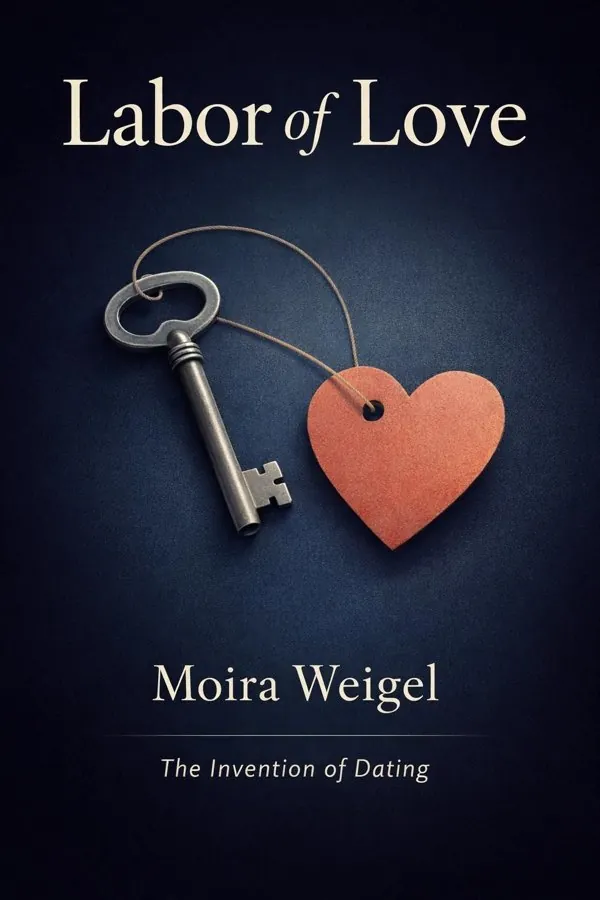
Labor of Love: The Invention of Dating: Summary & Key Insights
by Moira Weigel
 10 min5 chaptersAudio available
What Is Labor of Love: The Invention of Dating About?
Labor of Love: The Invention of Dating by Moira Weigel is a sociology book spanning 5 pages. In this cultural history, Moira Weigel explores how dating evolved as a social practice shaped by economic, technological, and gender changes. She traces the origins of modern dating from early twentieth-century courtship rituals to the digital age, showing how love and labor have always been intertwined in the pursuit of romance.
This FizzRead summary covers all 5 key chapters of Labor of Love: The Invention of Dating in approximately 10 minutes, distilling the most important ideas, arguments, and takeaways from Moira Weigel's work. Also available as an audio summary and Key Quotes Podcast.
Labor of Love: The Invention of Dating
In this cultural history, Moira Weigel explores how dating evolved as a social practice shaped by economic, technological, and gender changes. She traces the origins of modern dating from early twentieth-century courtship rituals to the digital age, showing how love and labor have always been intertwined in the pursuit of romance.
Who Should Read Labor of Love: The Invention of Dating?
This book is perfect for anyone interested in sociology and looking to gain actionable insights in a short read. Whether you're a student, professional, or lifelong learner, the key ideas from Labor of Love: The Invention of Dating by Moira Weigel will help you think differently.
- ✓Readers who enjoy sociology and want practical takeaways
- ✓Professionals looking to apply new ideas to their work and life
- ✓Anyone who wants the core insights of Labor of Love: The Invention of Dating in just 10 minutes
Want the full summary?
Get instant access to this book summary and 100K+ more with Fizz Moment.
Get Free SummaryAvailable on App Store • Free to download
Key Chapters
At the turn of the twentieth century, the idea that a young woman might go out unsupervised with a man, perhaps even one she barely knew, was shocking. Before dating, there was courtship: a domestic, often family-centered affair, conducted within parlors or front porches under parental surveillance. But the urban transformations of the early 1900s unraveled these norms. As men and women began leaving rural homes for cities, drawn by wages and independence, they entered a new social terrain—the public sphere of streets, theaters, dance halls, and department stores. In these bustling environments, the act of ‘going out’ took on new meanings. For the first time, romance became a public performance tied to the rhythms of modern life.
It was wage labor, above all, that enabled dating. Young women working as shop clerks or factory workers had a modest income but also a new kind of social visibility. The same held true for young men who could take a “date” out, demonstrating both generosity and respectability through the gesture of paying. The city, with its streetcars and cafés, made these encounters possible—but it also turned them into symbolic acts saturated with class and gender meaning. The working girl, as newspapers called her, became both an object of fascination and moral concern. People worried that young women trading companionship for meals or movie tickets blurred the line between respectability and prostitution. In truth, what was emerging was a new framework for love in which both emotional and economic negotiations intertwined.
When I study the diaries and letters of this period, what strikes me most is the self-consciousness of participants. They were learning a new language of romance, shaped by consumption and performance as much as by affection. Dating was a way of experimenting with modern identity—discovering who one could be when alone in the world. But even then, it was understood as work. Women invested time and labor into appearance and charm, while men managed the financial and emotional scripts of courtship. From the very beginning, love was inseparable from labor.
Once dating took root, businesses were eager to exploit it. The theater, restaurant, and later the cinema offered ideal venues for romantic display. Capitalism, ever alert to human desires, quickly realized that love could sell everything from lipstick to automobiles. To date was to consume—it required spending, dressing, and displaying oneself as a desirable commodity. The rise of leisure industries encouraged people to imagine love not simply as an inner feeling but as an experience to be purchased and staged.
In the budding advertising culture of the 1920s and 1930s, femininity and masculinity were redefined around consumption. For women, beauty became a form of capital. Magazines urged readers to invest in clothes and cosmetics as means of securing affection. For men, providing entertainment—paying for dinners or gifts—was proof of seriousness. Dating thus reinforced gender hierarchies even as it promised freedom. It gave women access to pleasure and public life, but always under the condition that their desirability could be converted into economic survival. Every night out became a small transaction in the romantic marketplace.
What I find most telling is that these patterns persisted and evolved rather than disappeared. The commercial logic of dating expanded with radio, Hollywood, and later television, embedding romance within broader cycles of marketing. Courtship scenes on screen not only reflected reality—they prescribed it. People learned how to act on dates by watching movie stars flirt across cocktail bars or whisper in darkened cinemas. Consumer culture taught us how love should look, sound, and be felt, and in doing so, it commodified intimacy itself.
+ 3 more chapters — available in the FizzRead app
All Chapters in Labor of Love: The Invention of Dating
About the Author
Moira Weigel is an American writer, historian, and scholar. She earned her Ph.D. from Yale University and writes on gender, technology, and culture. Her work has appeared in publications such as The Guardian, The New Yorker, and The Atlantic.
Get This Summary in Your Preferred Format
Read or listen to the Labor of Love: The Invention of Dating summary by Moira Weigel anytime, anywhere. FizzRead offers multiple formats so you can learn on your terms — all free.
Available formats: App · Audio · PDF · EPUB — All included free with FizzRead
Download Labor of Love: The Invention of Dating PDF and EPUB Summary
Key Quotes from Labor of Love: The Invention of Dating
“At the turn of the twentieth century, the idea that a young woman might go out unsupervised with a man, perhaps even one she barely knew, was shocking.”
“Once dating took root, businesses were eager to exploit it.”
Frequently Asked Questions about Labor of Love: The Invention of Dating
Labor of Love: The Invention of Dating by Moira Weigel is a sociology book that explores key ideas across 5 chapters. In this cultural history, Moira Weigel explores how dating evolved as a social practice shaped by economic, technological, and gender changes. She traces the origins of modern dating from early twentieth-century courtship rituals to the digital age, showing how love and labor have always been intertwined in the pursuit of romance.
You Might Also Like
Between the World and Me
Ta-Nehisi Coates
10 min
Half the Sky
Nicholas D. Kristof, Sheryl WuDunn
10 min
Men Explain Things To Me
Rebecca Solnit
10 min
Rational Ritual
Michael Suk-Young Chwe
10 min
The New Jim Crow
Michelle Alexander
10 min
Beyond Culture
Edward T. Hall
10 minBrowse by Category
Ready to read Labor of Love: The Invention of Dating?
Get the full summary and 100K+ more books with Fizz Moment.