
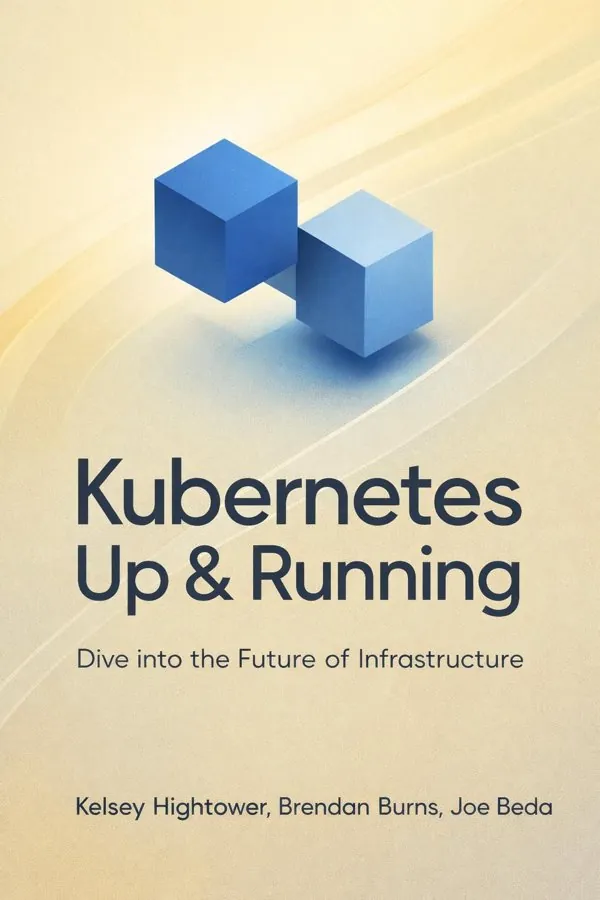
Kubernetes Up & Running: Dive into the Future of Infrastructure: Summary & Key Insights
by Kelsey Hightower, Brendan Burns, Joe Beda
 10 min7 chaptersAudio available
What Is Kubernetes Up & Running: Dive into the Future of Infrastructure About?
Kubernetes Up & Running: Dive into the Future of Infrastructure by Kelsey Hightower, Brendan Burns, Joe Beda is a programming book spanning 7 pages. Kubernetes Up & Running introduces readers to Kubernetes, the open-source system for automating deployment, scaling, and management of containerized applications. Written by three of the project's early contributors, the book provides practical guidance on setting up clusters, deploying applications, and managing workloads in production environments. It explains core concepts such as pods, services, and controllers, and offers real-world examples to help readers understand how to build resilient, scalable systems using Kubernetes.
This FizzRead summary covers all 7 key chapters of Kubernetes Up & Running: Dive into the Future of Infrastructure in approximately 10 minutes, distilling the most important ideas, arguments, and takeaways from Kelsey Hightower, Brendan Burns, Joe Beda's work. Also available as an audio summary and Key Quotes Podcast.
Kubernetes Up & Running: Dive into the Future of Infrastructure
Kubernetes Up & Running introduces readers to Kubernetes, the open-source system for automating deployment, scaling, and management of containerized applications. Written by three of the project's early contributors, the book provides practical guidance on setting up clusters, deploying applications, and managing workloads in production environments. It explains core concepts such as pods, services, and controllers, and offers real-world examples to help readers understand how to build resilient, scalable systems using Kubernetes.
Who Should Read Kubernetes Up & Running: Dive into the Future of Infrastructure?
This book is perfect for anyone interested in programming and looking to gain actionable insights in a short read. Whether you're a student, professional, or lifelong learner, the key ideas from Kubernetes Up & Running: Dive into the Future of Infrastructure by Kelsey Hightower, Brendan Burns, Joe Beda will help you think differently.
- ✓Readers who enjoy programming and want practical takeaways
- ✓Professionals looking to apply new ideas to their work and life
- ✓Anyone who wants the core insights of Kubernetes Up & Running: Dive into the Future of Infrastructure in just 10 minutes
Want the full summary?
Get instant access to this book summary and 100K+ more with Fizz Moment.
Get Free SummaryAvailable on App Store • Free to download
Key Chapters
Before we discuss the finer details, we must ground ourselves in the architecture. Kubernetes is not a single monolithic program; it is a composition of coordinated components that, together, form the control plane and data plane. The control plane includes the API server, the scheduler, and the controller manager—each responsible for a distinct layer of orchestration. The API server is Kubernetes’ front door; every configuration, query, or instruction passes through it. It validates requests and updates cluster state. The scheduler watches for unscheduled Pods and determines where they should run based on resource availability and constraints. The controller manager works as the unseen conductor, constantly comparing desired cluster state to observed reality and taking action to reconcile differences.
Worker nodes execute the workloads. Each runs a kubelet—a local agent that talks to the API server and ensures containers run as expected. It also hosts the kube-proxy, which manages networking rules to route requests to the appropriate Services or Pods.
When these components cooperate, Kubernetes becomes more than software—it is a distributed brain. The beauty of this model lies in its self-healing capability. Specify the desired state, and Kubernetes constantly drives the actual state toward it, even in the face of failure. To understand this architecture is to grasp its philosophy: declarative management over imperative control. We describe what we want, and Kubernetes figures out how to make it happen.
At the heart of Kubernetes lie its core objects: Pods, ReplicaSets, and Deployments. A Pod represents the smallest deployable unit—typically one or more containers that share network and storage space. Instead of thinking in single containers, Kubernetes encourages you to think in Pods because applications rarely work alone—they often need sidecars, logs shippers, or monitoring agents.
ReplicaSets guarantee consistency and availability. When you declare that your application should have three instances, the ReplicaSet ensures exactly that number exists at all times. If a node fails, Kubernetes recreates lost Pods automatically. Deployments build upon ReplicaSets, offering versioned and managed rollouts. This abstraction introduces a safe way to upgrade applications, roll back flawed deployments, or seamlessly scale workloads. The authors designed these concepts not as static definitions but as evolving entities—each one participates in the greater choreography that makes Kubernetes responsive.
Understanding application lifecycle through these objects shifts the operational paradigm. Instead of running commands to restart or scale your app, you modify declarative manifests and let Kubernetes implement your intent. This layer of self-management turns infrastructure into a living ecosystem where applications grow, heal, and change effortlessly.
+ 5 more chapters — available in the FizzRead app
All Chapters in Kubernetes Up & Running: Dive into the Future of Infrastructure
About the Authors
Kelsey Hightower is a software engineer and developer advocate known for his work on Kubernetes and cloud-native technologies. Brendan Burns is a co-founder of the Kubernetes project and a distinguished engineer at Microsoft. Joe Beda is also a co-founder of Kubernetes and a technology leader in cloud computing.
Get This Summary in Your Preferred Format
Read or listen to the Kubernetes Up & Running: Dive into the Future of Infrastructure summary by Kelsey Hightower, Brendan Burns, Joe Beda anytime, anywhere. FizzRead offers multiple formats so you can learn on your terms — all free.
Available formats: App · Audio · PDF · EPUB — All included free with FizzRead
Download Kubernetes Up & Running: Dive into the Future of Infrastructure PDF and EPUB Summary
Key Quotes from Kubernetes Up & Running: Dive into the Future of Infrastructure
“Before we discuss the finer details, we must ground ourselves in the architecture.”
“At the heart of Kubernetes lie its core objects: Pods, ReplicaSets, and Deployments.”
Frequently Asked Questions about Kubernetes Up & Running: Dive into the Future of Infrastructure
Kubernetes Up & Running: Dive into the Future of Infrastructure by Kelsey Hightower, Brendan Burns, Joe Beda is a programming book that explores key ideas across 7 chapters. Kubernetes Up & Running introduces readers to Kubernetes, the open-source system for automating deployment, scaling, and management of containerized applications. Written by three of the project's early contributors, the book provides practical guidance on setting up clusters, deploying applications, and managing workloads in production environments. It explains core concepts such as pods, services, and controllers, and offers real-world examples to help readers understand how to build resilient, scalable systems using Kubernetes.
You Might Also Like

ANSI Common Lisp
Paul Graham
10 min
Automate the Boring Stuff with Python: Practical Programming for Total Beginners
Al Sweigart
10 min
Black Hat Python: Python Programming for Hackers and Pentesters
Justin Seitz
10 min
Building Microservices: Designing Fine-Grained Systems
Sam Newman
10 min
C++ Primer
Stanley B. Lippman, Josée Lajoie, Barbara E. Moo
10 min
Clean Code: A Handbook of Agile Software Craftsmanship
Robert C. Martin
10 minBrowse by Category
Ready to read Kubernetes Up & Running: Dive into the Future of Infrastructure?
Get the full summary and 100K+ more books with Fizz Moment.