
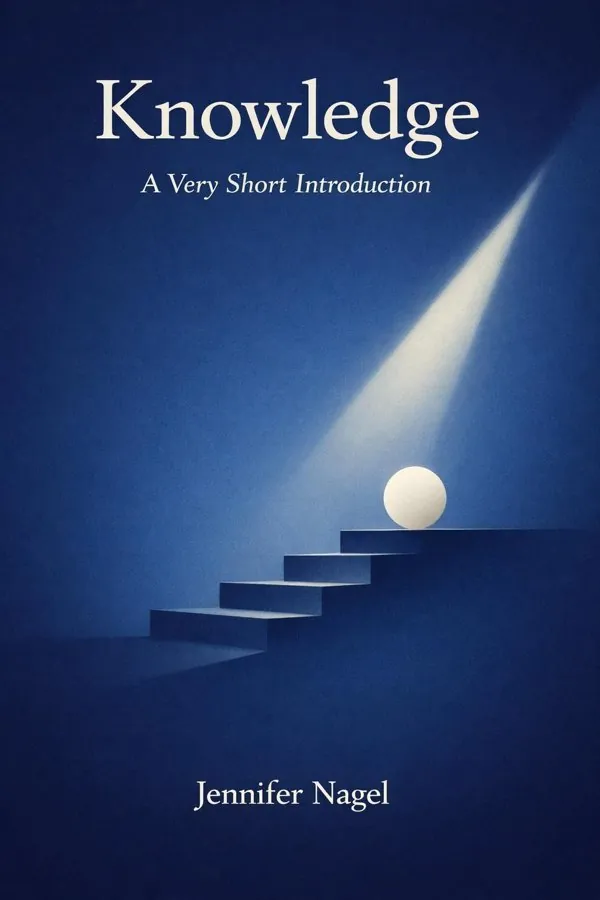
Knowledge: A Very Short Introduction: Summary & Key Insights
 10 min6 chaptersAudio available
What Is Knowledge: A Very Short Introduction About?
Knowledge: A Very Short Introduction by Jennifer Nagel is a western_phil book spanning 6 pages. This concise volume offers an accessible introduction to epistemology, the philosophical study of knowledge. Jennifer Nagel examines what knowledge is, how it differs from belief, and how we can know anything at all. The book explores classical and contemporary theories, including skepticism, reliabilism, and contextualism, providing readers with a clear overview of key debates in modern epistemology.
This FizzRead summary covers all 6 key chapters of Knowledge: A Very Short Introduction in approximately 10 minutes, distilling the most important ideas, arguments, and takeaways from Jennifer Nagel's work. Also available as an audio summary and Key Quotes Podcast.
Knowledge: A Very Short Introduction
This concise volume offers an accessible introduction to epistemology, the philosophical study of knowledge. Jennifer Nagel examines what knowledge is, how it differs from belief, and how we can know anything at all. The book explores classical and contemporary theories, including skepticism, reliabilism, and contextualism, providing readers with a clear overview of key debates in modern epistemology.
Who Should Read Knowledge: A Very Short Introduction?
This book is perfect for anyone interested in western_phil and looking to gain actionable insights in a short read. Whether you're a student, professional, or lifelong learner, the key ideas from Knowledge: A Very Short Introduction by Jennifer Nagel will help you think differently.
- ✓Readers who enjoy western_phil and want practical takeaways
- ✓Professionals looking to apply new ideas to their work and life
- ✓Anyone who wants the core insights of Knowledge: A Very Short Introduction in just 10 minutes
Want the full summary?
Get instant access to this book summary and 100K+ more with Fizz Moment.
Get Free SummaryAvailable on App Store • Free to download
Key Chapters
We begin with Plato, because every road in Western epistemology eventually leads back to him. In his dialogues—especially the *Theaetetus*—Plato proposed that knowledge is ‘justified true belief.’ To know that something is so, one must believe it, it must be true, and one must have justification for believing it. This triadic structure set the foundation for centuries of philosophical analysis.
In my own exploration, I emphasize how revolutionary Plato’s framing was. He took the everyday idea of knowing and placed it under the bright light of reason. Belief alone is not enough; truth must accompany it, and both must be anchored by justification—reasons or evidence that make belief secure. Yet this simplicity conceals deep difficulty. What counts as a good justification? Do we need certainty, or merely high probability? Can one be justified and still mistaken?
Through Plato’s influence, we inherit a discipline that oscillates between rational analysis and empirical grounding. Rationalists such as Descartes would later search for foundations so indubitable that even the most radical doubts could not unsettle them. Empiricists like Locke and Hume would turn the lens toward the senses, insisting that justification comes from experience and observation. In following their debate, you begin to see epistemology as a tension between two impulses—the desire for logical purity and the recognition of our human finitude.
As I write, I want readers to see Plato not merely as an ancient authority but as a fellow inquirer into a timeless mystery. His justified true belief formula is less a solution than a provocation: it invites us to test the boundaries of what counts as knowing. Understanding Plato’s conceptual legacy helps us appreciate why knowledge remains an urgent and living question.
Belief is an everyday mental act—we believe that tomorrow will be sunny, that our friend is honest, that a text message we received came from the person it claims to. Yet not all beliefs can be called knowledge. The reason lies in justification and truth, and in the critical challenge posed by skepticism.
Skeptical reasoning asks: can any of our beliefs ever be secure enough to count as knowledge? Once we realize how easy it is to be mistaken, how vulnerable we are to illusion, deception, or error, the ground beneath certainty begins to tremble. Traditional philosophical skepticism—from the ancient Pyrrhonists to Descartes’ Evil Demon thought experiment—tests the limits of justification itself. What if all our sensory evidence were fabricated? What if reality were systematically misleading?
In confronting skepticism, I encourage students not to fear doubt but to use it as a constructive instrument. Doubt, when philosophically disciplined, enhances understanding. Descartes’ methodical doubting led him to isolate the one belief he thought indubitable: his own existence as a thinking subject. From this seed, modern epistemology took shape. Later thinkers refined this struggle further—figures like Hume showed the difficulty of grounding induction, while Kant reimagined the boundaries between mind and world.
What matters for you is the practical insight here: justification is both necessary and fragile. Even in everyday life, we navigate probabilistic reasoning—trusting sources, weighing evidence, acknowledging fallibility. The skeptical challenge reminds us that knowledge is not mere possession of correct information, but a state earned through critical reflection and confidence in our cognitive processes.
+ 4 more chapters — available in the FizzRead app
All Chapters in Knowledge: A Very Short Introduction
About the Author
Jennifer Nagel is a professor of philosophy at the University of Toronto. Her research focuses on epistemology, philosophy of mind, and the history of modern philosophy. She is recognized for her work on knowledge, belief, and the cognitive foundations of epistemic evaluation.
Get This Summary in Your Preferred Format
Read or listen to the Knowledge: A Very Short Introduction summary by Jennifer Nagel anytime, anywhere. FizzRead offers multiple formats so you can learn on your terms — all free.
Available formats: App · Audio · PDF · EPUB — All included free with FizzRead
Download Knowledge: A Very Short Introduction PDF and EPUB Summary
Key Quotes from Knowledge: A Very Short Introduction
“We begin with Plato, because every road in Western epistemology eventually leads back to him.”
“Belief is an everyday mental act—we believe that tomorrow will be sunny, that our friend is honest, that a text message we received came from the person it claims to.”
Frequently Asked Questions about Knowledge: A Very Short Introduction
Knowledge: A Very Short Introduction by Jennifer Nagel is a western_phil book that explores key ideas across 6 chapters. This concise volume offers an accessible introduction to epistemology, the philosophical study of knowledge. Jennifer Nagel examines what knowledge is, how it differs from belief, and how we can know anything at all. The book explores classical and contemporary theories, including skepticism, reliabilism, and contextualism, providing readers with a clear overview of key debates in modern epistemology.
You Might Also Like
A Little History of Philosophy
Nigel Warburton
10 min
Areopagitica
John Milton
10 min
How To Think Like A Philosopher: Essential Principles For Clear Thinking
Peter Cave
10 min
Language, Truth and Logic
A. J. Ayer
10 min
The Age of Reason
Thomas Paine
10 min
The Essays
Michel De Montaigne
10 minBrowse by Category
Ready to read Knowledge: A Very Short Introduction?
Get the full summary and 100K+ more books with Fizz Moment.