
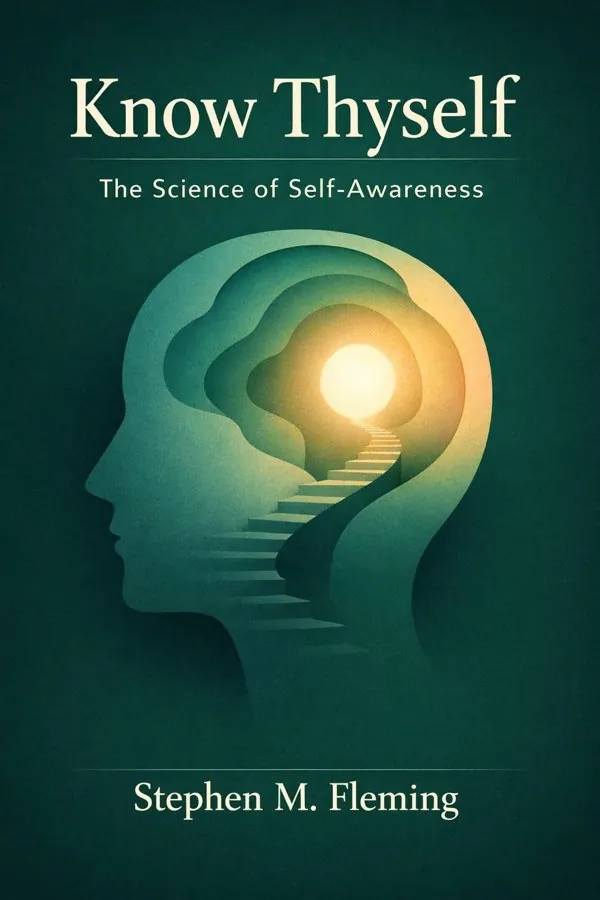
Know Thyself: The Science of Self-Awareness: Summary & Key Insights
 10 min8 chaptersAudio available
Key Takeaways from Know Thyself: The Science of Self-Awareness
Self-knowledge feels intimate and immediate, yet it has always been surprisingly difficult to explain.
One of the most remarkable things about the brain is that it does not only process the world; it also evaluates how well it is processing the world.
We often treat confidence as if it were a transparent window into truth, but Fleming shows that confidence is better understood as a psychological signal.
We tend to imagine self-awareness as a private achievement, but Fleming emphasizes that it develops in a social world.
One of the book’s most humbling lessons is that introspection is useful but deeply imperfect.
What Is Know Thyself: The Science of Self-Awareness About?
Know Thyself: The Science of Self-Awareness by Stephen M. Fleming is a neuroscience book spanning 11 pages. How do you know when you are right, when you are confused, or when you are fooling yourself? In Know Thyself, cognitive neuroscientist Stephen M. Fleming tackles one of humanity’s oldest questions with one of modern science’s most powerful toolkits. The book explores self-awareness not as a mystical trait or purely philosophical puzzle, but as a measurable mental capacity rooted in the brain’s ability to monitor its own thoughts, perceptions, and decisions. At the center of the story is metacognition: the mind’s capacity to think about its own thinking. Fleming shows why this matters far beyond the lab. Self-awareness influences how we learn, how confidently we speak, how accurately we judge our abilities, and how well we relate to other people. It also shapes mental health, social trust, and the quality of collective decision-making. Drawing on neuroscience, psychology, philosophy, and real-world examples, Fleming explains what the brain can know about itself, where introspection succeeds, and where it fails. As a leading researcher in metacognition at University College London, he brings both scientific authority and clarity to a topic that affects every choice we make.
This FizzRead summary covers all 8 key chapters of Know Thyself: The Science of Self-Awareness in approximately 10 minutes, distilling the most important ideas, arguments, and takeaways from Stephen M. Fleming's work. Also available as an audio summary and Key Quotes Podcast.
Know Thyself: The Science of Self-Awareness
How do you know when you are right, when you are confused, or when you are fooling yourself? In Know Thyself, cognitive neuroscientist Stephen M. Fleming tackles one of humanity’s oldest questions with one of modern science’s most powerful toolkits. The book explores self-awareness not as a mystical trait or purely philosophical puzzle, but as a measurable mental capacity rooted in the brain’s ability to monitor its own thoughts, perceptions, and decisions. At the center of the story is metacognition: the mind’s capacity to think about its own thinking.
Fleming shows why this matters far beyond the lab. Self-awareness influences how we learn, how confidently we speak, how accurately we judge our abilities, and how well we relate to other people. It also shapes mental health, social trust, and the quality of collective decision-making. Drawing on neuroscience, psychology, philosophy, and real-world examples, Fleming explains what the brain can know about itself, where introspection succeeds, and where it fails. As a leading researcher in metacognition at University College London, he brings both scientific authority and clarity to a topic that affects every choice we make.
Who Should Read Know Thyself: The Science of Self-Awareness?
This book is perfect for anyone interested in neuroscience and looking to gain actionable insights in a short read. Whether you're a student, professional, or lifelong learner, the key ideas from Know Thyself: The Science of Self-Awareness by Stephen M. Fleming will help you think differently.
- ✓Readers who enjoy neuroscience and want practical takeaways
- ✓Professionals looking to apply new ideas to their work and life
- ✓Anyone who wants the core insights of Know Thyself: The Science of Self-Awareness in just 10 minutes
Want the full summary?
Get instant access to this book summary and 100K+ more with Fizz Moment.
Get Free SummaryAvailable on App Store • Free to download
Key Chapters
Self-knowledge feels intimate and immediate, yet it has always been surprisingly difficult to explain. For centuries, philosophers treated the command to “know thyself” as a moral and intellectual ideal, while thinkers from Socrates to Descartes debated whether the mind could ever fully grasp itself. Fleming’s central move is to show that this old question has entered a new era: self-awareness can now be studied experimentally.
Rather than relying only on introspective reflection or philosophical argument, researchers can test how accurately people judge their own performance. For example, participants may complete a memory or perception task and then rate how confident they are in their answers. These confidence judgments reveal whether a person’s self-assessment tracks reality. Someone with strong metacognition knows not just what they think, but how reliable that thinking is.
This matters because the gap between performance and self-evaluation shapes everyday life. A student may misunderstand a topic but feel certain they understand it. A manager may hesitate despite having good judgment. A patient may overestimate or underestimate symptoms. In each case, behavior is guided not simply by raw ability, but by awareness of ability.
Fleming reframes self-awareness as a scientific target: observable, comparable, and deeply consequential. The old philosophical mystery is not solved by dismissing introspection, but by breaking it into measurable components. We can ask when people know what they know, when they misread themselves, and what brain systems support those judgments.
Actionable takeaway: Start separating performance from self-evaluation. After important tasks, ask not only “Was I correct?” but also “How accurate was my confidence?” That habit strengthens practical self-knowledge.
One of the most remarkable things about the brain is that it does not only process the world; it also evaluates how well it is processing the world. Fleming highlights research suggesting that self-monitoring depends heavily on networks in the prefrontal cortex, especially regions involved in integrating evidence, weighing uncertainty, and reflecting on decisions.
A useful way to think about this is to imagine two levels of cognition. First-order processes help you see, remember, decide, and act. Second-order processes assess those first-order processes: Was that memory reliable? Did I really see what I think I saw? Should I trust this decision? Metacognition is this second-order layer. It does not replace perception or memory; it comments on them.
Neuroscience shows that these abilities can come apart. A person may perform normally on a task but be poor at judging whether they were correct. Brain injury studies are particularly revealing here. Damage to parts of the prefrontal cortex can impair a person’s insight into their own performance even when basic task ability remains relatively intact. That suggests self-awareness is not simply “more thinking,” but a specialized function with its own neural basis.
In practical terms, this explains why intelligence alone does not guarantee wisdom. A sharp analyst may still be overconfident. A less dazzling thinker may compensate by noticing uncertainty and seeking feedback. In high-stakes fields like medicine, finance, and aviation, this distinction is crucial: good metacognition can prevent small errors from becoming major failures.
Actionable takeaway: Build “second-order pauses” into important decisions. Before acting, ask: “What evidence supports my judgment, and how certain am I really?” That question recruits the brain’s self-monitoring systems instead of running on automatic confidence.
We often treat confidence as if it were a transparent window into truth, but Fleming shows that confidence is better understood as a psychological signal. It can be informative, but it is never infallible. In metacognition research, confidence judgments are crucial because they reveal how the mind estimates the reliability of its own beliefs and perceptions.
A key insight is that confidence and accuracy are related but not identical. Sometimes they align: you answer correctly and feel sure because the evidence is strong. But sometimes they diverge. People can be highly confident and wrong, or hesitant and right. This disconnect helps explain many social and personal errors, from heated arguments to poor business bets.
Confidence is shaped by more than evidence. Stress, prior expectations, personality, social pressure, and even the way a question is framed can affect how certain we feel. Someone speaking fluently may sound sure without being correct. Another person may present excellent reasoning with visible doubt. If we equate confidence with competence, we risk rewarding style over substance.
Fleming’s work also points to confidence as a tool for learning. Students improve when they not only get feedback on right and wrong answers, but also compare that feedback with how sure they felt. This helps calibrate confidence over time. The goal is not to become less confident, but more accurately confident.
In daily life, calibrated confidence improves conversations and decisions. It encourages us to speak clearly when evidence is strong, and to remain open when evidence is thin. It also helps teams identify who genuinely has insight rather than who merely sounds convincing.
Actionable takeaway: When making claims, pair them with a confidence level. Saying “I’m fairly sure” or “I’m uncertain” trains better calibration and invites more honest, effective dialogue.
We tend to imagine self-awareness as a private achievement, but Fleming emphasizes that it develops in a social world. Children do not awaken into perfect introspection. They gradually learn to identify thoughts, feelings, and uncertainty through interaction with caregivers, teachers, and peers. In this sense, knowing yourself begins with being known by others.
Developmental psychology shows that children become better over time at reporting what they know, what they remember, and when they are unsure. This growth depends on language, attention, and feedback. Adults often help children build metacognition by asking questions like, “How did you figure that out?” or “Are you sure, or are you guessing?” These prompts do more than correct behavior; they teach children to monitor their own mental states.
Social experience continues to shape self-awareness in adulthood. Workplaces, friendships, and families constantly mirror aspects of ourselves back to us. Sometimes this improves insight. A colleague may notice that you rush decisions when stressed. A friend may detect self-doubt you hide from yourself. Of course, social feedback can also mislead, especially when people project their own biases onto us. The challenge is learning which signals to trust.
This social dimension matters because self-awareness is not merely inward-looking. It is tied to perspective-taking, empathy, and communication. People who can recognize their own uncertainty are often better at understanding that others have different perspectives and limited knowledge too.
Actionable takeaway: Treat feedback as part of self-knowledge. Regularly ask trusted people not just what they think of your outcomes, but what patterns they notice in how you think, decide, and react.
One of the book’s most humbling lessons is that introspection is useful but deeply imperfect. We like to believe we understand why we choose, feel, and act as we do. Yet research repeatedly shows that people often confabulate reasons, overlook hidden influences, and mistake stories about their minds for direct access to them.
This does not mean self-knowledge is impossible. It means introspection is partial and error-prone. Much of cognition happens automatically, outside conscious awareness. Your preferences may be nudged by framing, familiarity, mood, or social cues before you ever generate an explanation. When asked why you made a choice, your brain may produce a coherent narrative that feels true even if it misses the real causes.
Classic studies illustrate this point. People may choose an option because of subtle contextual effects, then confidently explain the choice in terms of quality or preference. In everyday life, this shows up when we justify impulsive purchases as rational, attribute success entirely to skill while ignoring luck, or assume our moral judgments arose from careful reasoning when they were partly intuitive.
Fleming does not argue that inner reflection is worthless. Instead, he urges a more disciplined view of it. Introspection is best treated as one source of evidence among others, to be checked against behavior, outcomes, and external feedback. This scientific attitude toward the self is more reliable than simply trusting whatever explanation comes most easily.
Actionable takeaway: When analyzing your motives, compare your story with observable patterns. Ask, “What did I actually do repeatedly?” Behavior often reveals what introspection alone hides.
Our capacity to evaluate our own thoughts is not just an intellectual curiosity; it is tightly connected to mental health. Fleming explores how metacognition can become distorted in different conditions, affecting how people interpret their experiences, trust their judgments, and respond to emotion.
In anxiety, for instance, people may over-monitor threat and underestimate their coping ability. In depression, self-evaluation can become globally negative, leading individuals to treat feelings of worthlessness as accurate self-knowledge. In psychosis, difficulties in distinguishing internally generated thoughts from external reality may involve disruptions in self-monitoring. Across these conditions, the problem is not simply “thinking badly,” but misjudging one’s own mental processes.
This perspective has practical value. It helps explain why reassurance sometimes fails: the issue is not a lack of information, but a distorted relationship to one’s own certainty and doubt. It also clarifies why some therapies work. Cognitive and metacognitive therapies teach people to notice thoughts as events in the mind rather than unquestionable facts. Mindfulness practices similarly strengthen awareness of mental states without immediate identification with them.
Even outside clinical disorders, mental well-being often depends on accurate self-appraisal. Underconfidence can trap people in avoidance; overconfidence can lead to impulsive risks and damaged relationships. Better metacognition supports emotional regulation, help-seeking, and resilience.
Fleming’s broader contribution is to frame self-awareness as a health resource. To understand the mind scientifically is also to care for it more intelligently.
Actionable takeaway: When distressed, pause before treating a thought as truth. Label it precisely: “I’m having the thought that…” This small shift can improve distance, perspective, and self-monitoring.
Self-awareness and social understanding are often treated as separate abilities, but Fleming shows they are deeply connected. The same mental machinery that allows you to estimate your own uncertainty may also help you infer what other people know, believe, or feel. In other words, understanding minds may begin with understanding your own.
This connection matters because social life constantly requires metacognitive judgment. During a conversation, you assess not only what you think, but whether your listener understands you. In a team, you decide whether to voice concern based partly on how sure you are. In conflict, your ability to recognize the limits of your own perspective influences whether you become defensive or curious.
Research suggests that people who are better calibrated about their own performance may also show stronger perspective-taking in some contexts. While the relationship is not perfect, it makes intuitive sense: if you recognize that your own mind can be mistaken, you are more likely to grant that other minds are complex rather than simply wrong or irrational.
This has implications for leadership, education, and public discourse. Good leaders communicate confidence without pretending certainty where none exists. Good teachers model how to say, “I don’t know.” Healthy communities depend on citizens who can hold beliefs firmly enough to act, yet loosely enough to revise them.
In practical terms, self-awareness can improve empathy. Not because introspection reveals everything, but because it makes us less naive about the hidden processes shaping judgment. That humility opens space for better listening, less blame, and more constructive disagreement.
Actionable takeaway: In your next disagreement, state one thing you might be missing before arguing your point. That simple move strengthens both self-awareness and mutual understanding.
All Chapters in Know Thyself: The Science of Self-Awareness
About the Author
Stephen M. Fleming is a leading cognitive neuroscientist whose work focuses on metacognition, decision-making, and the neural basis of self-awareness. He is a professor at University College London and has led influential research on how the brain monitors its own perceptions, memories, and choices. Fleming directs the Metacognition Group, where he studies confidence, introspection, and the relationship between self-evaluation and behavior. His research has been published in major scientific journals and has helped shape contemporary understanding of how people assess the reliability of their own minds. In his writing, Fleming brings together neuroscience, psychology, and philosophy with unusual clarity. Know Thyself reflects both his academic expertise and his ability to explain complex ideas in ways that are meaningful for everyday life.
Get This Summary in Your Preferred Format
Read or listen to the Know Thyself: The Science of Self-Awareness summary by Stephen M. Fleming anytime, anywhere. FizzRead offers multiple formats so you can learn on your terms — all free.
Available formats: App · Audio · PDF · EPUB — All included free with FizzRead
Download Know Thyself: The Science of Self-Awareness PDF and EPUB Summary
Key Quotes from Know Thyself: The Science of Self-Awareness
“Self-knowledge feels intimate and immediate, yet it has always been surprisingly difficult to explain.”
“One of the most remarkable things about the brain is that it does not only process the world; it also evaluates how well it is processing the world.”
“We often treat confidence as if it were a transparent window into truth, but Fleming shows that confidence is better understood as a psychological signal.”
“We tend to imagine self-awareness as a private achievement, but Fleming emphasizes that it develops in a social world.”
“One of the book’s most humbling lessons is that introspection is useful but deeply imperfect.”
Frequently Asked Questions about Know Thyself: The Science of Self-Awareness
Know Thyself: The Science of Self-Awareness by Stephen M. Fleming is a neuroscience book that explores key ideas across 8 chapters. How do you know when you are right, when you are confused, or when you are fooling yourself? In Know Thyself, cognitive neuroscientist Stephen M. Fleming tackles one of humanity’s oldest questions with one of modern science’s most powerful toolkits. The book explores self-awareness not as a mystical trait or purely philosophical puzzle, but as a measurable mental capacity rooted in the brain’s ability to monitor its own thoughts, perceptions, and decisions. At the center of the story is metacognition: the mind’s capacity to think about its own thinking. Fleming shows why this matters far beyond the lab. Self-awareness influences how we learn, how confidently we speak, how accurately we judge our abilities, and how well we relate to other people. It also shapes mental health, social trust, and the quality of collective decision-making. Drawing on neuroscience, psychology, philosophy, and real-world examples, Fleming explains what the brain can know about itself, where introspection succeeds, and where it fails. As a leading researcher in metacognition at University College London, he brings both scientific authority and clarity to a topic that affects every choice we make.
You Might Also Like
Anxious
Joseph LeDoux
10 min
Hallucinations
Oliver Sacks
10 min
The Biological Mind: How Brain, Body, and Environment Collaborate to Make Us Who We Are
Alan Jasanoff
10 min
The Feeling of Life Itself: Why Consciousness Is Widespread but Can't Be Computed
Christof Koch
10 min
The No-Nonsense Meditation Book
Steven Laureys
10 min
A General Theory of Love
Thomas Lewis, Fari Amini, Richard Lannon
10 minBrowse by Category
Ready to read Know Thyself: The Science of Self-Awareness?
Get the full summary and 100K+ more books with Fizz Moment.