
Stephen M. Fleming Books
Stephen M. Fleming is a cognitive neuroscientist and professor at University College London.
Known for: Know Thyself: The Science of Self-Awareness
Books by Stephen M. Fleming
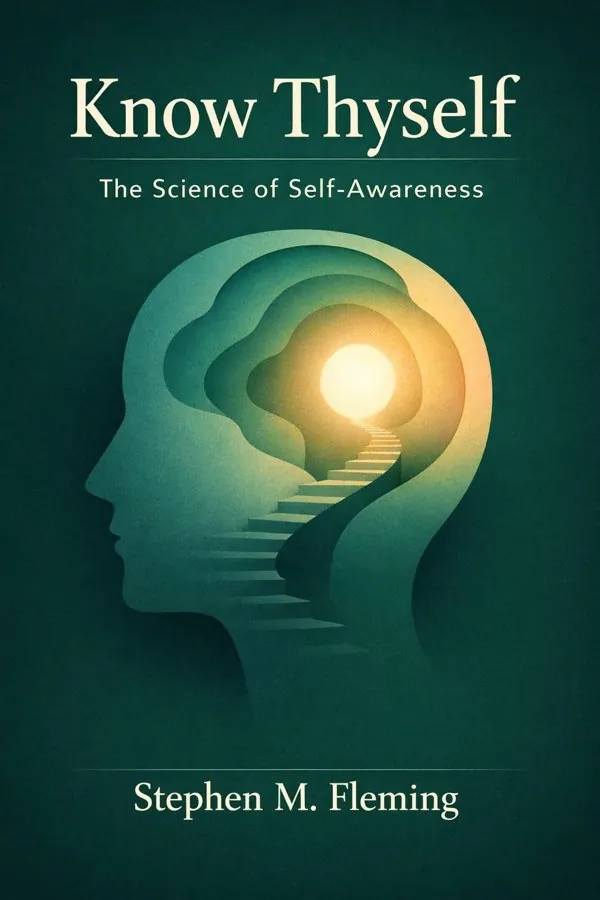
Know Thyself: The Science of Self-Awareness
How do you know when you are right, when you are confused, or when you are fooling yourself? In Know Thyself, cognitive neuroscientist Stephen M. Fleming tackles one of humanity’s oldest questions with one of modern science’s most powerful toolkits. The book explores self-awareness not as a mystical trait or purely philosophical puzzle, but as a measurable mental capacity rooted in the brain’s ability to monitor its own thoughts, perceptions, and decisions. At the center of the story is metacognition: the mind’s capacity to think about its own thinking. Fleming shows why this matters far beyond the lab. Self-awareness influences how we learn, how confidently we speak, how accurately we judge our abilities, and how well we relate to other people. It also shapes mental health, social trust, and the quality of collective decision-making. Drawing on neuroscience, psychology, philosophy, and real-world examples, Fleming explains what the brain can know about itself, where introspection succeeds, and where it fails. As a leading researcher in metacognition at University College London, he brings both scientific authority and clarity to a topic that affects every choice we make.
Read SummaryKey Insights from Stephen M. Fleming
An Ancient Question Meets Modern Science
Self-knowledge feels intimate and immediate, yet it has always been surprisingly difficult to explain. For centuries, philosophers treated the command to “know thyself” as a moral and intellectual ideal, while thinkers from Socrates to Descartes debated whether the mind could ever fully grasp itself...
From Know Thyself: The Science of Self-Awareness
The Brain Monitors Its Own Mind
One of the most remarkable things about the brain is that it does not only process the world; it also evaluates how well it is processing the world. Fleming highlights research suggesting that self-monitoring depends heavily on networks in the prefrontal cortex, especially regions involved in integr...
From Know Thyself: The Science of Self-Awareness
Confidence Is a Signal, Not Truth
We often treat confidence as if it were a transparent window into truth, but Fleming shows that confidence is better understood as a psychological signal. It can be informative, but it is never infallible. In metacognition research, confidence judgments are crucial because they reveal how the mind e...
From Know Thyself: The Science of Self-Awareness
Self-Awareness Develops Through Relationships
We tend to imagine self-awareness as a private achievement, but Fleming emphasizes that it develops in a social world. Children do not awaken into perfect introspection. They gradually learn to identify thoughts, feelings, and uncertainty through interaction with caregivers, teachers, and peers. In ...
From Know Thyself: The Science of Self-Awareness
Introspection Has Sharp Built-In Limits
One of the book’s most humbling lessons is that introspection is useful but deeply imperfect. We like to believe we understand why we choose, feel, and act as we do. Yet research repeatedly shows that people often confabulate reasons, overlook hidden influences, and mistake stories about their minds...
From Know Thyself: The Science of Self-Awareness
Mental Health Depends on Self-Monitoring
Our capacity to evaluate our own thoughts is not just an intellectual curiosity; it is tightly connected to mental health. Fleming explores how metacognition can become distorted in different conditions, affecting how people interpret their experiences, trust their judgments, and respond to emotion....
From Know Thyself: The Science of Self-Awareness
About Stephen M. Fleming
Stephen M. Fleming is a cognitive neuroscientist and professor at University College London. His research focuses on metacognition, decision-making, and the neural basis of self-awareness. He leads the Metacognition Lab and has published widely in leading scientific journals.


Frequently Asked Questions
Stephen M. Fleming is a cognitive neuroscientist and professor at University College London.
Read Stephen M. Fleming's books in 15 minutes
Get AI-powered summaries with key insights from 1 book by Stephen M. Fleming.