
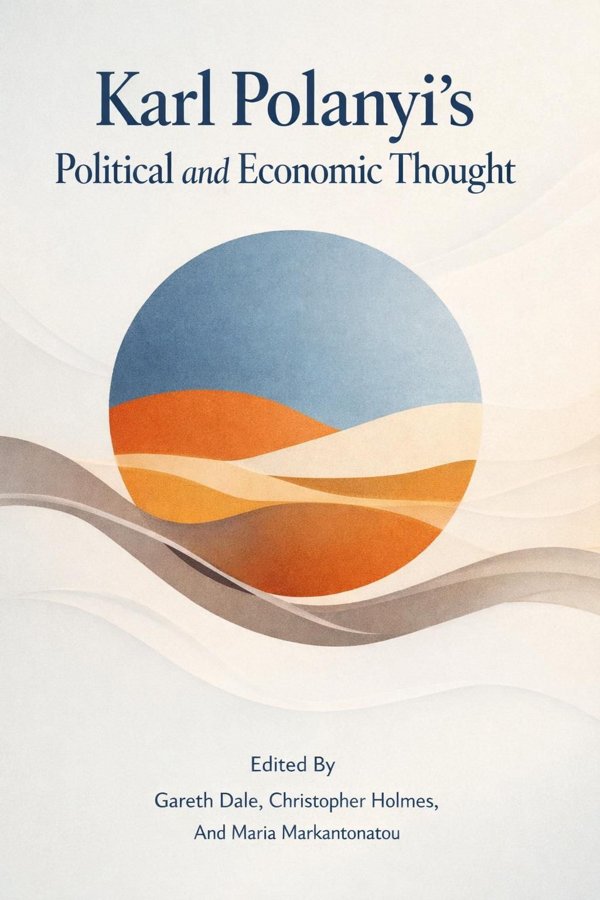
Karl Polanyi's Political and Economic Thought: Summary & Key Insights
by Edited By Gareth Dale, Christopher Holmes, And Maria Markantonatou
 10 min10 chaptersAudio available
What Is Karl Polanyi's Political and Economic Thought About?
Karl Polanyi's Political and Economic Thought by Edited By Gareth Dale, Christopher Holmes, And Maria Markantonatou is a politics book spanning 10 pages. This scholarly volume provides a comprehensive examination of Karl Polanyi’s political and economic ideas. It explores key themes such as the relationship between economy and society, the critique of market liberalism, and the continuing relevance of Polanyi’s thought to contemporary political economy. The book brings together contributions from leading academics to assess Polanyi’s influence across disciplines including economics, sociology, and political science.
This FizzRead summary covers all 10 key chapters of Karl Polanyi's Political and Economic Thought in approximately 10 minutes, distilling the most important ideas, arguments, and takeaways from Edited By Gareth Dale, Christopher Holmes, And Maria Markantonatou's work. Also available as an audio summary and Key Quotes Podcast.
Karl Polanyi's Political and Economic Thought
This scholarly volume provides a comprehensive examination of Karl Polanyi’s political and economic ideas. It explores key themes such as the relationship between economy and society, the critique of market liberalism, and the continuing relevance of Polanyi’s thought to contemporary political economy. The book brings together contributions from leading academics to assess Polanyi’s influence across disciplines including economics, sociology, and political science.
Who Should Read Karl Polanyi's Political and Economic Thought?
This book is perfect for anyone interested in politics and looking to gain actionable insights in a short read. Whether you're a student, professional, or lifelong learner, the key ideas from Karl Polanyi's Political and Economic Thought by Edited By Gareth Dale, Christopher Holmes, And Maria Markantonatou will help you think differently.
- ✓Readers who enjoy politics and want practical takeaways
- ✓Professionals looking to apply new ideas to their work and life
- ✓Anyone who wants the core insights of Karl Polanyi's Political and Economic Thought in just 10 minutes
Want the full summary?
Get instant access to this book summary and 100K+ more with Fizz Moment.
Get Free SummaryAvailable on App Store • Free to download
Key Chapters
Karl Polanyi’s thought cannot be disentangled from his remarkable life story. Born in Vienna in 1886 to a family marked by intellectual curiosity and political idealism, Polanyi grew up amid the contradictions of a multiethnic empire in decline. His education in law and his early political activism within socialist circles exposed him to the tensions between market capitalism and social solidarity long before they came to dominate his scholarship. He lived through the crises that many twentieth-century thinkers only theorized: empire, war, revolution, fascism, and exile. Each left a profound imprint on his understanding of society’s moral foundations.
As a young man in Budapest, Polanyi cofounded the Galilei Circle, an association dedicated to progressive inquiry and ethical socialism. This milieu linked scientific rationality with social justice, a synthesis that permeated Polanyi’s later belief that economic science must remain anchored in moral inquiry. His exile first to Austria, then to England and eventually to North America exposed him to the shifting landscape of global capitalism, from the industrial working classes of interwar Europe to the welfare state debates of postwar America. In each setting, Polanyi observed one consistent pattern: markets never arise spontaneously, and their expansion invariably triggers social resistance.
Polanyi’s intellectual formation drew from diverse sources — Marx, Durkheim, Mises, and more profoundly, Christian personalism. He rejected deterministic economism but shared Marx’s conviction that society’s welfare depends on restraining the commodification of human life. His personal philosophy fused socialism with humanism, insisting that society’s purpose was to secure the conditions of freedom rather than exploit the pursuit of profit.
These life experiences and ideological encounters provided the soil from which 'The Great Transformation' would grow. That book was not written from an ivory tower but from the lived agony of the interwar period. For Polanyi, the crisis of his age — endless unemployment, social dislocation, fascist propaganda — had a common root in the elevation of the self-regulating market to a social ideal. As he observed political regimes and economic experiments collapse around him, his scholarship matured into a moral critique of economic determinism itself.
When revisiting 'The Great Transformation,' we return to the dramatic narrative of how 19th-century capitalism turned the economy from a settled part of communal life into an autonomous and dominating system. Polanyi’s argument begins with the historical rupture brought about by industrialization. Societies had always possessed markets, he noted, but only modern capitalism created a 'market society' — one in which every aspect of life, from land to labor to money, became commodified. This transformation was not natural; it was politically orchestrated. State interventions legalized property regimes, uprooted peasants, and standardized currencies, making possible the fiction of a 'self-regulating market.'
Polanyi’s concept of the 'double movement' captures the dialectical rhythm of this upheaval. As markets expand, social forces invariably mobilize to protect society from their destructive effects — hence welfare legislation, trade unions, and social norms arise as countermovements. Far from being an obstacle to progress, these protective reactions were society’s own means of survival. In Polanyi’s eyes, the double movement was universal because human beings refuse to be reduced to commodities. Industrialization sparked both the commodification of life and the revolt against it.
In reassessing this framework today, contributors to our volume emphasize its continuing resonance. Globalization since the late twentieth century has reproduced the same dynamic of liberalization and protection. The neoliberal project, promising the liberation of markets from state constraint, has in practice depended on massive state interventions — from financial bailouts to security apparatuses — to stabilize the very system it unleashes. This insight vindicates Polanyi’s historical argument: markets are never free from politics. The myth of self-regulation conceals an enduring truth — that society organizes markets, not the other way around.
The 'double movement' also provides a lens for reading our own responses to neoliberalism’s discontents: the rise of populism, environmental activism, and demands for social justice. In each, we see society seeking to re-embed the economy within moral and ecological limits. Polanyi’s historical narrative becomes a prophecy of the present, reminding us that the ‘great transformation’ is not a closed chapter but a recurrent drama of modernity.
+ 8 more chapters — available in the FizzRead app
All Chapters in Karl Polanyi's Political and Economic Thought
About the Authors
Gareth Dale is a Reader in Political Economy at Brunel University London. Christopher Holmes is a Lecturer in Political Economy at King’s College London. Maria Markantonatou is an Associate Professor of Sociology at the University of the Aegean, Greece.
Get This Summary in Your Preferred Format
Read or listen to the Karl Polanyi's Political and Economic Thought summary by Edited By Gareth Dale, Christopher Holmes, And Maria Markantonatou anytime, anywhere. FizzRead offers multiple formats so you can learn on your terms — all free.
Available formats: App · Audio · PDF · EPUB — All included free with FizzRead
Download Karl Polanyi's Political and Economic Thought PDF and EPUB Summary
Key Quotes from Karl Polanyi's Political and Economic Thought
“Karl Polanyi’s thought cannot be disentangled from his remarkable life story.”
“Polanyi’s argument begins with the historical rupture brought about by industrialization.”
Frequently Asked Questions about Karl Polanyi's Political and Economic Thought
Karl Polanyi's Political and Economic Thought by Edited By Gareth Dale, Christopher Holmes, And Maria Markantonatou is a politics book that explores key ideas across 10 chapters. This scholarly volume provides a comprehensive examination of Karl Polanyi’s political and economic ideas. It explores key themes such as the relationship between economy and society, the critique of market liberalism, and the continuing relevance of Polanyi’s thought to contemporary political economy. The book brings together contributions from leading academics to assess Polanyi’s influence across disciplines including economics, sociology, and political science.
You Might Also Like

Antifa: The Anti-Fascist Handbook
Mark Bray
10 min
Attack from Within: How Disinformation Is Sabotaging America
Barbara McQuade
10 min
Coercion, Capital, and European States, AD 990–1992
Charles Tilly
10 min
Digital Democracy: Concepts, Methodologies, Tools, and Applications
Various Authors
10 min
Fascism
Stanley G. Payne
10 min
Fire And Fury: Inside The Trump White House
Michael Wolff
10 minBrowse by Category
Ready to read Karl Polanyi's Political and Economic Thought?
Get the full summary and 100K+ more books with Fizz Moment.