
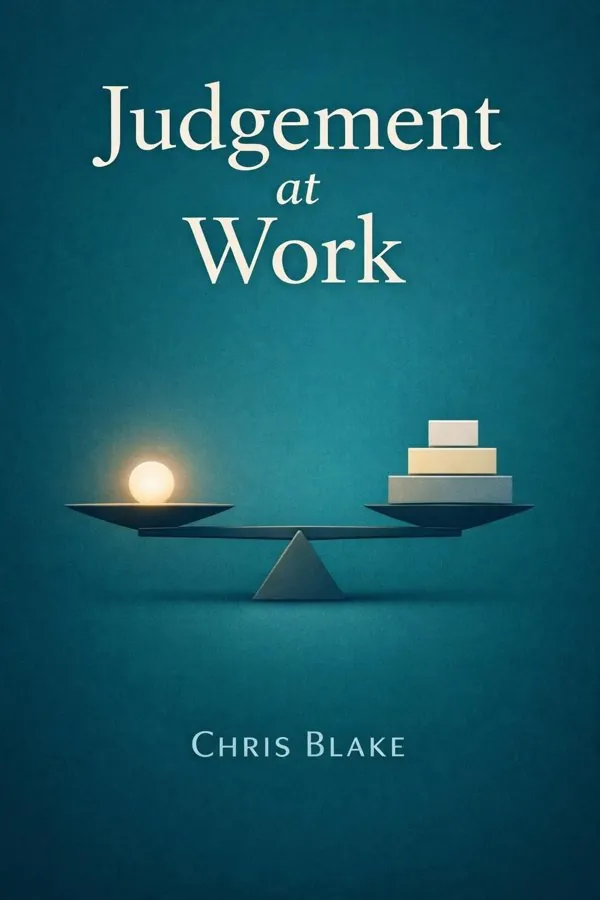
Judgement at Work: How Decision Making Drives Business Performance: Summary & Key Insights
by Chris Blake
 10 min11 chaptersAudio available
What Is Judgement at Work: How Decision Making Drives Business Performance About?
Judgement at Work: How Decision Making Drives Business Performance by Chris Blake is a leadership book spanning 11 pages. Judgement at Work explores how effective decision-making processes influence organizational success. The book provides frameworks and case studies illustrating how leaders can improve judgment under uncertainty, balance intuition with data, and create cultures that support sound decisions across all levels of business.
This FizzRead summary covers all 11 key chapters of Judgement at Work: How Decision Making Drives Business Performance in approximately 10 minutes, distilling the most important ideas, arguments, and takeaways from Chris Blake's work. Also available as an audio summary and Key Quotes Podcast.
Judgement at Work: How Decision Making Drives Business Performance
Judgement at Work explores how effective decision-making processes influence organizational success. The book provides frameworks and case studies illustrating how leaders can improve judgment under uncertainty, balance intuition with data, and create cultures that support sound decisions across all levels of business.
Who Should Read Judgement at Work: How Decision Making Drives Business Performance?
This book is perfect for anyone interested in leadership and looking to gain actionable insights in a short read. Whether you're a student, professional, or lifelong learner, the key ideas from Judgement at Work: How Decision Making Drives Business Performance by Chris Blake will help you think differently.
- ✓Readers who enjoy leadership and want practical takeaways
- ✓Professionals looking to apply new ideas to their work and life
- ✓Anyone who wants the core insights of Judgement at Work: How Decision Making Drives Business Performance in just 10 minutes
Want the full summary?
Get instant access to this book summary and 100K+ more with Fizz Moment.
Get Free SummaryAvailable on App Store • Free to download
Key Chapters
Every decision we make is a leap into the unknown. In business contexts, that leap is complicated by constraints, competing priorities, incomplete information, and the relentless pressure of time. In this chapter, I explore how individuals and teams navigate this uncertainty, and why even well-structured organizations find decision-making difficult.
Humans are, by nature, pattern-seeking creatures. We rely on experience to interpret new situations. Yet business challenges constantly evolve, meaning yesterday’s logic does not always fit today’s circumstances. Understanding decision-making begins with acknowledging that we operate under what I call bounded rationality—we never have full access to reality; we work with fragments, and we fill the gaps through inference and assumption. The most effective leaders are those who understand this limitation and design processes around it rather than pretending it doesn’t exist.
In practical terms, effective organizational judgment requires collective intelligence. A good team decision doesn’t depend on unanimity but on deliberate diversity—different perspectives colliding constructively to reveal blind spots. I often observed companies where meetings devolved into echo chambers, everyone agreeing too quickly. In contrast, high-performing teams invite deliberate dissent. They recognize that tension and disagreement, when skillfully managed, produce better clarity.
There is another dimension—tempo. Decision speed often correlates with organizational agility, yet speed without comprehension leads to reckless action. A company’s rhythm of decision-making needs calibration: fast where risk is low and experimentation is possible, slow where stakes are high and complexity demands reflection.
Ultimately, the nature of decision-making is both intellectual and emotional. It involves analysis and intuition, reason and courage. Mastering judgment begins by respecting this human complexity rather than trying to reduce it to numbers alone.
Here, I make the explicit connection between judgment and outcomes. Many performance metrics—profitability, market share, innovation rate—are ultimately reflections of thousands of individual and collective decisions. There is always a cause-and-effect chain linking judgment quality to performance quality.
Through years of consulting, I noticed something consistent: organizations that excel possess not just robust strategies but cohesive decision philosophies. They have shared assumptions about how to choose, how to evaluate options, and how to learn from results. Conversely, companies with erratic performance often suffer from fragmented judgment—leaders pursuing decisions independently, guided by conflicting mental models.
Judgment drives performance through alignment and coherence. When people throughout the organization make decisions guided by consistent principles, resources flow efficiently, communication improves, and execution accelerates. Think of it as organizational oxygen—without collective clarity in judgment, departments suffocate under confusion.
Performance also depends on how feedback is used. Good judgment means not only making a sound initial decision but also being ready to revise it when reality teaches us something new. Learning loops—structured reviews of past choices—transform mistakes into progress. The leaders who embed this discipline witness performance gains that look almost effortless, because the organization learns to decide better every time.
+ 9 more chapters — available in the FizzRead app
All Chapters in Judgement at Work: How Decision Making Drives Business Performance
About the Author
Chris Blake is a management consultant and author specializing in leadership development and organizational decision-making. He has advised numerous global companies on improving strategic judgment and performance management.
Get This Summary in Your Preferred Format
Read or listen to the Judgement at Work: How Decision Making Drives Business Performance summary by Chris Blake anytime, anywhere. FizzRead offers multiple formats so you can learn on your terms — all free.
Available formats: App · Audio · PDF · EPUB — All included free with FizzRead
Download Judgement at Work: How Decision Making Drives Business Performance PDF and EPUB Summary
Key Quotes from Judgement at Work: How Decision Making Drives Business Performance
“Every decision we make is a leap into the unknown.”
“Here, I make the explicit connection between judgment and outcomes.”
Frequently Asked Questions about Judgement at Work: How Decision Making Drives Business Performance
Judgement at Work: How Decision Making Drives Business Performance by Chris Blake is a leadership book that explores key ideas across 11 chapters. Judgement at Work explores how effective decision-making processes influence organizational success. The book provides frameworks and case studies illustrating how leaders can improve judgment under uncertainty, balance intuition with data, and create cultures that support sound decisions across all levels of business.
You Might Also Like

Extreme Ownership
Jocko Willink
10 min
Dare to Lead
Brene Brown
10 min
Leaders Eat Last
Simon Sinek
10 min
The 21 Irrefutable Laws of Leadership
John Maxwell
10 min
Start With Why
Simon Sinek
10 min
How to Lead When You're Not in Charge
Clay Scroggins
10 minBrowse by Category
Ready to read Judgement at Work: How Decision Making Drives Business Performance?
Get the full summary and 100K+ more books with Fizz Moment.