
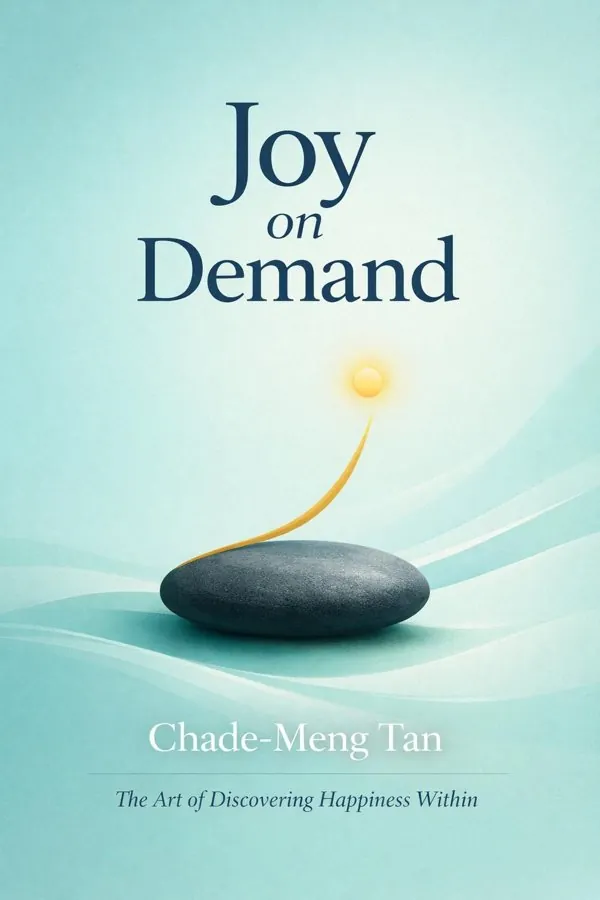
Joy on Demand: The Art of Discovering Happiness Within: Summary & Key Insights
 10 min8 chaptersAudio available
Key Takeaways from Joy on Demand: The Art of Discovering Happiness Within
Most people search for joy by trying to control the world around them, but Tan suggests that the more reliable place to begin is attention itself.
A powerful shift happens when you stop treating joy as luck and start treating it as a skill.
One of the book’s most important insights is that joy grows more reliably when it includes other people.
Many people overlook happiness because they expect it to arrive in dramatic, life-changing experiences.
Perhaps the most mature claim in the book is that joy is not reserved for easy times.
What Is Joy on Demand: The Art of Discovering Happiness Within About?
Joy on Demand: The Art of Discovering Happiness Within by Chade-Meng Tan is a positive_psych book spanning 5 pages. What if joy were not a rare emotional reward but a trainable inner skill available in ordinary moments? In Joy on Demand, Chade-Meng Tan argues that happiness does not need to depend on success, status, or ideal circumstances. Instead, it can be cultivated from within through mindfulness, attention training, compassion, and a wiser relationship with the mind. The book blends Buddhist contemplative insights with modern psychology and Tan’s distinctly practical, often playful style, making profound ideas feel usable in real life. This book matters because many people spend years chasing conditions they believe will finally make them happy, only to find the feeling temporary and fragile. Tan offers another path: learn how the mind works, and you can access steadier well-being right now. His authority comes not only from long-term meditation practice but also from his work at Google, where he helped bring mindfulness and emotional intelligence into a high-performance professional setting. Joy on Demand is both philosophical and hands-on, showing readers that joy is not escapist or naive. It is a disciplined, realistic practice of freeing attention from habitual stress and reconnecting with the mind’s natural clarity and warmth.
This FizzRead summary covers all 8 key chapters of Joy on Demand: The Art of Discovering Happiness Within in approximately 10 minutes, distilling the most important ideas, arguments, and takeaways from Chade-Meng Tan's work. Also available as an audio summary and Key Quotes Podcast.
Joy on Demand: The Art of Discovering Happiness Within
What if joy were not a rare emotional reward but a trainable inner skill available in ordinary moments? In Joy on Demand, Chade-Meng Tan argues that happiness does not need to depend on success, status, or ideal circumstances. Instead, it can be cultivated from within through mindfulness, attention training, compassion, and a wiser relationship with the mind. The book blends Buddhist contemplative insights with modern psychology and Tan’s distinctly practical, often playful style, making profound ideas feel usable in real life.
This book matters because many people spend years chasing conditions they believe will finally make them happy, only to find the feeling temporary and fragile. Tan offers another path: learn how the mind works, and you can access steadier well-being right now. His authority comes not only from long-term meditation practice but also from his work at Google, where he helped bring mindfulness and emotional intelligence into a high-performance professional setting. Joy on Demand is both philosophical and hands-on, showing readers that joy is not escapist or naive. It is a disciplined, realistic practice of freeing attention from habitual stress and reconnecting with the mind’s natural clarity and warmth.
Who Should Read Joy on Demand: The Art of Discovering Happiness Within?
This book is perfect for anyone interested in positive_psych and looking to gain actionable insights in a short read. Whether you're a student, professional, or lifelong learner, the key ideas from Joy on Demand: The Art of Discovering Happiness Within by Chade-Meng Tan will help you think differently.
- ✓Readers who enjoy positive_psych and want practical takeaways
- ✓Professionals looking to apply new ideas to their work and life
- ✓Anyone who wants the core insights of Joy on Demand: The Art of Discovering Happiness Within in just 10 minutes
Want the full summary?
Get instant access to this book summary and 100K+ more with Fizz Moment.
Get Free SummaryAvailable on App Store • Free to download
Key Chapters
Most people search for joy by trying to control the world around them, but Tan suggests that the more reliable place to begin is attention itself. Joy becomes possible when we learn to notice experience clearly instead of being swept away by reactivity. Mindfulness, in this sense, is not merely calm observation. It is a precise and vivid awareness of what is happening in the present moment, including sensations, thoughts, emotions, and impulses. When attention stabilizes, the mind becomes less trapped by rumination, craving, and resistance, all of which block happiness.
Tan draws from Buddhist teachings while presenting mindfulness in a secular, practical way. Instead of treating joy as an abstract ideal, he shows how mindful awareness interrupts the mental habits that create suffering. For example, when you feel irritated in traffic, mindfulness allows you to notice the tightening in the body, the angry story in the mind, and the urge to react. That small pause weakens the automatic cycle and creates space for a lighter response. The same applies at work, in family conflict, or during anxious moments before an important decision.
Mindfulness also reveals something encouraging: many moments of life are already okay before the mind labels them inadequate. A few conscious breaths, a warm cup of tea, sunlight on your face, or the feeling of walking can all become openings into grounded well-being.
Actionable takeaway: Spend three minutes each day practicing simple mindfulness. Sit still, follow the breath, and whenever the mind wanders, gently return. Treat this not as relaxation alone but as training the very faculty that makes joy accessible.
A powerful shift happens when you stop treating joy as luck and start treating it as a skill. Tan challenges the common belief that happiness arrives only when life cooperates. Instead, he argues that joy can be cultivated through repeated mental training, much like physical fitness or musical ability. If attention can be trained, then emotional tendencies can also be shaped over time.
This idea is liberating because it places well-being within human agency. We may not control every event, but we can influence how the mind relates to experience. Repeatedly noticing pleasant moments, relaxing unnecessary mental resistance, and redirecting attention away from habitual negativity gradually changes what feels natural. Just as lifting weights strengthens muscles, practicing joy strengthens the mind’s capacity to return to openness, appreciation, and ease.
In daily life, this may look surprisingly small. You pause before opening your laptop and notice one thing you are grateful for. You take ten seconds to enjoy the first sip of coffee instead of rushing through it. You consciously let yourself feel warmth when a friend texts. These moments may seem trivial, but repetition matters. A mind trained to register goodness becomes less dependent on dramatic external rewards.
Tan does not deny pain or difficulty. Training joy is not pretending everything is fine. It is deliberately building inner conditions that allow positive states to arise more often and last longer. Over time, this reduces the mind’s habit of defaulting to dissatisfaction.
Actionable takeaway: Choose one tiny joy practice and repeat it daily for a week, such as pausing for one full breath before meals and noticing something pleasant. Consistency matters more than intensity.
One of the book’s most important insights is that joy grows more reliably when it includes other people. Many forms of pleasure are self-focused and short-lived, but compassion and gratitude widen the heart and create a more stable kind of happiness. Tan explains that when the mind wishes well for others or genuinely appreciates what is already present, it becomes less trapped in scarcity, comparison, and self-preoccupation.
Compassion is not only a moral virtue in this framework. It is also a practical method for reducing internal suffering. When you respond to others with goodwill instead of judgment, the mind relaxes. Hostility, resentment, and envy are exhausting states. Compassion interrupts those patterns. For example, if a difficult coworker seems irritating, you might reflect that they too want to be happy and may be acting from stress or insecurity. This does not excuse harmful behavior, but it softens unnecessary emotional friction.
Gratitude works similarly by retraining attention. The mind naturally scans for what is missing, but gratitude asks what is already here that supports life. A safe home, functioning senses, a kind friend, a lesson learned through hardship, or even one quiet moment in a chaotic day can become anchors of appreciation. This does not erase pain, yet it broadens perspective and counters the illusion that life contains nothing good.
Tan suggests that joy deepens when it is shared internally as goodwill and externally through kind action. Smiling at a stranger, listening fully, or silently wishing someone well can shift the emotional tone of a day.
Actionable takeaway: At the end of each day, name three specific things you appreciate and one person to whom you will consciously send goodwill, even if only silently.
Many people overlook happiness because they expect it to arrive in dramatic, life-changing experiences. Tan invites readers to discover a more available source of well-being: microjoys. These are small moments of ease, beauty, connection, or sensory pleasure that appear throughout the day but often pass unnoticed. Joy does not always need a major achievement. Sometimes it is hidden in the texture of ordinary life.
This matters because the mind is often biased toward threat, urgency, and dissatisfaction. We rush from task to task, missing the countless pleasant details that could nourish us. A stretch of the body after sitting, the laughter of a child, cool air on the skin, finishing one task well, hearing a favorite song, or noticing a tree moving in the wind can all become real sources of emotional replenishment when attention is present.
Tan’s broader point is that the quality of life is shaped less by occasional peak experiences than by how we inhabit repeated everyday moments. If we learn to notice microjoys, the baseline of experience changes. Life feels less like an endless series of demands and more like a field containing both effort and quiet delight.
This practice is especially useful for busy people who believe they do not have time for inner work. You do not need a retreat or a perfect schedule to access brief moments of happiness. Commuting, eating, washing dishes, or walking between meetings can all become opportunities to notice something wholesome and pleasant.
Actionable takeaway: Set three reminders on your phone labeled “Notice one good thing.” When each reminder appears, pause for ten seconds and let yourself actually feel one small pleasant experience.
Perhaps the most mature claim in the book is that joy is not reserved for easy times. Tan does not promise constant pleasure or emotional invulnerability. Instead, he suggests that even in hardship, the mind can access pockets of peace, tenderness, and resilience. This is a crucial distinction. Joy in adversity is not denial of pain. It is the refusal to let pain become the whole story.
When life becomes difficult, the untrained mind often adds secondary suffering through resistance, catastrophizing, self-blame, or hopelessness. Mindfulness helps us meet discomfort more directly. Compassion softens the inner atmosphere. Gratitude and microjoys remind us that not everything is broken at once. These practices create enough psychological space for wisdom to function.
Consider someone facing illness, grief, or professional failure. The pain is real and cannot be fixed by positive thinking. Yet even in such periods, there may be moments of support from loved ones, the relief of a deep breath, the dignity of courage, or a brief sense of beauty in nature. Noticing these moments does not diminish suffering; it prevents the heart from collapsing entirely under it.
Tan’s approach offers emotional steadiness rather than forced optimism. He encourages a relationship with adversity that is both honest and spacious. A person can cry, feel uncertainty, and still contact an inner capacity for kindness and ease.
Actionable takeaway: In the middle of a difficult moment, ask yourself three questions: What am I feeling right now? Can I soften around it by 5 percent? What supportive or beautiful thing is also present, however small?
A subtle but transformative idea in Joy on Demand is that attention does not merely observe reality; it helps determine the reality you live in psychologically. Two people can move through the same day and inhabit entirely different inner worlds depending on what their minds repeatedly notice and reinforce. If attention keeps returning to insult, delay, and inadequacy, life feels hostile and thin. If it becomes skilled at recognizing calm, goodness, and connection, experience becomes more spacious and workable.
Tan is not suggesting we ignore facts. Rather, he highlights that the mind is always selecting from a vast stream of data. Training attention means becoming less helpless before that selection process. You can learn to notice beauty without becoming naive, and recognize difficulty without becoming consumed by it.
This has profound implications for work and relationships. In a team meeting, for instance, you can obsess over the one critical remark or also register cooperation, effort, and opportunities to improve. In parenting, you can fixate only on problems or intentionally notice moments of affection, growth, and humor. The emotional consequence of each attentional habit compounds over time.
Tan’s training methods point toward a practical freedom: while we cannot control every thought, we can increasingly guide attention toward what is wholesome, useful, and true. This turns joy from a random emotional event into the fruit of mental craftsmanship.
Actionable takeaway: For one day, practice a “three-to-one ratio.” Each time you catch yourself fixating on something negative, intentionally identify three neutral or positive things that are also true in that moment.
One reason people abandon meditation is that they approach it like a performance test. They sit down, discover a noisy mind, and conclude they are failing. Tan offers a more encouraging approach: meditation works best when practiced with lightness, curiosity, and self-kindness. The goal is not to force the mind into silence but to become familiar with it in a way that reduces struggle.
This matters because harshness toward the self becomes another obstacle to joy. If every wandering thought is met with irritation, meditation simply rehearses frustration. But when distraction is treated as natural and returning attention is treated as success, the practice becomes sustainable. Each return to the breath is not evidence of weakness; it is the repetition that builds mental stability.
Gentleness also opens the door to enjoyment. Meditation need not always feel austere. Tan often emphasizes ease, even humor. A practitioner can appreciate the simple relief of pausing, the subtle pleasure of breathing, or the warmth that arises from goodwill practices. This softens resistance and helps meditation become something one wants to do rather than another self-improvement burden.
In practical terms, beginners benefit from short sessions, comfortable posture, and realistic expectations. Even one minute of sincere attention matters. Over time, familiarity grows, and moments of quiet clarity become more accessible.
Actionable takeaway: Replace the goal “clear my mind” with “begin again kindly.” In your next meditation, each time you notice distraction, label it softly and return without criticism.
Modern life trains people to believe happiness lives somewhere outside the present moment: in promotion, romance, recognition, comfort, or control. Tan’s central argument cuts against this assumption. While external conditions do affect well-being, depending on them completely makes joy fragile. If happiness always requires the world to arrange itself perfectly, it remains unstable and scarce.
Inner freedom begins when we discover that the mind can generate wholesome states independent of constant external reward. Through mindfulness, gratitude, kindness, and intentional attention, we learn that contentment can arise even in simple, imperfect circumstances. This does not mean ambition or pleasure are wrong. It means they stop carrying the impossible burden of being our sole source of fulfillment.
This idea can be applied immediately. Someone waiting for a vacation to finally relax may instead practice brief moments of ease during the workweek. A person seeking validation online may notice the emptiness of repeated checking and experiment with resting in the satisfaction of meaningful effort itself. A partner may stop demanding that a relationship fix all discomfort and begin taking responsibility for their own inner balance.
The result is not detachment in the cold sense, but resilience. You enjoy good conditions when they arise, yet your emotional life is no longer completely hostage to them. That is a quieter and more durable kind of happiness.
Actionable takeaway: Notice one recurring thought that says, “I’ll be happy when...” Write it down, then ask, “What small experience of peace or joy is available before that condition is met?”
All Chapters in Joy on Demand: The Art of Discovering Happiness Within
About the Author
Chade-Meng Tan is a Singapore-born author, former Google engineer, and influential advocate for mindfulness and emotional intelligence in modern life. As one of Google’s early employees, he became widely known for creating the company’s Search Inside Yourself program, which introduced meditation and self-awareness practices into a high-performance workplace environment. Tan’s work bridges contemplative traditions and contemporary psychology, translating ideas from Buddhist meditation into practical tools for stress reduction, happiness, compassion, and leadership. He is admired for making serious inner practices feel approachable, secular, and useful for everyday people, especially professionals. Through his writing and teaching, Tan has helped popularize the idea that mental well-being can be systematically trained, not merely hoped for, and that inner development belongs not only in monasteries but also in offices, homes, and daily routines.
Get This Summary in Your Preferred Format
Read or listen to the Joy on Demand: The Art of Discovering Happiness Within summary by Chade-Meng Tan anytime, anywhere. FizzRead offers multiple formats so you can learn on your terms — all free.
Available formats: App · Audio · PDF · EPUB — All included free with FizzRead
Download Joy on Demand: The Art of Discovering Happiness Within PDF and EPUB Summary
Key Quotes from Joy on Demand: The Art of Discovering Happiness Within
“Most people search for joy by trying to control the world around them, but Tan suggests that the more reliable place to begin is attention itself.”
“A powerful shift happens when you stop treating joy as luck and start treating it as a skill.”
“One of the book’s most important insights is that joy grows more reliably when it includes other people.”
“Many people overlook happiness because they expect it to arrive in dramatic, life-changing experiences.”
“Perhaps the most mature claim in the book is that joy is not reserved for easy times.”
Frequently Asked Questions about Joy on Demand: The Art of Discovering Happiness Within
Joy on Demand: The Art of Discovering Happiness Within by Chade-Meng Tan is a positive_psych book that explores key ideas across 8 chapters. What if joy were not a rare emotional reward but a trainable inner skill available in ordinary moments? In Joy on Demand, Chade-Meng Tan argues that happiness does not need to depend on success, status, or ideal circumstances. Instead, it can be cultivated from within through mindfulness, attention training, compassion, and a wiser relationship with the mind. The book blends Buddhist contemplative insights with modern psychology and Tan’s distinctly practical, often playful style, making profound ideas feel usable in real life. This book matters because many people spend years chasing conditions they believe will finally make them happy, only to find the feeling temporary and fragile. Tan offers another path: learn how the mind works, and you can access steadier well-being right now. His authority comes not only from long-term meditation practice but also from his work at Google, where he helped bring mindfulness and emotional intelligence into a high-performance professional setting. Joy on Demand is both philosophical and hands-on, showing readers that joy is not escapist or naive. It is a disciplined, realistic practice of freeing attention from habitual stress and reconnecting with the mind’s natural clarity and warmth.
More by Chade-Meng Tan

You Might Also Like
Don't Sweat the Small Stuff... and It's All Small Stuff
Richard Carlson
10 min
Option B
Sheryl Sandberg & Adam Grant
10 min
Hallelujah Anyway: Rediscovering Mercy
Anne Lamott
10 min
I Can Do It: How to Use Affirmations to Change Your Life
Louise Hay
10 min
The Coffee Bean: A Simple Lesson to Create Positive Change
Jon Gordon, Damon West
10 min
The Happiness Hypothesis: Finding Modern Truth in Ancient Wisdom
Jonathan Haidt
10 minBrowse by Category
Ready to read Joy on Demand: The Art of Discovering Happiness Within?
Get the full summary and 100K+ more books with Fizz Moment.